
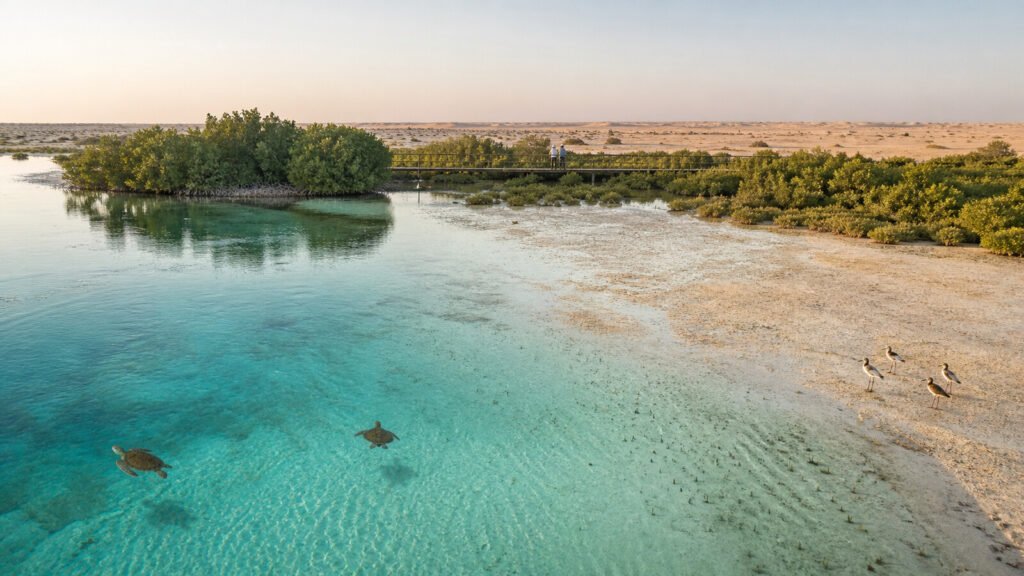
Abu Dhabi has introduced a broader framework for protecting wildlife and the places where it lives. Resolution No. 2 of 2026 covers terrestrial and marine habitats across the emirate, including important biodiversity areas outside formally protected reserves.
That last point gives the decision practical significance. A species does not remain inside a reserve boundary, and a feeding, nesting or migration area can matter even when it sits beside ordinary development. The new framework is meant to connect protection, restoration and responsible development across the wider landscape.
What the resolution covers
The official Abu Dhabi announcement says the rules apply to terrestrial and marine habitats throughout the emirate. They also cover native and migratory species included on lists approved by the Environment Agency Abu Dhabi.
The framework includes areas identified for biodiversity conservation outside existing protected areas. It also addresses the restoration and rehabilitation of degraded habitats and affected species. Invasive and non native species are excluded from the protection provisions described in the announcement.
The resolution is designed to balance environmental protection with sustainable development. It sets requirements and procedures for activities that may affect species or habitats and calls for measures that reduce negative effects on biodiversity.
Why habitat matters as much as the animal
Protecting a rare animal only when it is seen is not enough. Wildlife depends on breeding sites, food sources, shelter and safe movement between areas. A shallow coastal zone may support turtles or dugongs. A desert patch can provide feeding or nesting space. A wetland may be essential to migratory birds for only part of the year.
Damage to one link can affect the whole pattern. Bright lights may disturb nesting behaviour. Noise and repeated vehicle movement can push animals away from a feeding area. Dredging or sediment can change a marine habitat even when no animal is directly harmed at the moment work begins.
By covering important habitat beyond reserve boundaries, the framework gives decision makers a way to consider those connections earlier. It also supports restoration when an area has already been degraded.
What businesses and project teams should do
A company planning construction, coastal work, land clearance, events or other activity near a natural area should not assume that being outside a named reserve removes environmental responsibilities. Project teams should check the site against current Environment Agency maps, approved species lists and permit requirements.
Early assessment is usually easier than redesigning after approvals are sought. Developers can identify sensitive seasons, movement corridors and habitat features before fixing the layout. Contractors can then plan access, lighting, noise control and waste management around those findings.
The public announcement does not reproduce every technical control or penalty. Businesses should obtain the applicable guidance directly from the Environment Agency Abu Dhabi and the relevant permitting authority. A general summary cannot replace a site assessment or formal approval.
What residents and visitors can do
Most residents will not need to complete paperwork because of this resolution. Their role is simpler. Avoid driving away from permitted tracks in natural areas, do not disturb nests or resting animals, and never leave fishing line, plastic or food waste behind.
Keep a respectful distance from wildlife, especially young animals and nesting birds. A close photograph is not worth forcing an animal to move. Boats and personal watercraft should follow local speed, access and fishing rules in sensitive marine areas.
If you see an injured animal, an illegal capture or damage to a habitat, record the location from a safe distance and report it through an official Environment Agency channel. Do not attempt to handle a wild animal unless trained authorities tell you to do so.
How this fits Abu Dhabi’s conservation work
Abu Dhabi contains desert, mountain, wetland, island and marine ecosystems. Migratory species also connect the emirate with places far beyond the UAE. That means conservation decisions need reliable surveys, repeated monitoring and coordination across government and private projects.
The Environment Agency has long monitored species such as dugongs, turtles and birds. The new resolution provides a legal framework for using that knowledge to protect habitats, regulate related activities and restore damaged areas.
Its effectiveness will depend on the details of implementation. Clear maps, current species lists, consistent permit conditions and practical guidance will help people understand what is expected. Monitoring will then show whether protection and restoration are producing healthier ecosystems.
What is still not clear from the announcement
The published summary confirms the scope and purpose but does not provide the full list of regulated activities, the approved species lists or a public schedule of penalties. It also does not say that every outdoor activity now needs a permit.
Readers should be careful with claims that go beyond the official text. The safe conclusion is that native and migratory species and terrestrial and marine habitats now sit within an integrated protection framework, including valuable areas outside reserves. The exact requirement for a particular project or activity must be checked with the competent authority.
Questions people often ask
Does the resolution apply only inside nature reserves?
No. The official announcement says it also applies to important biodiversity areas outside protected areas, as well as terrestrial and marine habitats across the emirate.
Which animals are covered?
It covers native and migratory species included on lists approved by the Environment Agency Abu Dhabi. The full lists were not included in the public summary.
Are invasive species protected under these rules?
The announcement says invasive and non native species are excluded from the provisions described for protected species and habitats.
Does every visit to a natural area require a permit?
The public announcement does not say that. Visitors should follow the access, activity and conservation rules already posted for each location.
Where should a business check project requirements?
Project teams should contact the Environment Agency Abu Dhabi and the relevant permitting authority for current maps, controls and approval requirements.


