
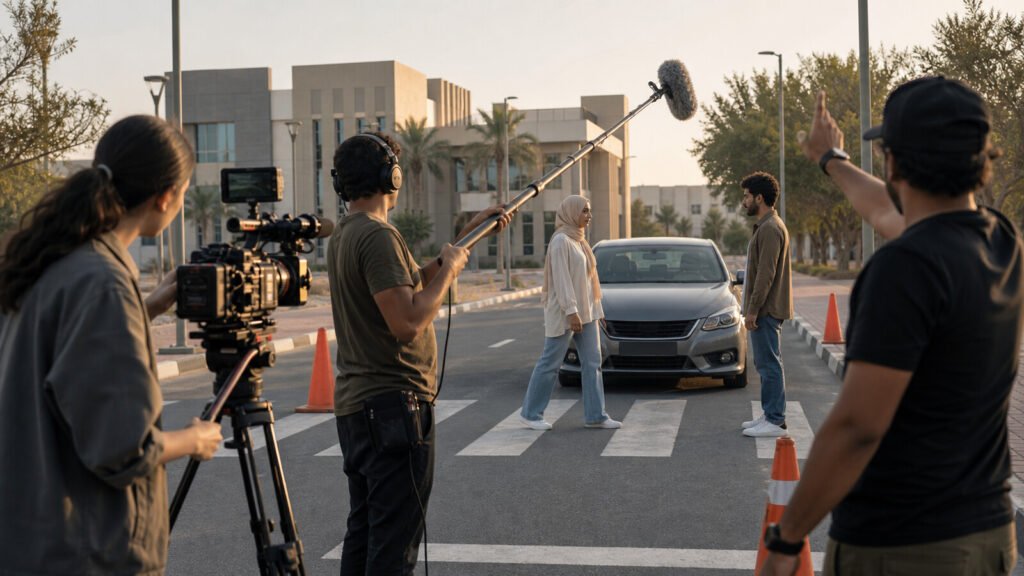
A useful road safety film does not need a large crew or a dramatic crash scene. It needs one clear behaviour, a believable situation and an ending that gives viewers something practical to remember. Dubai’s second Road Safety Film Festival is accepting short films until 22 November 2026, with categories for young creators, organisations and the wider community.
Films must run for one to three minutes and be submitted through the Roads and Transport Authority website. The competition offers cash prizes in the youth and community sections, while government and private organisations compete for recognition trophies.
Choose the category before filming
Youth and university entrants can choose between a general safe driving film and an innovative film made with modern technology. Individual participants in this section must be aged 16 to 35, or studying at a UAE university or college. Postgraduate students are included, and teams can have up to three members.
The organisation section has separate awards for government bodies and private companies. Eligible entrants include government and semi government organisations, charities, production companies, transport operators, delivery services, logistics firms, contractors and fleet businesses operating in the UAE.
The community section is open to all. One subcategory focuses on family road safety, including seat belts, child restraints, safe crossing and behaviour around schools. The other asks for sensitive films about the human effect of road crashes, based on true or reality inspired situations without harming privacy.
Understand the prize structure
The top three films in each youth subcategory and each community subcategory receive AED 30,000, AED 20,000 and AED 10,000. That creates total cash prizes of AED 240,000 across those four subcategories. Government and private organisation winners receive RTA recognition trophies.
The official competition page lists 24 August as the opening date and 22 November as the submission deadline. Evaluation is scheduled for 16 December, with winners due to be announced at an awards event in January 2027.
A prize should not drive the creative decision on its own. Select the category that matches the people making the film and the message being shown. An entry can be rejected when the category or eligibility does not fit, even if the production looks polished.
Build the idea around one unsafe behaviour
The youth safe driving category names sudden swerving, phone use, speeding, slow driving in the fast lane and unsafe electric scooter behaviour among its subjects. Trying to cover all of them in three minutes will usually weaken the message.
Choose one moment. A driver could look at a message and miss a pedestrian. A family could show why a child restraint matters before a short trip. A scooter rider could approach a crossing without checking for turning traffic. The situation should feel possible on UAE roads and lead naturally to the safety point.
Research is worth 10 points in judging, while impact is worth 30. Creativity receives 20 points, clarity 15 and film quality 25. A well researched idea still needs clear sound, steady images and a message viewers understand the first time.
Create a simple shot plan before recording. Mark the location, people, spoken lines and safety control needed for every scene. Rehearse away from moving traffic, then film only where the team has permission and can work without distracting drivers or blocking pedestrians. If a real road is not safe, suggest the situation through close details, sound and editing instead of staging dangerous behaviour.
Know where artificial intelligence is allowed
The rules permit artificial intelligence generated films only in the youth subcategory for innovative road safety films using modern technology. Do not assume that permission applies across the community or organisation categories.
All images, footage, music and sound effects must be owned or legally licensed. Artificial intelligence does not remove that responsibility. Keep records showing where every asset came from and what licence allows it to be used.
Films must be in Arabic or English and include narration or subtitles in either language. Most of the footage must be created in the UAE. Obtain any filming permission required for the location, and never create a real traffic danger to capture a shot.
How to submit the finished film
Upload the film to YouTube or Vimeo and make sure the judging panel can view it. Then complete the official submission form, select the correct category and provide the viewing link.
Test the link in a private browser window before submitting. A link that works only for the account owner may leave judges unable to open the film. Check the title, team leader details and contact information carefully.
RTA reserves the right to republish submitted films for awareness purposes. Read the complete rules before uploading if the film contains identifiable people, a true story or material created with a partner. Films entered in the first festival are not eligible for this edition.
Questions people often ask
What is the deadline for entries?
The submission deadline is 22 November 2026. Entries opened on 24 August.
How long can the film be?
Every competition category requires a film between one and three minutes long.
Can a team enter the youth category?
Yes. Youth and university entries may be individual or made by a team of up to three people with one named leader.
Are films made with artificial intelligence accepted?
They are allowed only in the youth subcategory for innovative road safety films using modern technologies.
How is the film sent to RTA?
Upload it to YouTube or Vimeo, make the link accessible to judges and submit that link through the official RTA form.


