
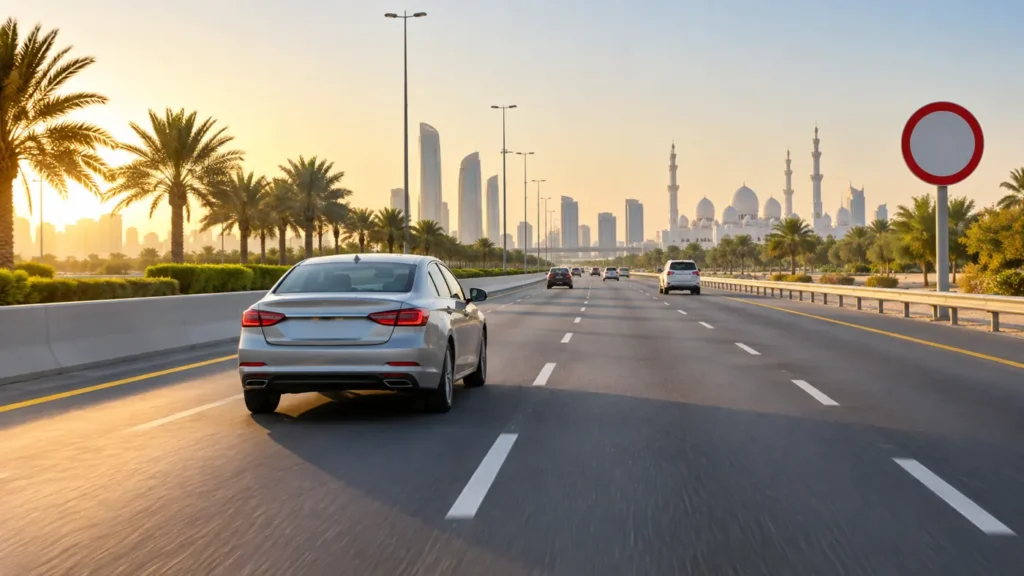
Abu Dhabi motorists using a major stretch of Sheikh Mohammed bin Rashid Al Maktoum Street (E311) now face a lower speed limit. The speed limit on a major stretch of Sheikh Mohammed bin Rashid Al Maktoum Street (E311) has been reduced from 120km/h to 100km/h in both directions, with the change taking effect from today.
Drivers using Abu Dhabi’s E311 should plan around the speed displayed on the road signs—not an assumed tolerance. If the relevant signed limit is 100km/h, then 101km/h is above that limit. The practical answer to “what happens at 101?” is therefore simple: do not treat one kilometre per hour as a permitted buffer. Slow down safely and keep the vehicle at or below the posted limit.
This is a road-safety guide, not a promise about a camera trigger point or a substitute for a traffic fine enquiry. Enforcement technology, lane arrangements, temporary signs and road conditions can change. Only the relevant authority can determine whether a particular vehicle movement is recorded as a violation. The sensible driving habit is to leave a small margin below the sign, rather than trying to drive exactly at it while watching the speedometer.
Why 101km/h matters when the sign says 100
Abu Dhabi Police has previously announced that it aligns radar settings with posted limits and removes the speed margin on Abu Dhabi roads. That is why the sign must be treated as the maximum, not as a starting point for calculation. Read the current official guidance from Abu Dhabi Police’s speed-limit information before relying on any general rule copied online.
The driver’s displayed speed can fluctuate with gradients, traffic flow, cruise-control adjustments and attention. Trying to sit on “100 exactly” while overtaking, approaching a junction or reading a navigation prompt is a poor trade-off. Pick a steady, legal speed that suits conditions, keep an appropriate gap and use the road signs as the authoritative instruction.
| Situation | Safe interpretation | What to do |
|---|---|---|
| Sign shows 100km/h | 100km/h is the maximum posted limit | Settle below or at the signed limit without abrupt braking |
| Vehicle reads 101km/h | You are above the posted limit | Ease off smoothly; do not depend on a tolerance |
| Temporary lower sign | The lower sign applies for that section | Reduce speed early and follow lane instructions |
| Uncertain about a fine | Do not guess from an app screenshot | Use official Abu Dhabi Police traffic services |
How to approach a lower limit safely
Do not brake sharply the moment you see a sign. Lift off the accelerator in good time, check mirrors, use the appropriate lane and let speed reduce smoothly. This is especially important where road works, merging traffic, poor visibility or a busy exit makes the environment more complex. Our UAE foggy-morning driving guide explains why visibility should change both your speed and following distance.
E311 is part of a larger journey for many drivers travelling between Dubai and Abu Dhabi. If your plan includes the airport, add transfer time with our Dubai Airport terminal transfer guide rather than recovering lost time by speeding. If the destination is central Dubai, our Dubai Metro Nol guide may help you choose a calmer final connection instead of taking the car through every part of the trip.
What not to do
- Do not assume a historical “buffer” applies to the current signed road.
- Do not test the limit by deliberately driving at 101km/h or above.
- Do not brake hard in a live lane after noticing your speed.
- Do not copy another driver’s speed simply because traffic is moving quickly.
- Do not ignore temporary signs, lane closures or weather conditions.
- Do not use an unofficial post as proof of a fine, rule or radar setting.
What to do if you think you have a traffic fine
Wait for the official record and use Abu Dhabi Police’s online traffic services to enquire about or pay a violation. Keep the vehicle and driver details accurate, but avoid making decisions from forwarded messages or a friend’s experience. A fine is a compliance question; road safety still comes first. In an urgent incident, use the contacts in our UAE emergency numbers guide rather than trying to resolve an emergency through a traffic-service page.
For everyday driving, remove avoidable pressure before leaving. Check parking at the destination using our Dubai parking payment guide if you are continuing to Dubai, charge your phone, set navigation before moving and leave early. Families can also use the routines in our UAE school-run safety guide: calm preparation and predictable decisions work on a school route and on a motorway.
Questions people often ask
Will I get a fine for driving at 101km/h in a signed 100km/h section?
101km/h is above a 100km/h posted limit. Do not rely on a buffer; enforcement of a specific incident is determined by the relevant authority and its official record.
Does Abu Dhabi have a speed tolerance?
Abu Dhabi Police has announced removal of the speed margin and alignment of radar settings with posted limits. Treat the sign as the maximum and check official guidance for current details.
What should I do when the limit drops from a higher speed?
Reduce speed progressively before the lower-limit area, watch mirrors and lane conditions, and avoid abrupt braking.
Can I use cruise control at 100km/h?
It can help with a steady speed only when road, weather and traffic conditions make it appropriate. You remain responsible for the vehicle and the signed limit.
Where can I check an Abu Dhabi traffic fine?
Use Abu Dhabi Police’s official traffic services or app, rather than an unofficial website, screenshot or forwarded message.


