
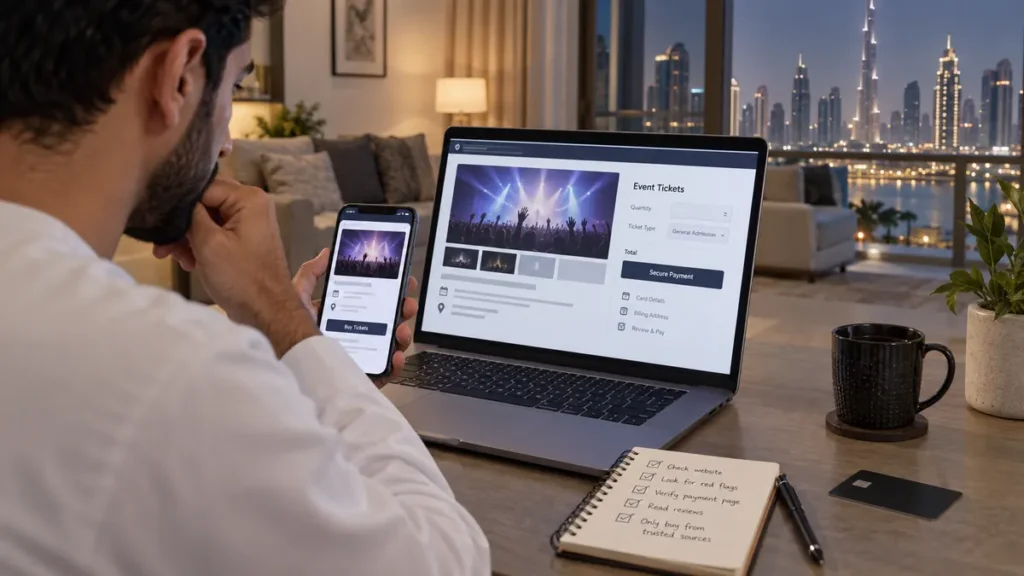
Popular concerts, festivals and family attractions can attract fake ticket websites and social accounts that copy official colours, images and event wording. A convincing page is not proof that the seller is authorised. Before paying, buyers should confirm the official sales channel independently, inspect the web address and treat urgent private messages or unusually low prices as warning signs.
Use the Dubai Police official website for current cybercrime reporting and public warnings. If money or card data has already been exposed, contact the bank immediately through a trusted number and follow official police guidance. Waiting for the seller to reply can reduce the time available to protect an account.
Start from an official source
Type the organiser, venue or authority’s known official address yourself or use a verified government event listing. Do not begin with a sponsored search result, shortened link or message forwarded by an unknown account. From the official page, follow the named ticket-sales link and compare the complete domain—not just the logo or page design.
Be cautious with lookalike spelling, extra hyphens, unfamiliar domain endings and web addresses hidden behind buttons. A padlock shows that the connection is encrypted; it does not prove the business is genuine. Our Dubai deepfake scam guide explains why polished audio, video and copied identities must still be verified through a separate channel.
Check the offer and payment route
Fraudulent sellers often create pressure: a countdown, a claim that only one ticket remains or a private message demanding immediate transfer. Stop and compare the price, seating category, refund terms and seller details with the official event information. Avoid direct transfers to an unknown individual, cryptocurrency demands or requests to send card details in chat.
Online purchase records matter. The UAE online-shopping guide covers receipts and seller information, while the lost-phone and banking guide helps protect payment accounts if a device is compromised.
| Check | Safer sign | Warning sign |
|---|---|---|
| Website route | Reached from an official venue or organiser page | Unknown message or shortened link |
| Domain | Exact expected spelling and secure checkout | Extra words, characters or copied branding |
| Price | Matches the official category and terms | Unrealistic discount with urgency |
| Payment | Recognised checkout with a receipt | Transfer to an unknown personal account |
| Support | Contact details independently verified | Only private chat or disappearing messages |
Before-payment checklist
- Find the official event or venue page independently.
- Compare the full ticketing domain letter by letter.
- Read the date, category, entry and refund terms.
- Use a payment method with clear transaction records.
- Save the confirmation and verify that it matches the order.
If you have already paid
Save the web address, screenshots, messages, receipt, transaction reference and the account used by the seller. Do not continue arguing or send more money for a supposed refund, release fee or ticket upgrade. Contact the bank immediately and submit a report through the relevant official channel. Change a reused password from a safe device and enable stronger account protection.
If the fake offer was connected to a day out, rebuild the plan only through verified sources. The Dubai museum guide, public parks guide and heritage walk guide show how to check official access information without relying on random sellers.
Travellers should also protect identity documents. The UAE travel-document checklist explains what should be carried and verified, and the flight-status guide shows why operational updates should come from official airport or airline channels.
The safest ticket is not simply the one that looks professional. It is the one reached through a verified route, sold under clear terms and supported by a traceable payment record. Taking two minutes to check can prevent both financial loss and identity misuse.
Questions people often ask
Does the padlock icon prove a ticket website is genuine?
No. It only indicates an encrypted connection. Scammers can also use encrypted websites, so verify the full domain and official sales route.
Are sponsored search results always authorised sellers?
No. Begin with the known official organiser, venue or authority page and follow its ticket link.
What if a social account offers a large last-minute discount?
Treat urgency and unusually low prices as warning signs. Verify the offer independently before opening a link or paying.
What should I save after a suspected ticket scam?
Keep the URL, screenshots, messages, transaction details, seller account information and any receipt or confirmation.
Who should I contact after sending card details?
Contact the bank immediately through a trusted number, then follow Dubai Police’s current official cybercrime reporting guidance.


