
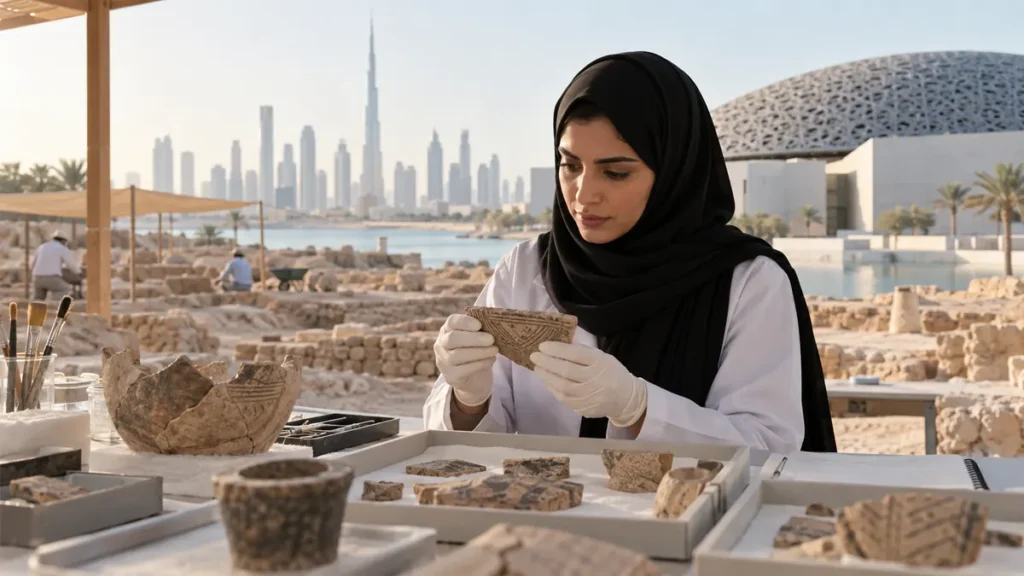
Dubai’s archaeological record belongs in protected sites, official collections and carefully documented research—not in a visitor’s pocket. Law No. 11 of 2026 strengthened the emirate’s framework for identifying, registering and safeguarding antiquities and archaeological sites across land, marine and mountain areas. For residents and visitors, the practical message is simple: look, learn and photograph where permitted, but do not disturb, remove or trade a possible artefact.
The official Dubai Media Office announcement explains that Dubai Culture and Arts Authority oversees antiquities and archaeological sites. It says a person who discovers a possible antiquity must leave it undisturbed, stop work that could affect it and notify Dubai Culture or Dubai Police within 48 hours. A marine find must be reported immediately and handed to Dubai Culture within seven days. This guide summarises visitor-friendly precautions; the official law and authority instructions take priority.
Enjoy heritage places without changing them
Stay within marked visitor routes and obey barriers, signs and staff directions. A wall fragment, pottery sherd or worked stone may look ordinary outside its context, yet its position can help specialists understand date, use and surrounding activity. Picking it up can remove that information even if it is later returned. Do not climb on ruins, move stones for a photograph, trace carvings, leave markings or use a drone where permission has not been confirmed.
Families planning a cultural day can combine this guidance with the Dubai museum visit guide and the Dubai cultural day planner. For an outdoor historical route, the Dubai heritage walk guide helps with timing, heat and respectful behaviour.
If you notice a possible artefact
Stop before touching or cleaning it. Note the location as accurately as possible without entering a restricted area. Take a wide contextual photograph only if photography is allowed and can be done without disturbing the place. Record the date, time and nearby fixed landmarks. Then contact the appropriate official authority. Do not post exact coordinates publicly, invite others to inspect the spot or attempt to decide the item’s financial value.
| Situation | Practical first step | What to avoid |
|---|---|---|
| Possible object on land | Leave it in place and record the location | Cleaning, pocketing or relocating it |
| Find during construction | Stop work that could affect the remains | Covering or continuing around it |
| Possible marine antiquity | Report immediately and follow handover instructions | Private sale or unsupervised removal |
| Protected visitor site | Follow barriers, signs and staff directions | Climbing, marking or entering closed areas |
| Uncertain object | Describe it factually to the authority | Making public claims about age or value |
A responsible visitor checklist
- Use marked paths and respect every closed area.
- Leave stones, pottery, shells and metal objects where found.
- Photograph only where permission allows it.
- Keep exact find locations private until authorities advise otherwise.
- Report promptly and preserve any reference number.
Plan a useful cultural day
Build enough time for interpretation rather than rushing through several locations. The Coins Museum guide shows how small objects can reveal trade and daily life, while the Dubai public libraries guide points readers towards quieter research resources. The Museum of the Future guide can add a modern contrast without treating heritage as a backdrop for careless content.
Carry water, dress for conditions and supervise children closely. The Dubai desert trip safety guide is useful if a wider outing leaves paved urban areas. Do not conduct informal digging, metal detecting or sampling. Archaeological activity requires official permission and specialist methods.
Respect protects both the object and the story around it. A prompt, accurate report is more valuable than a dramatic social-media post, and leaving a find untouched gives professionals the best chance to assess it properly.
Questions people often ask
Can I take home a pottery fragment that looks abandoned?
No. Leave a possible antiquity where it is and report it through the official channel.
What information should I record after a chance discovery?
Record the date, time, location and nearby landmarks, plus a contextual photograph only where it is safe and permitted.
How quickly should a land discovery be reported?
The official 2026 announcement says Dubai Culture or Dubai Police must be notified within 48 hours.
May I clean an object before photographing it?
No. Cleaning can damage material and remove evidence. Do not brush, wash or scrape it.
Can visitors enter a closed archaeological area for a quick photo?
No. Follow barriers and official directions; entry to closed areas requires approval.


