
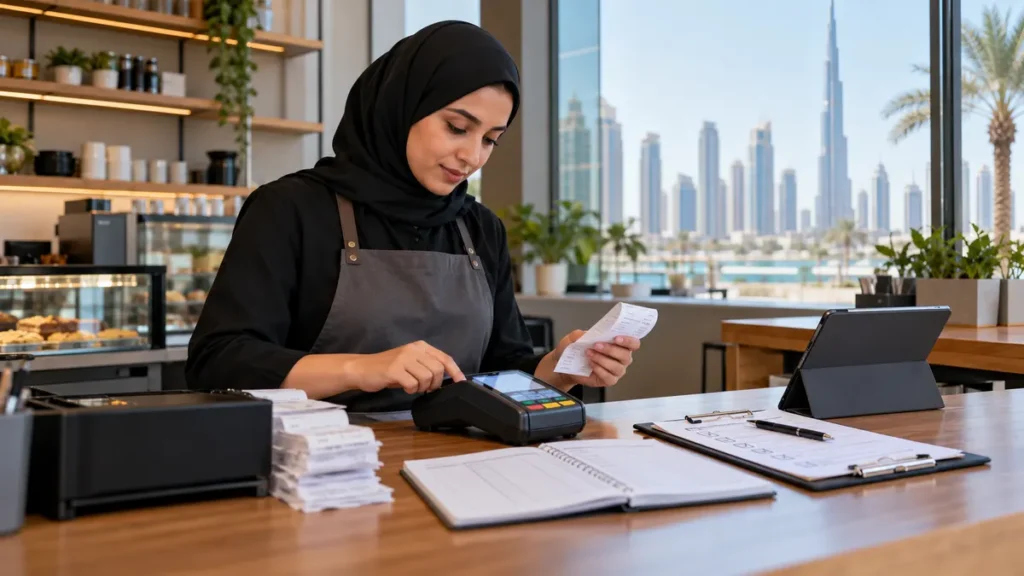
Dubai’s move toward digital payments creates convenience, but a card terminal alone does not make a business cashless-ready. A small retailer, salon, café or service provider needs a reliable payment setup, clear customer information, daily reconciliation, secure staff access and a backup plan for outages. The business should also understand fees, settlement timing, refunds and chargebacks before choosing a provider.
The official Dubai digitalisation overview says the Dubai Cashless Strategy aims for cashless transactions to reach 90% across government and private sectors by 2026. This is a strategic target, not permission for a merchant to hide fees, ignore consumer rights or use an unapproved personal payment account. Businesses should use regulated providers and ensure the payment method matches their licensed activity.
Build the payment setup around customer needs
| Area | Question to answer | Evidence to keep |
|---|---|---|
| Provider | Is the service suitable and regulated? | Contract and support contacts |
| Fees | What does each transaction cost? | Current pricing schedule |
| Settlement | When does money reach the account? | Daily settlement report |
| Refunds | Who can approve and process them? | Refund log and receipt |
| Outage | How will staff respond safely? | Written continuity checklist |
| Security | Who can access devices and dashboards? | User-access register |
Compare the full cost rather than the headline transaction rate. Ask about equipment rental, minimum charges, cross-border cards, online links, refunds, chargebacks and early termination. Confirm how the merchant name appears on the customer’s bank statement; an unfamiliar descriptor can trigger avoidable disputes.
Daily operating checklist
- Inspect the terminal for damage or an unexpected attachment.
- Confirm the displayed amount before asking the customer to tap or insert.
- Offer a receipt in the agreed format.
- Keep supervisor functions restricted to authorised staff.
- Reconcile sales, refunds and settlements at the end of the shift.
- Report a missing terminal or suspicious login immediately.
- Use a documented outage process instead of improvising.
Protect the customer at the counter
Staff should never ask a customer to disclose a PIN or send a one-time password. Let the customer control the card or phone wherever possible and keep the amount visible. Do not photograph cards, IDs or payment screens. If a transaction fails, verify the terminal response before retrying so the customer is not charged twice.
The small-business cyber-response guide gives immediate steps after a suspected breach. The Dubai scam-safety guide is useful when a caller pretends to be a bank, payment provider or senior manager.
Receipts, refunds and reconciliation
A receipt should identify the transaction clearly without exposing full card details. Keep business records for the period required by applicable tax, accounting and licensing rules. Reconcile the terminal total with the point-of-sale system and bank settlement, then investigate differences while staff still remember the shift.
The UAE business-records guide supports document control. Businesses registered for VAT can use the UAE VAT return guide as a reminder to match sales records with returns, while confirming their own tax period and obligations through the Federal Tax Authority.
Prepare for outages without weakening security
Write down who contacts the provider, how customers are informed and which approved alternative can be used. Do not store card numbers on paper, accept a photo of a card, or ask a customer to share credentials through messaging. If the business accepts bank transfers, verify the payment in the business account rather than relying on a screenshot.
Keep provider support numbers in a controlled contact list and test the backup internet connection if one is available. The small-business document guide helps organise contracts and support records. The online review guide explains how to respond constructively if a payment disruption leads to a public complaint.
Train staff for disputes
Staff should know the difference between a declined transaction, a technical error, a duplicate payment and a later chargeback. Escalate calmly and preserve the receipt, time, device and response code. Do not promise an instant bank reversal unless the provider confirms it. A consistent process protects both the customer and the business.
Questions people often ask
Does Dubai require every small business to stop accepting cash?
The Dubai Cashless Strategy sets a citywide digital-payment target. A business should check the rules for its exact activity and licence rather than assuming the strategy alone bans cash.
Can a shop add a card surcharge?
Do not add an undisclosed fee. Check the merchant agreement, consumer-protection requirements and rules for the specific payment method before applying any charge.
What should staff do if a card terminal stops working?
Use the written outage plan, contact the provider and offer only approved alternatives. Never copy card details or rely on a payment screenshot as proof.
How can a business prevent duplicate charges?
Check the terminal response and transaction history before retrying, then reconcile the final settlement. Give the customer a clear receipt for each completed payment.
What records should a merchant keep?
Keep provider contracts, pricing, settlement reports, refunds, chargeback evidence, receipts and access records for the periods required by applicable business and tax rules.


