
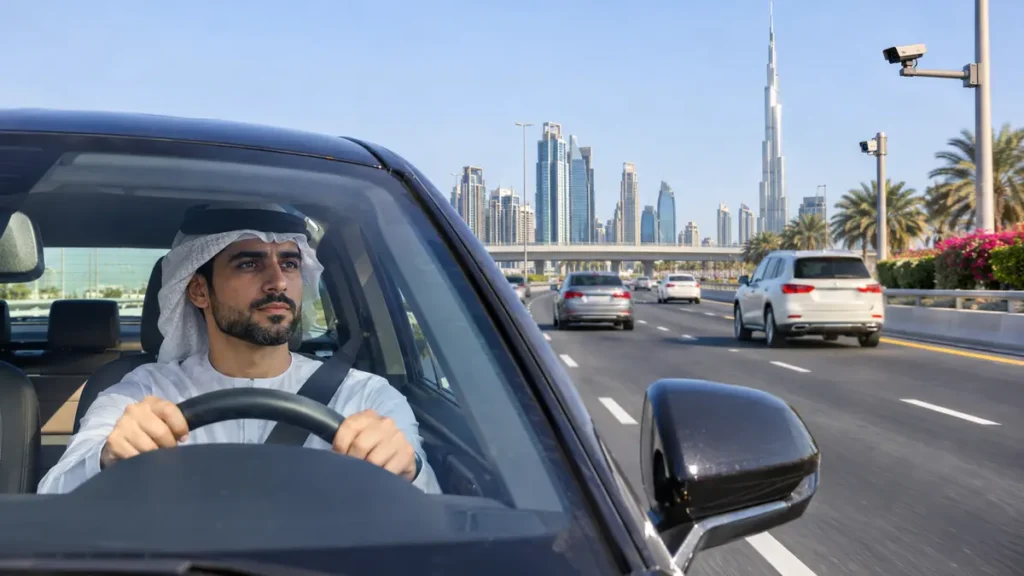
Dubai Police is expanding smart traffic monitoring after its system recorded 27,756 violations in October 2026. The practical message for motorists is not to search for camera locations; it is to remove behaviours that create risk anywhere on the road. A camera may document an offence, but safe driving protects people before enforcement becomes relevant.
The official Emirates News Agency report says AI-powered systems help identify dangerous driving affecting motorists, passengers and pedestrians, and that Dubai Police plans more smart monitoring devices on internal roads and major highways. The report does not provide a complete catalogue of every device or offence, so drivers should rely on current traffic law and official fine records rather than social-media camera maps.
What the new announcement confirms
| Point | Confirmed information | Driver response |
|---|---|---|
| Recorded violations | 27,756 during October 2026 | Treat road rules as continuous duties |
| Technology | AI-powered smart monitoring | Do not assume an unsafe act goes unseen |
| Coverage | Internal roads and major highways | Drive consistently on every route |
| Expansion | More devices are planned | Ignore unofficial camera-location lists |
| Purpose | Detect dangerous behaviour and improve safety | Focus on attention, space and control |
The UAE following-distance guide explains how to preserve stopping space. Long-distance drivers should also read the UAE fatigue and driving-time guide.
Make attention visible in your driving
Set navigation and audio before moving, place the phone out of reach and ask a passenger to handle messages. A red light or slow queue is not an invitation to type. Keep both hands ready, scan several vehicles ahead and use mirrors before changing position. Sudden swerving, tailgating and distraction can create danger even when traffic appears light.
- Set the route before leaving
- Secure the phone and loose objects
- Wear seat belts in every seating position
- Maintain a gap suitable for speed and conditions
- Signal early and check mirrors and blind spots
- Stop in a lawful safe place if attention is needed
- Review fines only through an official channel
The UAE road-trip guide supports route and rest planning. If central traffic will make a journey stressful, the Metro Park and Ride guide may offer an alternative.
Check a fine without trusting a random message
A fine notification should be verified through Dubai Police or the relevant official traffic channel. Do not open a shortened payment link received by SMS or chat. Compare the vehicle, plate, location, date and offence description with your records. Save a copy of the official result and payment receipt.
The responsible-sharing guide explains why unverified warnings spread quickly. If a payment request appears fraudulent, the payment-fraud guide provides evidence-preservation principles that also help individuals.
When you believe a record is wrong
Use the official review or objection process, provide a calm factual chronology and attach lawful evidence. Do not post a plate, face or alleged camera image publicly in an attempt to crowdsource a verdict. An authority may need the precise timestamp, direction and vehicle information. Keep the original file rather than an edited screenshot.
For urgent collisions or hazards, use the UAE emergency numbers guide. Fine review is not an emergency channel.
Questions people often ask
How many violations did Dubai’s smart system record in October 2026?
The official announcement reports 27,756 traffic fines.
Where will more smart devices be installed?
Dubai Police said coverage will expand across internal roads and major highways, without publishing a complete device map.
Should I use an online camera map to avoid fines?
No. Follow the law everywhere; unofficial maps can be incomplete, inaccurate and unsafe to consult while driving.
How should I verify a fine message?
Open the relevant official traffic service independently and compare the vehicle, date, location and offence details.
Can smart cameras replace attentive driving?
No. Monitoring supports enforcement, while the driver remains responsible for attention, control and safe decisions.


