
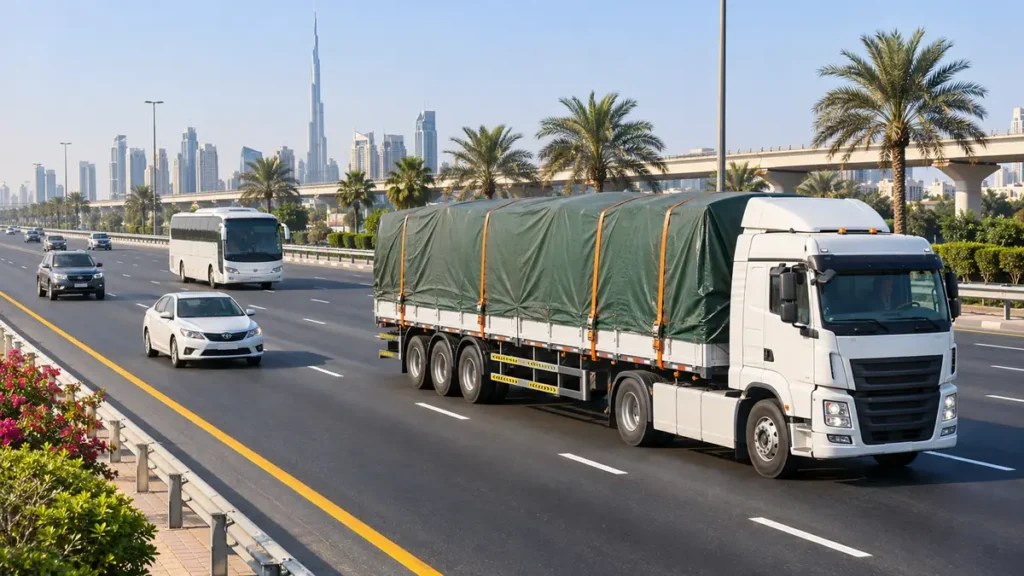
New UAE traffic regulations take effect on 1 January 2027 and strengthen the framework for vehicles, professional drivers and road safety. For truck and bus operators, the sensible preparation is to review routes, load controls, driver duties and records before a vehicle leaves the depot. For ordinary motorists, the practical response is to allow heavy vehicles more space and avoid disappearing into their blind areas.
The official Emirates News Agency overview confirms that Cabinet Decision No. 174 of 2026 implements the federal traffic law from the start of 2027 and covers professional drivers alongside broader vehicle and safety requirements. Existing national legislation also requires operators to respect approved dimensions, axle loads and road limits. Operators should obtain the exact current requirements for their vehicle, load and route from the licensing and road authority.
Heavy-vehicle planning checklist
| Area | Why it matters | Before departure |
|---|---|---|
| Route and lane | Restrictions can depend on road and time | Confirm the authorised route and signs |
| Vehicle condition | Long stopping distances magnify defects | Inspect tyres, brakes, lights and mirrors |
| Load security | Movement can affect control and other road users | Cover, restrain and distribute the load |
| Weight and dimensions | Limits protect roads and safe handling | Use verified measurements and permits |
| Driver readiness | Fatigue and distraction increase risk | Check rest, licence and journey plan |
The UAE road-trip planning guide helps with documents and rest stops. Professional drivers should also review the UAE driving-time and fatigue guide.
Secure the vehicle and load as one system
A load that is within the headline weight limit can still be unsafe if it is poorly distributed, inadequately restrained or able to shed material. Use restraints suited to the load, inspect anchor points, cover loose material and confirm that doors and tailgates are secure. Recheck after the first part of the journey and whenever the load has been disturbed. Do not let cargo obscure lamps, number plates or the driver’s view.
- Confirm the route, lane and time restrictions
- Inspect tyres, brakes, lights and warning equipment
- Verify weight, dimensions and axle distribution
- Use suitable restraints and a secure cover
- Record the inspection and responsible person
- Plan rest stops before the driver becomes tired
- Stop safely if the load shifts or a defect appears
The UAE following-distance guide explains why large vehicles need a greater safety envelope. The Dubai smart-camera guide reinforces that safe behaviour matters across every road, not only near a known enforcement point.
How car drivers should share the road
Do not remain alongside a truck or bus longer than necessary. If you cannot see the driver in the mirror, assume the driver may not see you. Pass only where lawful, leave a generous gap before returning to the lane and never cut into the stopping space. On bends, remember that a long vehicle may need more room and its rear wheels can track differently from the front.
At junctions, loading areas and roundabouts, be patient rather than forcing a small gap. A flashing indicator does not by itself prove that a manoeuvre is safe, but it tells you to create space. The UAE emergency numbers guide explains whom to call for an actual collision or road danger.
Keep evidence without creating paperwork theatre
A useful file identifies the vehicle, driver, route, inspection, load, measurements, restraints and any required permit. Records should be accurate enough to show what was checked and what corrective action followed. Generic tick boxes completed after the journey do not improve safety. The UAE record-keeping guide offers a practical structure for dated, retrievable evidence.
Questions people often ask
When do the new UAE traffic regulations take effect?
The announced effective date is 1 January 2027.
Do heavy-vehicle limits apply only to total weight?
No. Operators must consider dimensions, axle loads, distribution, route conditions and any required permits.
Why must loose loads be covered?
A secure cover and suitable restraints help prevent material falling, shifting or endangering other road users.
How should a car pass a truck?
Pass only where lawful, move through the blind area without lingering and leave a generous gap before returning to the lane.
Where should an operator confirm a specific requirement?
Use the relevant UAE licensing and road authority for the vehicle, emirate, route and type of cargo.


