
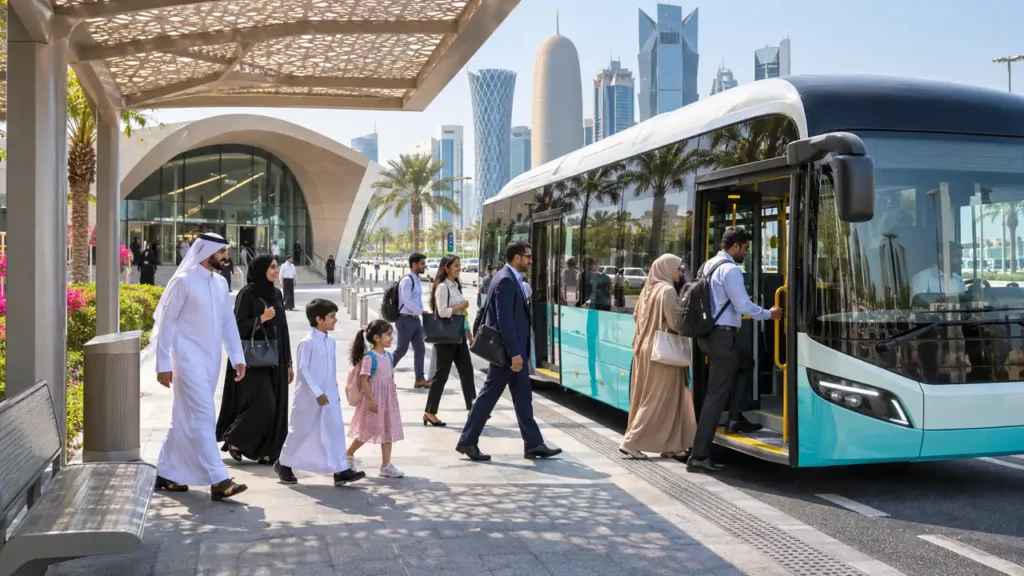
Qatar’s Ministry of Transport says nine metrolink feeder routes were introduced during 2026, increasing the network total to 76. The expansion is designed to improve first- and last-mile access between Doha Metro stations and surrounding neighbourhoods. For passengers, the key benefit is not simply a larger route count but more options for reaching stations without a private car.
The official Ministry of Transport news page identifies the new services as M102, M103, M119, M154, M304, M305, M307, M308 and M318. It says they serve the metro stations of Lusail QNB, Al Sudan, Sports City, Al Waab QLM, Al Qassar and Msheireb. The announcement does not replace live timetables, stop maps or service notices, which passengers should verify before travel.
New routes and served stations
| Network detail | Confirmed information | Passenger check |
|---|---|---|
| New route numbers | M102, M103, M119, M154, M304, M305, M307, M308, M318 | Match the route to the official stop map |
| Network total | 76 metrolink routes | Use current journey-planning information |
| Served stations | Lusail QNB, Al Sudan, Sports City, Al Waab QLM, Al Qassar, Msheireb | Confirm the correct station exit |
| Purpose | First- and last-mile connectivity | Allow time for the transfer |
| Operational detail | Subject to current service information | Check notices before departure |
How to plan a metrolink transfer
Start with the final destination, then identify the nearest confirmed stop and the metro station that connects to it. Route numbers alone do not show which side of a road or station entrance to use. Save the return stop as well as the outbound stop, and allow time for walking, lifts and platform changes. The transfer method in the public-bus planning guide offers useful general questions even though Qatar’s system has different fares and operators.
Live conditions can affect waiting time. A feeder bus may be delayed by traffic, events or temporary road arrangements, so do not build a flight, appointment or medical visit around a zero-minute connection. The flight-status travel guide explains why a transport backup matters for time-critical journeys.
Before boarding
- Confirm the route number and direction on an official source
- Check the nearest stop and station exit
- Allow walking and transfer time
- Keep aisles, doors and priority spaces clear
- Ask the operator about current accessibility arrangements
- Keep children close at stops and station entrances
- Recheck the final service for the return journey
Passengers with mobility devices, visual or hearing needs, pushchairs or heavy luggage should verify the complete path, not only whether the bus itself is accessible. The accessible journey checklist shows how to check pavement, boarding, interchange and destination access together.
Safe and responsible use
Wait behind the kerb or marked area, board in order and never step into the road to signal a bus. Keep bags controlled and give priority seating and spaces to passengers who need them. The official-alerts guide helps travellers distinguish real service notices from unsourced messages.
The recent Qatar robotaxi trial guide covers another part of the country’s mobility programme, but a controlled trial should not be confused with an available feeder service. For broader regional connections, the GCC travel-planning guide reinforces the need to verify every transport segment separately.
Do not assume rules from another country apply in Qatar. Current operator notices should determine route, hours, fare integration and luggage conditions. Use the responsible-sharing guide before reposting an alleged route change.
Questions people often ask
How many new metrolink routes were introduced in Qatar in 2026?
The Ministry of Transport says nine new routes were added.
How many metrolink routes are there in total?
The announced network total is 76 routes.
Which stations are named in the announcement?
Lusail QNB, Al Sudan, Sports City, Al Waab QLM, Al Qassar and Msheireb are listed.
Does the announcement provide every timetable and stop?
No. Passengers should use current official journey information for stop locations and operating times.
Should passengers allow transfer time?
Yes. Walking, station access, waiting and service conditions can all affect the connection.


