
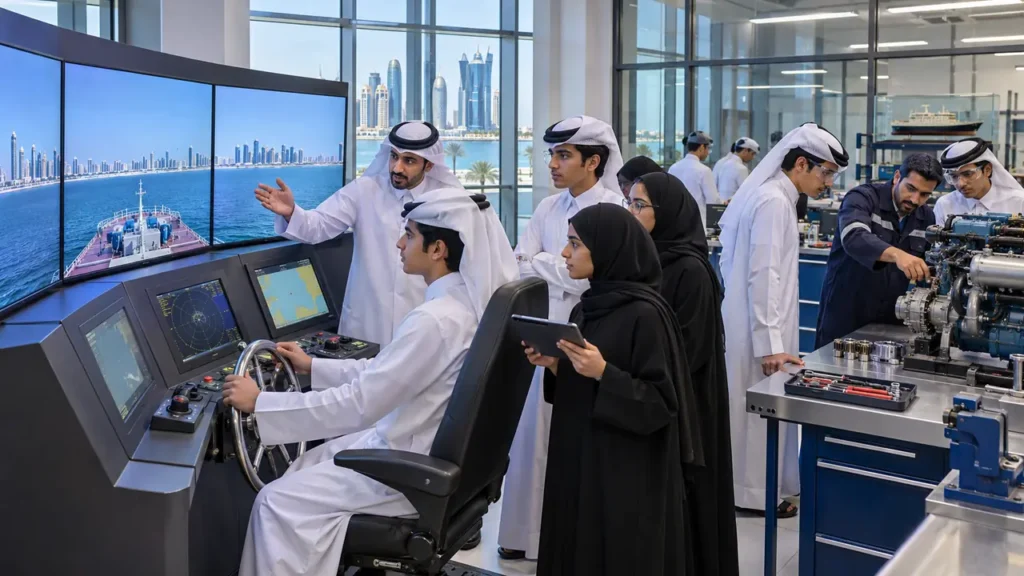
Qatar’s Ministry of Transport has been introducing students to maritime careers through workshops, presentations and field visits covering marine engineering, navigation, vessel registration, licensing and safety. The initiative helps young people see the sector as a network of technical and public-service roles rather than only work at sea.
Students interested in the field should compare academic routes, medical and licensing requirements, practical training and the daily realities of each role. A strong choice connects personal aptitude with recognised qualifications and real workplace exposure.
Maritime roles extend beyond the bridge
Navigation officers plan and monitor vessel movement, while marine engineers maintain propulsion, electrical and safety systems. Shore-based careers include port operations, hydrography, logistics, vessel inspection, registration, maritime law, environmental protection and emergency planning.
Each role has a different balance of mathematics, physics, communication, shift work and responsibility. Students should speak to practitioners about schedules, time away from home and progression instead of choosing only from a job title or uniform.
| Career area | Typical focus |
|---|---|
| Navigation | Route planning and safe vessel operation |
| Marine engineering | Mechanical, electrical and propulsion systems |
| Port operations | Cargo, berth and traffic coordination |
| Maritime regulation | Licensing, inspection and safety compliance |
Readers planning the wider day can also use Saudi National Museum guide and Qatar Metrolink guide to coordinate transport, timing and practical requirements without relying on last-minute assumptions.
Skills students can build now
School subjects such as mathematics, physics, computing and English can support later study. Clear written communication is equally important because maritime work depends on procedures, logs, permits and precise handovers between teams.
Teamwork and calm decision-making matter in safety-critical environments. Clubs, volunteering and supervised technical projects can demonstrate these qualities. Swimming confidence and general fitness may help, but medical standards vary by role and programme.
- Strengthen mathematics, science and technical English.
- Attend official career events and field visits.
- Verify course recognition and licensing pathways.
- Ask how practical placements and sea time are arranged.
- Compare shipboard and shore-based working patterns.
For another useful layer of preparation, Oman festival guide and Kuwait documentation guide explain related UAE procedures and public-safety considerations in more detail.
Choosing education and practical training
Prospective cadets should verify whether a course is recognised for the certification they want. Ask how sea time or industrial placement is arranged, who pays related costs and what happens if a placement is delayed.
A field visit can reveal whether a student prefers vessel operations, engineering spaces, control rooms or shore-based analysis. Keep notes and compare the tasks observed with university modules, apprenticeship routes and licensing steps.
Before setting out, compare the advice here with Bahrain visitor guide and regional emergency planning guide; both provide context that can make the experience smoother and more predictable.
Questions to ask before committing
Families should review costs, scholarships and likely employment pathways together. Marketing promises are not a substitute for accreditation, published entry criteria and a clear training agreement.
The maritime sector supports trade, transport and national infrastructure, making it relevant to students with both technical and administrative strengths. The best first step is an informed conversation followed by verified study and training research.
For current details, consult Qatar Ministry of Transport news before making a time-sensitive decision.
Questions people often ask
What maritime careers are available in Qatar?
Options include navigation, marine engineering, port operations, logistics, inspection, vessel registration, safety, law and environmental roles.
Do all maritime jobs require working at sea?
No. Many roles are based in ports, government, logistics companies, training institutions and technical offices.
Which school subjects are useful?
Mathematics, physics, computing and English are commonly useful, although exact entry requirements depend on the programme.
Why is course recognition important?
A recognised course should align with the certification or professional pathway required for the intended role.
How can a student test interest before applying?
Attend official workshops, speak with practitioners, join field visits and compare observed tasks with course modules and working conditions.


