
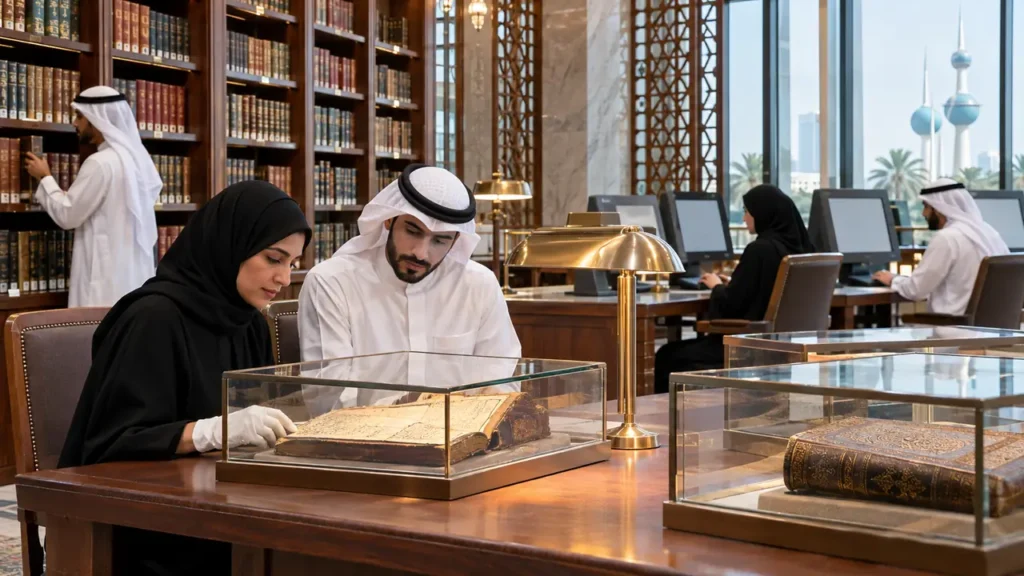
Kuwait’s cultural authorities continue to emphasise the preservation of the country’s literary heritage. For readers, students and visitors, that heritage is not limited to old books: it includes periodicals, manuscripts, oral history, theatre, poetry, correspondence and the work of writers who documented social change.
Exploring this material requires a method. Start with an official library or cultural catalogue, define the period or author you want to study, and keep enough publication information to distinguish an original source from a later commentary.
Where a literary search can begin
National and public libraries are a logical first stop because catalogues may point to books, newspapers, journals and special collections. Cultural institutions can also publish event calendars for lectures, readings and exhibitions that introduce writers to a general audience.
Before visiting, check opening hours, registration rules and whether materials must be requested in advance. Some rare or fragile items may be available only under supervision or through a digital copy. A catalogue record is not a guarantee of immediate access.
| Resource | How to use it |
|---|---|
| Library catalogue | Find editions, subjects and locations |
| Newspaper archive | Check contemporary context and reception |
| Manuscript collection | Study original or rare material under rules |
| Cultural programme | Hear scholars, writers and curators |
Readers planning the wider day can also use Saudi National Museum guide and Qatar Metrolink guide to coordinate transport, timing and practical requirements without relying on last-minute assumptions.
Reading sources in historical context
A text reflects its time, audience and publication setting. Record the author, title, edition, publisher and date, then compare it with contemporary newspapers or other writers. This helps separate what a source actually says from a modern interpretation.
Translation can widen access but may change tone or cultural references. When possible, compare the Arabic original with a reputable translation and note the translator and edition. Ask a librarian for guidance instead of relying on an unattributed online scan.
- Define a period, author or theme before searching.
- Record full publication and catalogue details.
- Confirm access and photography rules in advance.
- Compare primary material with reliable context.
- Respect copyright, privacy and archival handling rules.
For another useful layer of preparation, Oman festival guide and Kuwait documentation guide explain related UAE procedures and public-safety considerations in more detail.
Using archives responsibly
Follow handling rules for archives: clean hands, pencils rather than ink where required, no food, and careful support for bindings. Photograph only when permitted and capture the catalogue reference so the image can be cited later.
Copyright and privacy still apply to historical material. Publication online may require permission even when reading-room access is allowed. Personal letters and oral histories can involve living families, so researchers should use them with sensitivity.
Before setting out, compare the advice here with Bahrain visitor guide and regional emergency planning guide; both provide context that can make the experience smoother and more predictable.
Building a personal Kuwait reading pathway
A beginner can choose one theme—sea life, urban development, education, theatre or women’s writing—and read across genres. Pair a literary work with a historical overview and an official cultural talk to deepen understanding.
Keep a simple research log with quotations, page numbers and questions. Over time, this turns casual reading into a reliable map of Kuwait’s literary history and makes it easier to share sources accurately.
For current details, consult Kuwait News Agency cultural coverage before making a time-sensitive decision.
Questions people often ask
What counts as Kuwait literary heritage?
It can include books, poetry, theatre, newspapers, journals, manuscripts, correspondence and recorded oral history connected with Kuwait.
Where should a beginner start?
Begin with an official library catalogue or cultural institution and choose one manageable author, period or theme.
Can rare books be photographed?
Rules vary by collection and condition. Ask permission and record the catalogue reference for every permitted image.
Why compare different editions?
Editing, translation and publication context can change wording and interpretation, so edition details matter.
How should online scans be used?
Verify the source, edition and completeness. Prefer official or reputable digital collections and cite the original record.


