
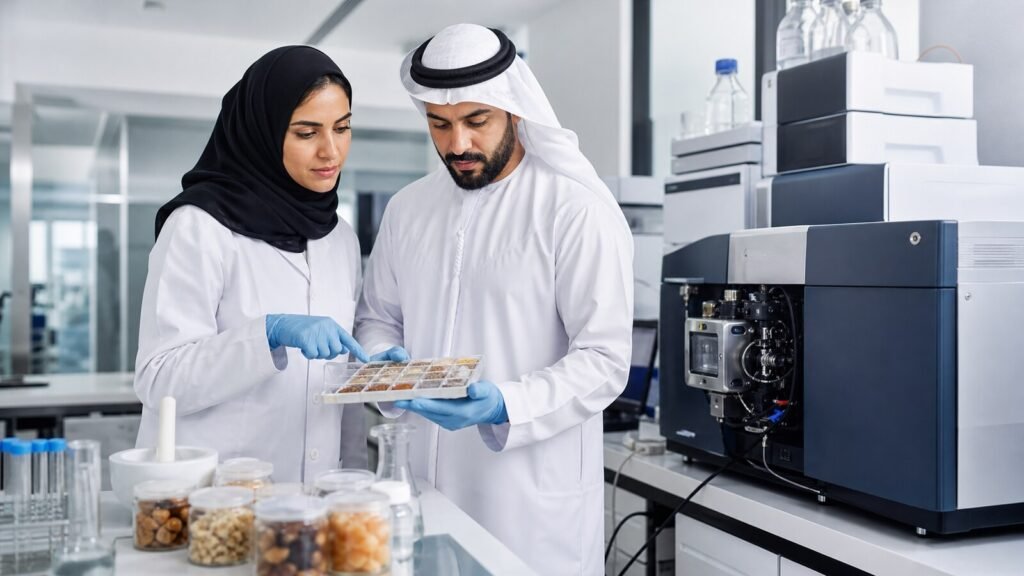
Most shoppers never see the laboratory work behind a packaged snack, sauce or coloured food product. The label and the final product are visible. The testing used by regulators is not. Dubai Municipality has added a specialist laboratory that can examine extremely small particles in processed food and return certain results in less than five minutes.
The new facility focuses on detecting titanium dioxide and distinguishing ordinary forms of the substance from particles manufactured at nanoscale size. It is a regulatory and technical testing development, not a new test that shoppers are expected to request for every product.
What the laboratory actually examines
The facility uses a technology known as ICP MS. In practical terms, the equipment helps specialists analyse the composition of a sample with very high sensitivity. The official Dubai Municipality announcement says the system can characterise particle size, distribution and physical and chemical properties.
That level of detail allows the laboratory to separate traditional titanium dioxide from material produced at nanoscale size. The distinction matters because a substance can behave differently when its particles are made extremely small. Regulators therefore need tools that look beyond a basic ingredient name.
The equipment is being used to assess compliance with approved technical specifications and requirements. Dubai Municipality did not announce a general ban on all products containing titanium dioxide in this statement, and consumers should not interpret the opening of a laboratory as proof that every tested product is unsafe.
Why processed food needs specialised testing
Food manufacturing uses ingredients for colour, texture, stability and other practical purposes. As production methods change, laboratory testing has to keep pace. A traditional test may identify which chemical is present without giving enough information about the size and structure of its particles.
The new laboratory is meant to close that technical gap. It gives regulators and industry partners a quicker way to understand what is in a sample and whether it meets the relevant rules. A result time of no more than five minutes can help when a clear decision is needed without holding a product or shipment for an unnecessarily long period.
Fast analysis does not mean the entire regulatory process always takes five minutes. Sampling, documentation, interpretation and any follow up action can require additional time. The published figure refers to the laboratory test result.
What this means for shoppers
For an ordinary customer, the change mainly strengthens the testing system operating behind the market. Shoppers do not need to identify nanoparticles by looking at food. That is precisely why specialist equipment and trained staff are used.
Continue to read ingredient and allergen information, buy from recognised retailers and report a product that appears damaged, tampered with or incorrectly stored. Those simple checks remain more useful at home than trying to draw conclusions from technical language found in a social media post.
Anyone with a medical concern about an ingredient should speak with a qualified health professional. The laboratory announcement explains regulatory capacity. It does not provide individual dietary advice or diagnose a health condition.
What food businesses should understand
Importers and manufacturers need reliable information about ingredients, production methods and supplier specifications. If a product uses a material that may exist in different particle forms, a general description may not be enough for a modern compliance review.
Businesses should keep technical records organised and confirm current Dubai requirements before importing, producing or registering a food item. If laboratory analysis identifies a problem, clear batch records and supply chain documents make it easier to locate affected stock and respond properly.
The Municipality also offers services for food item registration, food permits, establishment approval and the release or transfer of food consignments. The correct route depends on the business activity. The nanoparticle laboratory supports that broader food safety system rather than replacing it.
The technology may be used more widely later
Dubai Municipality says the laboratory creates a base for possible future work involving cosmetics, pharmaceuticals and packaging materials. Those are potential areas, not a statement that every such product is currently tested through the same process.
The Central Laboratory has also developed other specialised food testing capacity, including genomic detection of foodborne viruses. The direction is clear. As products become more technically complex, regulators need faster and more precise ways to examine them.
For the public, the useful takeaway is measured. A more capable laboratory can support better oversight, but it does not turn one ingredient name into a simple verdict about every product. Context, concentration, particle form and the applicable standard all matter.
Questions people often ask
What does the new Dubai food laboratory test
It specialises in detecting and characterising nanoparticles in processed food, with an initial focus on distinguishing nanoscale titanium dioxide from traditional forms.
How quickly can it issue a result
Dubai Municipality says certain test results can be completed in no more than five minutes. Other regulatory steps may take additional time.
Can consumers submit food for testing
The announcement presents the facility as part of Dubai Central Laboratory support for regulators and public and private sector partners. It does not describe a walk in consumer testing service.
Does the laboratory announcement mean titanium dioxide is banned
No. The announcement describes detection and compliance testing. It does not itself announce a blanket ban on every product containing the substance.
Will the technology be used outside food
Possibly. Dubai Municipality says future research and applications may include cosmetics, pharmaceuticals and packaging materials.


