
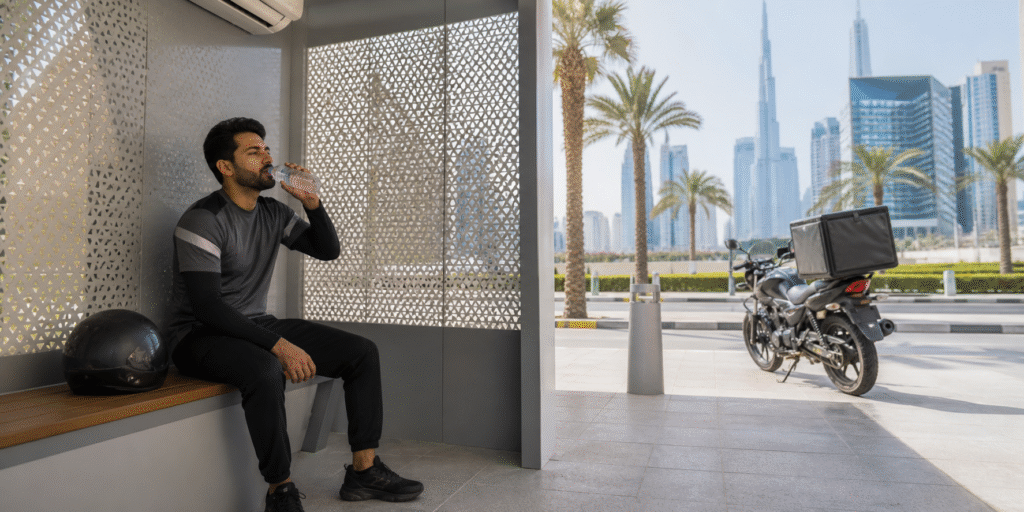
A delivery rider can cross several neighbourhoods during one lunch shift. Unlike a construction crew or a shop team, riders do not have a fixed workplace where they can step inside when the afternoon heat becomes difficult. Their workplace moves with every order.
That is why the UAE has expanded its network of summer rest stations for delivery workers. More than 12,000 air conditioned spaces are available across the country during the 2026 heat protection period. The stations are not a small perk. They give riders a practical place to cool down, drink water and recover without travelling far away from an active delivery area.
A national network built around delivery routes
The stations have been created with support from transport authorities, economic departments, fuel stations, restaurants, shopping centres, shops and cloud kitchens. Major delivery platforms are also involved, including Talabat, Deliveroo, Noon, Careem and Keeta.
According to the Emirates News Agency, riders can locate participating stations through interactive maps in the apps they use for work. That detail is important. A rest point is only useful during a busy shift if the rider can find one near the current route.
The network has grown quickly. There were about 6,000 stations in 2024 and more than 10,000 in 2025. The total for 2026 now exceeds 12,000. That expansion brings more stops closer to residential districts, restaurants and other places where delivery demand is concentrated.
How the midday protection period works
The UAE Occupational Heat Stress Prevention Policy runs every year from 15 June to 15 September. Work under direct sunlight and in open places is restricted each day from 12.30pm to 3pm.
The Ministry of Human Resources and Emiratisation guidance says employers must provide shaded rest areas, cooling equipment, drinking water, hydration supplies and first aid support. The policy applies across the UAE and is intended to reduce the risk created by long exposure to intense summer heat.
Some urgent tasks are exempt from the restriction. These include essential repairs that affect services such as water, electricity, communications or traffic, and certain technical jobs that cannot be postponed. Employers must still provide suitable protection for anyone doing exempt work. The exception does not remove the responsibility to manage heat safely.
Why delivery riders need a different approach
Food, medicine and other time sensitive orders may still need to reach customers during the restricted hours. Riders can continue or pause work during that period in coordination with their company. The rest station system supports that arrangement by providing a safe place to stop between orders.
Heat exposure is not limited to the minutes spent riding. A rider may wait outside a restaurant, carry an order through a car park, stand at a building entrance or return to a parked motorcycle that has been sitting in the sun. A proper break in a cooled room can help the body recover before the next part of the route.
Protective clothing and a helmet are essential on the road, but they can also make a hot afternoon feel harder. Riders therefore need regular access to water and cooling, not just one long break at the start or end of a shift.
Dedicated facilities in Dubai
Dubai has also prepared about 40 dedicated air conditioned rest areas through the Roads and Transport Authority. The facilities are located in busy delivery districts including Hessa Street, Al Khawaneej, Al Barsha, Al Satwa, Oud Metha, Al Karama and Arjan.
The locations were selected using delivery demand information, which should make them more useful than placing every facility in a distant central area. Riders may also find rest points inside participating fuel stations, malls, restaurants and other commercial sites.
What riders can do before a shift
A rider should check the map supplied through the delivery platform and note a few nearby stations before the busiest part of the day. One location may be full or slightly outside the next route, so having alternatives can save time.
Water should be taken regularly rather than only after thirst becomes strong. Any rider who feels dizzy, unusually weak, confused or sick should stop in a safe place and seek help. These symptoms should not be treated as an ordinary part of summer work.
Workers can report concerns about the midday protection rules to the ministry through its website, mobile application or call centre on 600590000. A rider who is unsure about a company procedure should also raise it with the employer or platform.
Customers have a small part to play
Most customers will not notice when a rider uses a rest station. The order may simply take a little longer during the hottest hours. Clear directions, a working phone number and prompt collection at the entrance can reduce the time a rider spends waiting outdoors.
The extra few minutes are worth keeping in perspective. Behind an ordinary doorstep delivery is someone dealing with road heat, traffic, protective clothing and repeated stops. The rest network helps the service continue while giving riders somewhere suitable to recover.
Frequently asked questions
When are the rest stations available?
They support riders during the annual heat protection period from 15 June to 15 September.
Are deliveries stopped between 12.30pm and 3pm?
Not necessarily. Riders can continue or pause work during the restricted hours in coordination with their delivery company.
How can a rider find the nearest station?
Interactive maps are made available through participating delivery applications so riders can find a rest point close to the current route.
What should a summer rest area provide?
The national guidance requires suitable shade, cooling, drinking water, hydration supplies and first aid support for outdoor workers.
Where can a possible violation be reported?
Reports can be made to the Ministry of Human Resources and Emiratisation through its website, mobile application or call centre on 600590000.


