
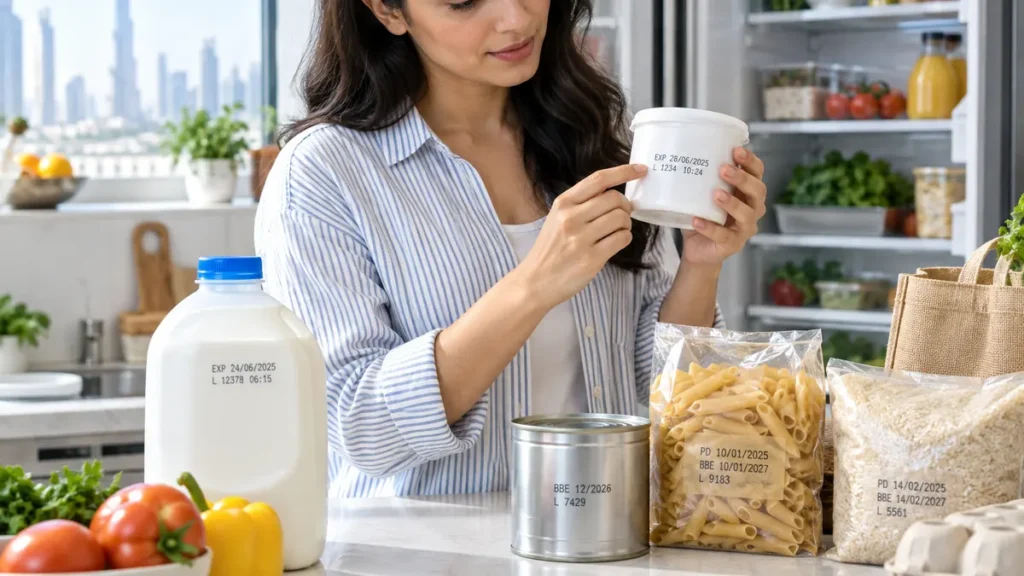
A printed date is only one part of deciding whether packaged food is suitable to buy, store or use. Shoppers also need to check what the date refers to, whether the package is intact and whether the product has been kept under the conditions stated on its label. A chilled item can become unsafe before its printed date if it was left warm; an unopened dry product can still be unsuitable when its seal is broken or there is an official recall.
The official UAE Government food-safety overview explains that municipalities supervise food-safety requirements and correct expiry labelling. It also describes the federal framework protecting consumers from harmful, adulterated or misleading food. For a specific product, follow the wording on its approved package and any current notice from the relevant authority.
Read the date together with its label wording
Do not look only for a row of numbers. Identify whether the label marks production, packaging, expiry or another date reference. Formats can vary, especially when the year is shortened or the order of day and month is unclear. If the printing is smudged, overwritten or impossible to interpret, ask the retailer rather than guessing.
The Dubai food-label guide helps readers connect the date with ingredients, allergens, serving size and storage directions. A date does not cancel a warning such as “keep refrigerated” or “use within three days of opening”.
Separate unopened shelf life from life after opening
Many products change once opened. Air, utensils, moisture and repeated temperature changes can reduce quality or increase risk. Write the opening date on a container when the label gives a limited period after opening. Use clean utensils and close the package promptly.
For chilled groceries, place items in the refrigerator without an unnecessary stop after shopping or delivery. The food-delivery storage guide explains what to unpack first, while the home-freezer guide covers labels, portions and safe defrosting.
| Check | Question to ask | Action when uncertain |
|---|---|---|
| Date wording | Is this production, packing, best-before or expiry information? | Ask the retailer or manufacturer |
| Storage | Was the required temperature maintained? | Do not rely on the date alone |
| Package | Is the seal sound and the container undamaged? | Reject leaking, swollen or broken packs |
| After opening | When was it opened and how was it handled? | Label the opening date or discard if unknown |
| Official status | Is there a recall or safety notice? | Follow the authority’s instructions |
Five checks before using dated food
- Read the complete date wording and storage statement.
- Inspect the seal, can, cap, pouch or carton for damage.
- Confirm how long the product has been open.
- Consider its real temperature history, not only the printed date.
- Check official recall information when a product is under discussion.
Do not use smell as the only safety test
Some spoilage is obvious, but harmful contamination may not create a strong smell, colour change or visible mould. Do not taste food to test whether it is safe. Swollen cans, leaking packages, broken seals, unexpected gas, severe dents at a seam or an unusual appearance are reasons to stop and seek proper guidance.
Eggs and dairy products need especially consistent refrigeration. The cooked-food cooling guide explains why leftovers have their own timing and handling rules. A packaged ingredient’s date does not become the date of a meal cooked from it.
Respond correctly to recalls and complaints
If an official recall identifies a product by name, batch, size or date, compare every detail rather than assuming similar packaging is included. The Dubai food-recall guide shows what to record before returning or isolating an item. Keep the package, receipt and photographs where safe.
For a suspected problem bought in Dubai, the food-safety concern guide helps organise evidence. If food has already been cooked, the rice and leftovers guide explains why quick cooling and controlled reheating matter independently of the original ingredient labels.
Good date-label decisions combine the printed information with storage, opening history, package condition and official alerts. When a critical detail cannot be verified, choose the safer option.
Questions people often ask
Is a production date the same as an expiry date?
No. A production or packing date identifies when the product was made or packed; the expiry information indicates the end of the stated usable period under required conditions.
Can food be safe simply because the expiry date has not arrived?
No. Broken packaging, poor temperature control, contamination or a recall can make a product unsuitable before its printed date.
What should I do when the date format is unclear?
Do not guess. Ask the retailer or manufacturer and keep the product under its required storage conditions while checking.
Should I taste food to decide whether it has spoiled?
No. Tasting is not a safe test, and some hazards cannot be detected by taste or smell.
Does the original date still apply after opening?
The package may give a shorter after-opening period. Record when it was opened and follow both that instruction and the required storage conditions.


