
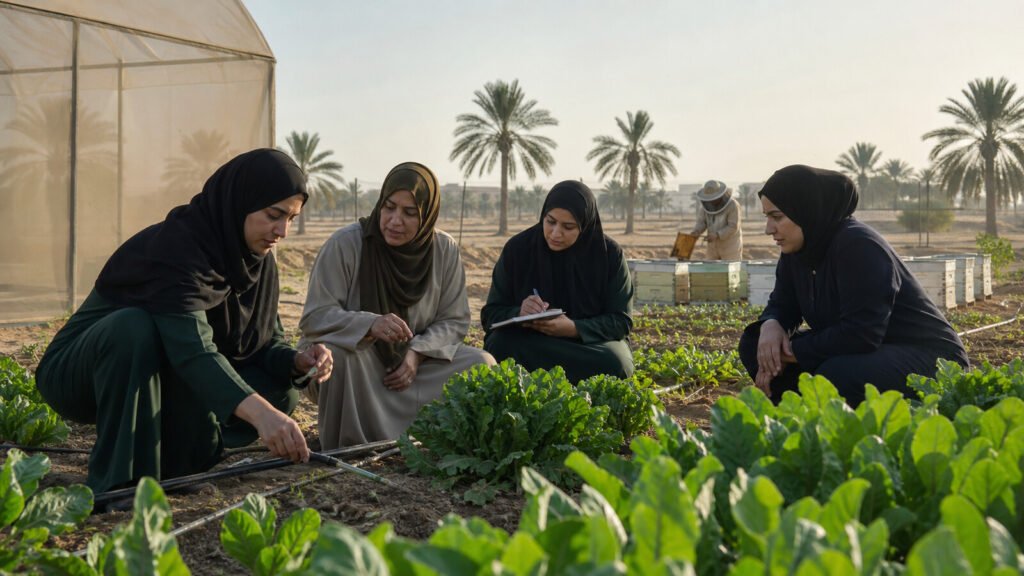
Growing food in the UAE asks a farmer to make careful choices about water, heat, pests and costs. A decision that looks small in one week can affect a whole season. The new Women Farmer Field Schools programme is built around learning on farms, where those choices can be observed and tested rather than discussed only in a classroom.
The Ministry of Climate Change and Environment launched the first phase on 23 August 2026. It is aimed at Emirati women farmers, beekeepers and others interested in agriculture, with field training due to begin across several emirates in September.
What a field school actually does
A farmer field school uses practical group learning. Participants study a real crop, farm or apiary, observe what is happening and compare ways of managing it. The approach treats farmers as active decision makers who learn from evidence and from one another.
For this UAE programme, the official announcement says training will take place across farms and agricultural sites. That is important because conditions differ between a greenhouse, an open field, a date palm area and an apiary. Advice becomes more useful when participants can connect it to visible plants, pests, irrigation systems and records.
The programme is being delivered by the ministry with the Abu Dhabi Agriculture and Food Safety Authority and the Food and Agriculture Organization of the United Nations. It builds on an earlier school in Abu Samrah in Al Ain.
What women farmers will learn
The planned subjects cover both production and business decisions. Date palm training will include sustainable management and ways to combat red palm weevil and other pests. Fruit and vegetable work will look at irrigation and fertilisation in greenhouses and open fields.
Beekeepers will be able to study apiary management, honey production and products that add value beyond the basic harvest. Record keeping and economic evaluation are also part of the programme. Those skills help a farmer see whether a change improved output, reduced waste or simply added cost.
This combination makes the initiative more than a series of growing tips. A healthy crop does not automatically produce a sustainable farm business. Farmers also need to understand expenses, yields, product quality and the routes available to market what they produce.
Why practical pest training matters
Pest management is most effective when a problem is recognised early and handled with the right method. Red palm weevil can be difficult to detect before damage becomes serious. Field learning gives participants a chance to discuss signs, monitoring and responsible responses with specialists.
The same principle applies to vegetables and fruit. A mark on a leaf does not always have one cause. Water stress, nutrition, heat and pests can produce symptoms that look similar to an untrained eye. Learning to observe patterns can prevent a farmer from spending money on the wrong response.
Participants should still follow the instructions of the relevant agricultural authority and use approved products correctly. A field school helps build judgement, but it does not replace official controls or professional advice for a serious outbreak.
Water and farm efficiency
Water management is central to food production in an arid climate. More irrigation is not always better. Timing, delivery, soil conditions, crop stage and the performance of equipment all affect how much water reaches the plant and how much is lost.
Farm based training lets participants inspect systems and connect irrigation decisions with plant health. Record keeping then turns those observations into something measurable. A farmer can compare water use, input costs and yield over time instead of relying on memory.
That habit supports both environmental and commercial goals. Efficient use of water and fertiliser can reduce waste, while better records make it easier to explain how a product was grown and where improvements are still needed.
How the programme connects food and family
The launch coincides with Emirati Women’s Day and the UAE Year of the Family. The ministry links women’s agricultural knowledge with household nutrition, sustainable food practices and the transfer of skills through families and communities.
That does not mean every participant must run a large farm. A beekeeper, a producer testing a small greenhouse or a woman exploring an agricultural career can all contribute different knowledge. The first step is to confirm eligibility and the participation route through the ministry’s official channels.
The programme also offers links to the Emirates Youth Council for Agriculture and opportunities to participate in agricultural exhibitions and festivals. For a producer, those connections can help with learning, visibility and understanding what buyers expect. They should not be treated as a promise of sales, but they can make the route from production to market less isolated.
What interested participants should do
The ministry scheduled a virtual introductory session for 27 August, followed by field training from September. Anyone interested should use the ministry’s official channels to check registration, eligibility, the location of sessions and whether places remain available.
Before joining, it helps to write down the farm problem you most want to solve. Bring recent records if available, including crop dates, irrigation use, pest observations, input costs and yield. Specific information makes it easier to turn a general lesson into a decision that fits your own operation.
Questions people often ask
Who is the programme for
It is intended for Emirati women farmers, beekeepers and others interested in agriculture, subject to the ministry’s participation rules.
When does field training begin
The official announcement says field based training will begin in September 2026 across farms and agricultural sites in several emirates.
Will the programme cover beekeeping
Yes. Planned topics include apiary management, honey production and products that can add value to the harvest.
Does it include business skills
Yes. Agricultural record keeping and economic evaluation are included alongside technical production subjects.
Where should someone register
Interested participants should use the official channels of the Ministry of Climate Change and Environment and confirm current availability.


