
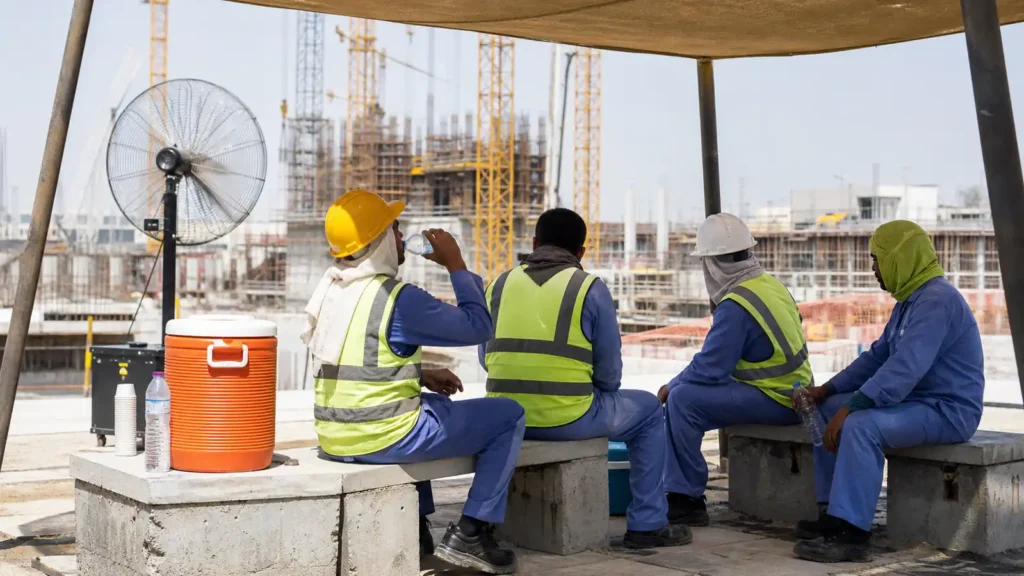
The UAE’s annual Midday Break is scheduled to run through 15 September 2026. For employers, supervisors, delivery companies and outdoor workers, the important point is that the protection does not end at the start of the day: the restricted period still applies on 15 September from 12:30pm to 3pm.
The rule is part of the UAE’s Occupational Heat Stress Prevention Policy. It prohibits work carried out under direct sunlight and in open places during the protected hours, helping reduce the risk of heat stress, heat exhaustion and heatstroke during the hottest part of the day.
The restriction applies each year from 15 June to 15 September. That means outdoor schedules should remain compliant until the final 3pm break period has passed on 15 September, unless the Ministry of Human Resources and Emiratisation (MOHRE) issues a specific official update.
For the current rule and reporting options, use MOHRE’s official Midday Break guidance. The UAE Government’s workplace health-and-safety guidance also explains the annual timing and the limited technical exemptions.
What the midday-break rule means in practice
The rule is straightforward in principle: work under direct sunlight and in open places must stop between 12:30pm and 3pm during the annual protection period.
This is especially relevant to construction, road works, landscaping, loading and unloading, maintenance, outdoor cleaning, delivery operations and any role that regularly requires staff to work outside.
It does not mean every employee in the UAE stops work at 12:30pm. Office-based, indoor and air-conditioned work is different. The key question is whether the work is being performed in direct sun or an open outdoor location.
| Item | What workers and employers should know |
|---|---|
| Final date for 2026 | Tuesday 15 September 2026 |
| Restricted hours | 12:30pm to 3pm |
| Restricted work | Work under direct sunlight and in open places |
| Core purpose | Reduce heat-related health risks during peak daytime conditions |
| Employer facilities | Shade, cooling, drinking water and first-aid arrangements are required |
| Exemptions | Only limited technical or emergency work; extra protections still apply |
| Reporting concerns | MOHRE call centre, website or mobile app |
The rule should be treated as a health-and-safety requirement, not a scheduling inconvenience. A short planning change — starting earlier, working later or moving tasks indoors — can make a significant difference to a worker’s wellbeing.
What employers should do before 15 September
Employers should not wait for an inspection or a complaint to check their arrangements. The final days of the policy are a good time to review site practices and make sure supervisors understand exactly what is expected.
A practical employer checklist includes:
- Stop affected outdoor work before 12:30pm.
- Confirm staff are not sent back outside before 3pm.
- Provide shaded rest areas close enough to be genuinely usable.
- Ensure cooling equipment is available where needed.
- Supply enough drinking water for the number of workers on site.
- Keep first-aid materials accessible and ensure supervisors know the emergency process.
- Brief workers in a language they understand.
- Record any technical exemption and the protections provided.
For businesses that use contractors or subcontractors, the responsibility should not disappear at the boundary of the main site. Confirm that every team working under your project plan follows the same protected-hours schedule.
Companies planning September site visits or business meetings may also find our [WETEX Dubai 2026 visitor guide](/business/wetex-dubai-2026-visitor-guide/) useful when organising later autumn events.
What workers should expect
Workers should know when the outdoor break starts, where the rest area is and who to speak to if conditions are unsafe. A proper rest period should not mean sitting in direct sun beside the work area without water or cooling.
Employers are expected to provide practical protective arrangements, including shaded areas, suitable cooling, sufficient drinking water and first-aid equipment. These provisions matter during the break and when workers are performing permitted duties.
Workers should also take heat symptoms seriously. Dizziness, headache, nausea, confusion, unusual weakness, heavy sweating or feeling faint can all be warning signs. Tell a supervisor immediately, move to a cooler place and seek medical help if symptoms are severe or do not improve.
The end of the formal Midday Break does not mean that UAE heat risks disappear overnight. September afternoons can still be very hot, so sensible hydration, rest and site-safety practices should continue after 15 September.
Which activities can be exempt?
The UAE’s rules recognise that a small number of tasks cannot always stop without causing a wider safety, technical or public-service problem. Examples include:
- Asphalt laying or concrete pouring that cannot feasibly be postponed.
- Urgent repairs needed to prevent a hazard or restore essential services.
- Work that has a permit from the relevant authority because it affects traffic, roads or public services.
An exemption is not a free pass to ignore worker welfare. When a technical reason requires work to continue, employers must still provide strong protective measures, including cold drinking water, appropriate hydration fluids approved by local health authorities, first aid, cooling and shade.
The best practice is to document why the work cannot be deferred, limit the number of people exposed, rotate staff where possible and make a clear supervisor responsible for monitoring conditions.
How to handle delivery and mobile teams
Delivery riders, drivers, mobile maintenance staff and field teams need extra planning because they may not have a fixed worksite. Employers should make sure teams know where they can access a suitable rest point and how to contact a supervisor if they need support.
MOHRE has highlighted air-conditioned rest stations for delivery workers during the policy period. For delivery businesses, this should be part of route planning — not something a rider has to discover after becoming unwell.
Customers can play a part too. If you are ordering during the middle of the afternoon, choose a realistic delivery window and avoid pressuring riders to make unsafe journeys in extreme conditions.
For household planning, our [Dubai September dining offers guide](/food-drink/dubai-september-dining-offers-2026/) can help you schedule an indoor meal instead, while the latest [UAE petrol and diesel prices](/business/uae-petrol-diesel-prices-september-2026-announced/) are helpful for people budgeting regular travel.
What happens after 15 September?
After the final restricted period on 15 September, the specific annual Midday Break window concludes. Employers may return to their normal outdoor schedules, but they must still meet wider occupational-health-and-safety responsibilities.
Good employers will keep the useful parts of the summer plan in place: accessible water, shaded rest areas, reasonable workload planning and a clear process for reporting unsafe conditions. These are practical safeguards throughout the year, not only during the formal ban.
If you are organising an outdoor family plan after the summer period, our [Dubai Mallathon guide](/things-to-do/dubai-mallathon-2026-final-days-guide/) and [Expo City Dubai family guide](/things-to-do/expo-city-terra-vision-family-guide/) offer useful planning ideas.
Questions people often ask
Does the UAE Midday Break apply on 15 September?
Yes. The policy runs from 15 June to 15 September, so employers should continue to follow the 12:30pm to 3pm restriction on 15 September.
Does every worker have to stop working during the Midday Break?
No. The restriction applies to work performed under direct sunlight and in open places. Indoor and air-conditioned work is not the same as outdoor sun-exposed work.
Can an employer ask workers to continue outdoor work between 12:30pm and 3pm?
Only limited technical or emergency activities may be exempt. Even then, the employer must provide the required protections, such as water, shade, cooling and first-aid arrangements.
What should a worker do if the rule is not being followed?
Workers and members of the public can report concerns through MOHRE’s call centre on 600590000, its website or the MOHRE mobile app.
Does the end of the Midday Break mean outdoor heat risks are over?
No. The annual restriction ends, but hot weather can continue in September. Employers should maintain sensible heat-safety practices and workers should continue to take hydration and heat symptoms seriously.


