
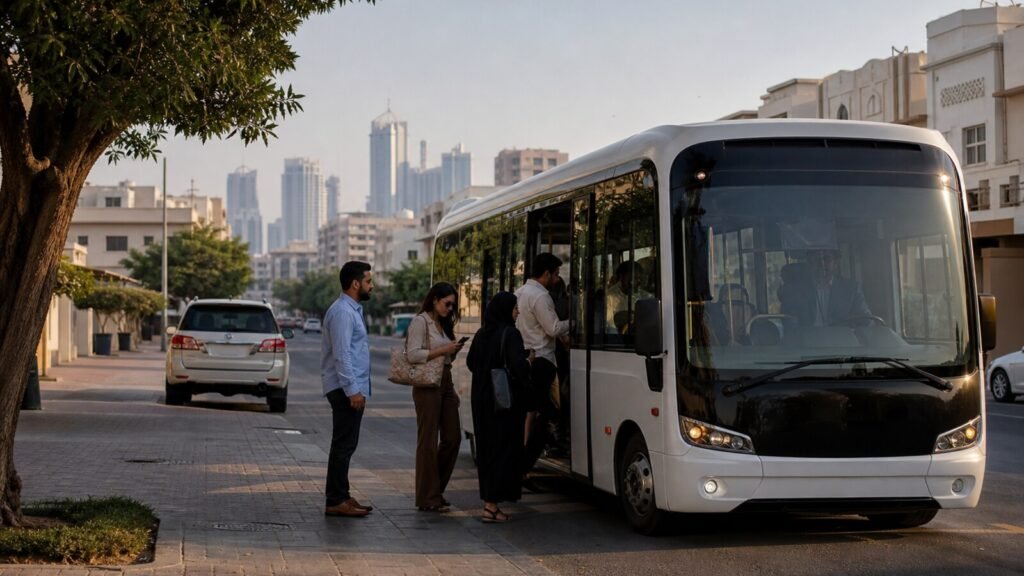
A short trip to the Metro can be awkward when the station is too far to walk but too close to justify a long taxi ride. Dubai Bus on Demand is designed for that gap. It uses smaller buses and app bookings to collect passengers within supported neighbourhoods rather than asking everyone to reach a traditional fixed route stop.
The service has now expanded into Al Satwa, Al Quoz and Mirdif. That takes its Dubai coverage to 20 areas and makes it relevant to many more daily journeys.
The three areas added in 2026
The newest service areas are Al Satwa, Al Quoz and Mirdif. The expansion was announced by Dubai Roads and Transport Authority in August 2026. It is intended to improve the first and last part of a public transport journey, particularly the connection between homes, workplaces and major transport links.
The official RTA announcement says the complete network now covers Al Barsha, Al Nahda, Dubai Silicon Oasis, Dubai Academic City, Al Rigga, Port Saeed, Business Bay, Downtown Dubai, Oud Metha, Al Karama, Barsha Heights, Al Mankhool, Dubai International Financial Centre, Al Warqaa, Dubai Investment Park, JVC and Al Qusais, plus the three new locations.
Coverage within an area should still be checked in the booking app. An area name does not necessarily mean every street, building entrance or destination sits inside the live pickup zone.
How to book a journey
Passengers need the Dubai Bus on Demand app. Register, enter the requested information and complete activation before trying to book. The app then uses the chosen pickup point and destination to show whether a journey is available.
This is different from standing at a normal bus stop and waiting for a numbered route. The trip is requested through the app, and the system groups journeys where practical. Allow enough time for the bus to reach the collection point and watch the live instructions rather than assuming it will stop directly outside a building.
Payment options listed by RTA include credit cards, debit cards and nol cards. Check the fare displayed during booking because prices, supported payment methods and service conditions can change. A nol card should also have enough balance before the passenger begins the journey.
Where the service can save time
The best use is often a local connection. Someone in Mirdif may need a practical link from a residential street to a larger transport corridor. A worker in Al Quoz may need to cross an area where blocks are long and summer walking is difficult. In Al Satwa, the service can help with short neighbourhood movements where parking or a full taxi journey is inconvenient.
It may also help visitors staying in supported districts, although they need mobile data, the app and a usable payment method. A first time passenger should make a test search before the day of an important appointment. That reveals whether both ends of the intended trip are covered and gives a more realistic idea of collection time.
The service is not automatically the fastest choice for every journey. A normal bus or Metro route may be better for a direct trip along a major corridor. Bus on Demand is most useful when it removes an inconvenient walk or connects a local address to the wider network.
Why RTA expanded the network
Demand has been rising. RTA recorded 527,000 riders during the first half of 2026, which was 25.1 per cent more than during the same period in 2025. June was the busiest month in that period with 105,990 riders.
The operating area grew by 54 per cent and the fleet increased to 55 buses. Those figures show that the service is becoming a regular transport option rather than a small trial. They do not mean a bus will always be immediately available. Traffic, nearby requests and the number of active vehicles can still affect the wait.
Small choices that make the trip smoother
Set the pickup pin carefully. In large developments, choosing the wrong side of the road can add a long walk or force the driver to circle. Wait in a safe, legal place where the bus can stop without blocking traffic. Keep notifications turned on until boarding.
Enter the final destination rather than a rough neighbourhood name. If the app proposes a nearby meeting point, check the walking route before confirming, especially with children, luggage or reduced mobility. Summer heat makes even a short uncovered walk feel much longer.
For a connection to another bus or the Metro, leave a sensible buffer. On demand transport responds to live requests and road conditions, so it should not be treated like a guaranteed private transfer. The practical approach is to compare the suggested journey with regular RTA options each time.
Questions people often ask
Which areas were added to Dubai Bus on Demand
Al Satwa, Al Quoz and Mirdif were added in the 2026 expansion. The service now covers 20 named areas across Dubai.
Do I need an app to use the service
Yes. RTA directs passengers to register and book through the Dubai Bus on Demand app. Use the app to confirm that the intended pickup and destination are covered.
Can I pay with a nol card
Yes. RTA lists nol cards, credit cards and debit cards as payment options. Check the current booking screen and keep enough balance available.
Does the bus follow a fixed route
The service responds to app bookings within supported zones rather than operating like a conventional numbered route. The assigned meeting point and journey details appear in the app.
Is Bus on Demand always faster than the Metro
No. It is mainly useful for local connections and the first or last part of a journey. A direct Metro or regular bus route may be faster for travel along a major corridor.


