
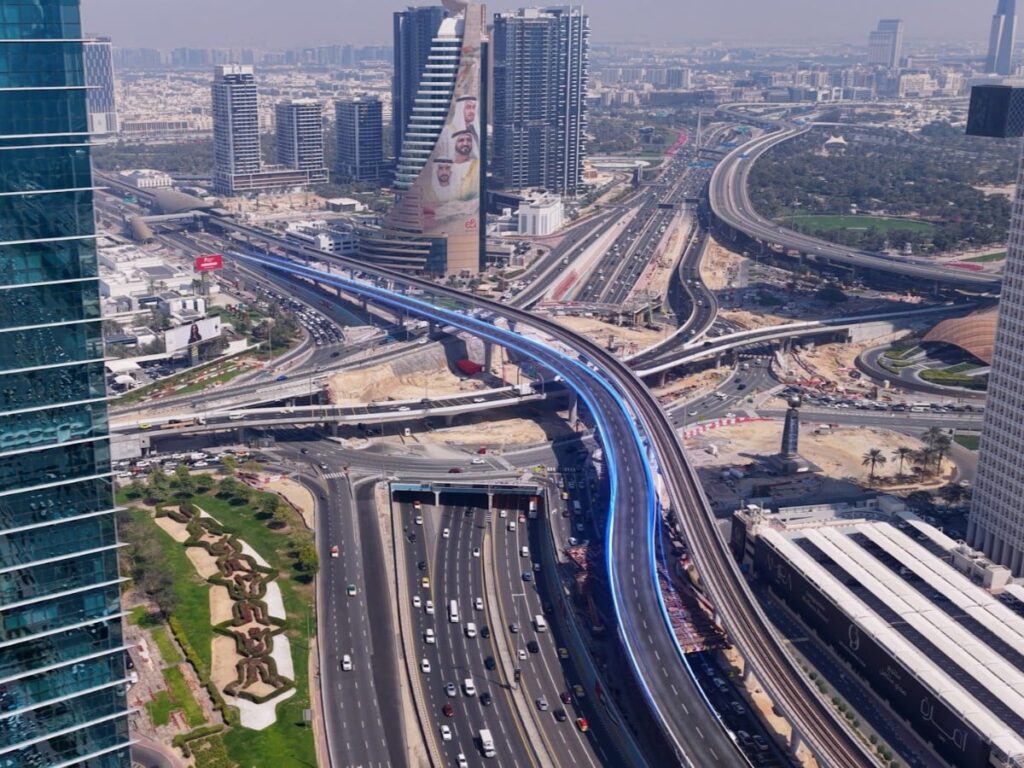
Dubai has now made a significant stride toward decongesting one of the busiest road and road junctions in the city with a massive new traffic clearing bridge in the vicinity of the locality. The bridge will ensure that commuters have an easier time traveling every day since it will link important sections of the city road system.
A 1,000-metre-long elevated bridge, which is part of the current Roundabout Development Project that is the World Trade Centre, was officially open by the Roads and Transport Authority (RTA). The new building is located at one of the most strategic crossroads of the emirate, and it is already transforming the way people move around the center of Dubai.
Also look for 6 Dubai Neighbourhoods Where Rents Are Rising in 2026
The Strategic Traffic Solution
Its significant upgrade in infrastructure was meant to ease the congestion at the World Trade Centre Roundabout – one of the major crossroads where various major roads collide namely the sheikh Zayed road and the sheikh Khalifa bin Zayed street.
In the past, cars passing this intersection used to take up to 12 minutes during the busy periods. Due to the new bridge, the time taken to pass through these areas has reduced drastically.
The new bridge has already reduced the journey time of about six minutes to only one minute in a motorist travelling between Sheikh Zayed Road and towards Sheikh Khalifa bin Zayed Street and towards the Al Karama and Deira according to the RTA data. This will be a great enhancement to commuters who use this route on a regular basis.
How the Bridge Works?
The new bridge is a level-two two-lane bridge with the capacity of approximately 3,000 vehicles per hour. It accommodates traffic that travels southwards on the Sheikh Zayed Road to the Sheikh Khalifa bin Zayed Street to avoid the congestion that used to accumulate on the ground at the crossing point.
This bridge is only the component of an even bigger plan to reform the whole roundabout. The entire project consists of five bridges that are interconnected and have an overall length of about 5,000 metres whereby all the bridges are designed to offer free movement of traffic in two or more directions. Other two bridges, which will cater traffic of Sheikh Rashid Street and Al Majlis Street, will be opened later in 2026.
What This Means for Drivers?
It is likely to have an enormous effect on the traffic every day:
- Less traffic during the peak hour: The process of passing one of the busiest intersections of Central Dubai will become significantly faster.
- Enhanced connectivity: More connections between the Sheikh Zayed Road, the main road in the city of Dubai, and other key streets.
- More efficiency: Commuter movement, resident movement, and visitor movement around the World Trade Centre and other surrounding areas is made easier.
According to RTA authorities, this upgrading of the roundabout is considered to be one of the most important intersection enhances in the road system of Dubai as it is located at the crossing of five large corridors.
Who Benefits Most?
When complete, the project would have benefited over half a million people including:
- Daily traffic users on Sheikh Zayed Road corridor.
- The people of the surrounding places such as the Al Satwa, Zabeel, Al Karama, Al Jafiliya and Al Mankhool.
- Travelers and employees commuting to the Dubai International financial centre (DIFC) and world trade centre dubai one of the major international exhibition, conferences and trade shows venue over the past forty years.
Enhanced accessibility at the WTC precinct will be particularly appreciated during the high business hours and when key events are being hosted at the centre as it will provide a better experience to delegates and the attendees.
The Road Ahead
Despite the fact that one bridge is in operation, work is ongoing in the rest of the structures that are related to the roundabout redevelopment. After all five bridges have been designed and constructed, as well as the transformation of the old roundabout into a signalised at-grade intersection, the number of average delays is anticipated to be reduced dramatically, and travelling will become much more predictable and efficient to users of the road.
This is one of the latest World Trade Centre Dubai news, which can be considered the most remarkable one as Dubai tries to modernize its infrastructure and congestion-free urban space.
Final Thought
To any person who may be commuting to central Dubai on a day-to-day basis, the newly constructed bridge is actually a blessing in terms of convenience and commuting time. Like the project, World Trade Centre Dubai Information will keep developing as it goes through 2026 with the promise of more interconnected and efficient road system among its residents, workers and visitors.
FAQS
What are the essential characteristics of the new bridge around the Dubai World Trade Centre?
The new bridge is to reduce congestion in the busy environment around Dubai world trade centre and offer an easy flow of traffic in the area with increased lanes and connectivity.
What will this bridge do to the traffic of the Dubai world trade centre?
The bridge should also help greatly in eliminating traffic congestion during the peak hours, which are likely to improve the general traffic movement and accessibility to business centres in Dubai.
When did the new traffic busting bridge open, and how does it enhance connectivity?
Bridge received an official opening date and the bridge enhances connectivity by providing easier access to major roads, access to important places in less time, such as Dubai International Financial Centre (DIFC), Dubai International Airport, and residential areas located nearby.


