
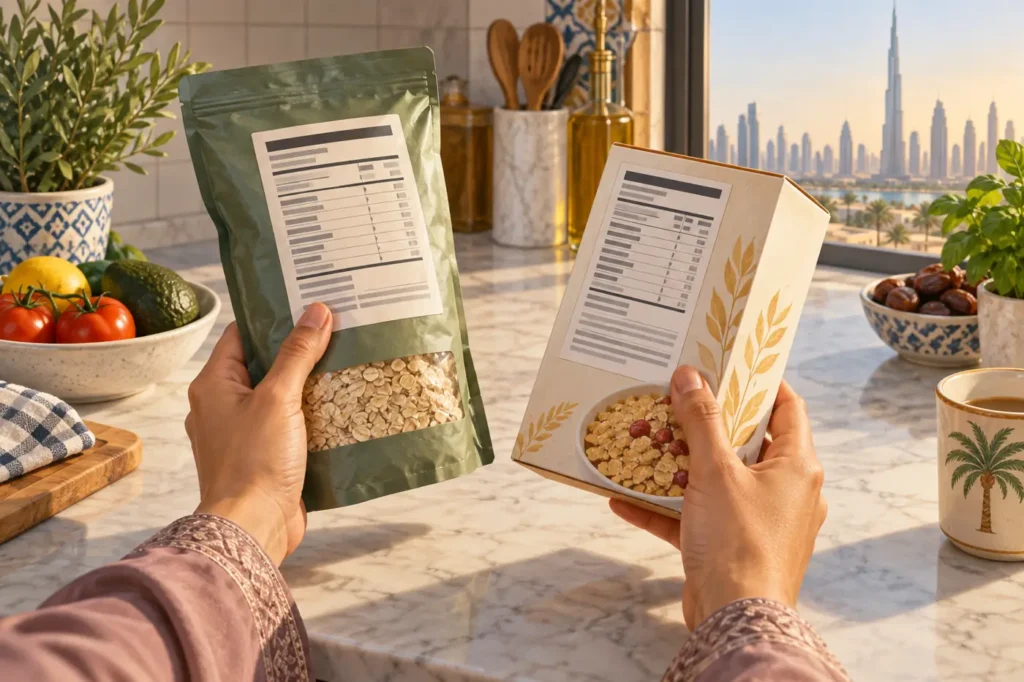
Two packets can look almost identical on a Dubai supermarket shelf yet describe very different serving sizes. One may show figures for a small portion, while the other shows the whole pack. Before deciding which suits your household, turn both around and compare the same quantity. That simple step is more useful than choosing by the largest claim on the front.
This is a shopping guide, not a personal diet prescription. Imported products can carry different label formats. Read the units and headings on the actual package rather than assuming every panel follows the same layout. If you need a medically restricted diet, take the label to your clinician or dietitian for advice specific to you.
Start with what the numbers describe
Look for the serving size, the number of servings in the container, and whether information is also given per 100g or 100ml. On US-format labels, the FDA’s label-reading guide explains that serving size describes the amount typically consumed, not a recommendation for how much you should eat.
Here is a hypothetical example, not a real product: a packet contains two servings, each with 120 calories. Eating the whole packet gives 240 calories. The same multiplication applies to the listed nutrient amounts. Compare the amount you expect to consume, not just the lowest printed number.
| Label detail | Question to ask | Useful action |
|---|---|---|
| Serving size | How much food do these figures cover? | Compare equal quantities. |
| Servings per pack | Will I use more than one? | Calculate the amount actually eaten. |
| Ingredients | Does it contain something I must avoid? | Read the full list and warnings. |
| Storage instructions | What changes after opening? | Keep the instructions with the food. |
Read ingredients separately from nutrition
A nutrition panel and an ingredient list answer different questions. A calorie figure cannot tell you whether a food is suitable for someone with an allergy. Dubai Municipality has highlighted reading packaged-food labels as part of consumer food-safety awareness. Read the ingredients and warnings on the packet in your hand, including when replacing a familiar product with a different size or imported version.
If the information is obscured or unclear, ask for a readable label before buying. Do not guess from a product photograph or from what a similar item contained last time. Our food-allergy dining guide covers the separate questions to ask when the food is prepared by a restaurant rather than sold in a labelled packet.
Make comparisons that help your household
Choose one or two priorities rather than trying to rank every number at once. For example, you might compare the stated serving quantity and the ingredient list across two versions of the same everyday food. Avoid treating a single nutrient figure as a verdict on the entire product or your whole diet.
The FDA distinguishes total sugars from added sugars on its label format. That distinction can help explain why the two lines are not interchangeable, but it should not be used to infer information missing from a different format. Read what is actually declared. A packet without an added-sugars line does not, by itself, establish that nothing was added.
- Compare like-for-like quantities and units.
- Check how many servings you will actually use.
- Read ingredients and allergen warnings independently.
- Keep storage and preparation instructions visible.
- Check the date marking before putting the item in the basket.
- Ask for clarification instead of guessing at unclear print.
Keep useful information after the shopping trip
If you decant food into a household container, keep a photograph of its label and date information. Label reading is only useful if the instructions are still available when someone else prepares the meal. Our grocery-delivery storage guide addresses the next stage, while the takeaway and picnic guide covers planning food away from home.
For a day out, decide who is carrying food and who needs to read the packaging. That is especially useful when a group combines a meal with activities from our Dubai budget guide. If eating out instead, use the restaurant dietary-needs checklist. For a beach outing, the Kite Beach food-planning guide helps separate the meal stop from the rest of the day.
Questions people often ask
Is a serving size a recommended portion?
Not necessarily. The FDA says serving size on its label format reflects typical consumption, not a recommendation.
How do I calculate a whole two-serving packet?
Multiply the per-serving calories and nutrient amounts by two if you eat both servings.
Can calories tell me whether a food contains an allergen?
No. Read the ingredient list and allergen information separately.
Are total sugars and added sugars the same?
No. On the FDA format, total sugars include naturally present sugars as well as added sugars.
What if I cannot read part of the label?
Ask for clear information before buying, especially where an ingredient or storage instruction affects suitability.


