
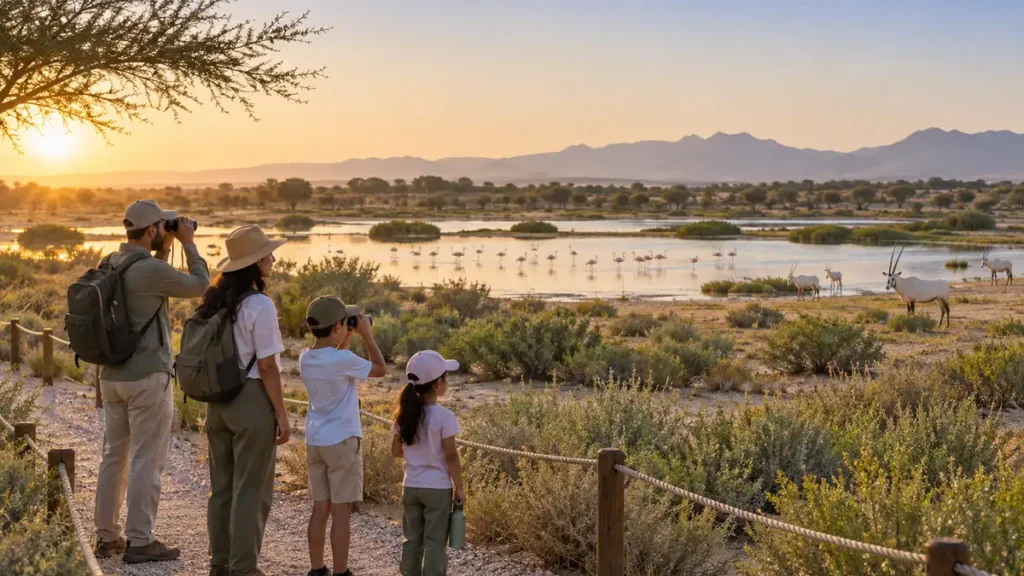
Dubai’s cooler season makes its desert and wetland landscapes easier to explore, but a nature reserve is not an ordinary picnic ground. The point of a protected area is to give wildlife and habitats space to function while allowing carefully managed public access. Visitors can improve the experience for everyone by checking where public entry is permitted, keeping to established routes and treating every sighting as an observation rather than an invitation to approach.
The official Dubai Municipality protected-areas portal says Dubai has eight designated reserves representing desert, mountain, coastal and marine ecosystems. It identifies Ras Al Khor Wildlife Sanctuary and Al Marmoom Desert Conservation Reserve as open to the public year-round. Access arrangements, hides and routes can still change, so the authority’s current information and signs at the site take priority over an old social-media post.
Choose the right reserve and visit window
Begin with the experience you actually want. Ras Al Khor is suited to patient birdwatching from designated hides, while Al Marmoom offers a much wider desert setting with lakes, bird hides and the possibility of seeing native wildlife at a distance. A first-time family should choose one clearly defined stop rather than attempting to cover a large area without a route.
Early morning generally offers softer light, cooler conditions and more comfortable observation. Late afternoon can also work, but the return must be completed before fading light makes navigation difficult. The Ras Al Khor birdwatching guide explains hide etiquette, while the Dubai public-parks guide is a better match when a group mainly wants lawns, playgrounds and conventional facilities.
Protect wildlife by controlling distance and noise
Use binoculars or a zoom lens instead of walking closer. Wildlife that changes direction, stops feeding or repeatedly looks towards a visitor may already be disturbed. Do not feed birds, gazelles or other animals. Human food can alter natural behaviour, create dependency and expose animals to unsuitable ingredients or packaging.
Keep voices low, supervise children and never chase an animal for a photograph. Drones, off-road driving, professional shoots and organised activities may need specific permission. Stay on the planned route and do not enter water, vegetation or a restricted track merely because another person has done so. The same leave-no-trace approach is useful for the Dubai desert-trip safety guide.
| Visitor decision | Responsible approach | Why it matters |
|---|---|---|
| Route choice | Use public paths, hides and signed access points | Reduces habitat damage and navigation risk |
| Wildlife sighting | Observe quietly through binoculars | Avoids stress and behaviour change |
| Photography | Use distance and natural light | Prevents crowding, flash and pursuit |
| Food and waste | Carry everything out in closed containers | Stops litter and accidental feeding |
| Weather change | Shorten the visit and return early | Protects the group from heat or poor visibility |
Pack for observation, not a campsite
- Binoculars shared among the group and a camera with sound disabled.
- Water, sun protection and closed footwear suitable for the route.
- A charged phone, offline location reference and vehicle details.
- A small rubbish bag so nothing is left behind.
- Quiet activities for children while waiting at a bird hide.
Make a family visit useful
Give children a simple task: count different bird shapes, compare tracks without touching them or note changes between wetland and desert plants. Avoid asking them to collect feathers, shells, stones or plants. A field note or sketch preserves the memory without removing anything. The screen-free family guide has ideas that can be adapted for quiet observation.
If the group wants to add cycling, use only permitted routes and review the family cycling-track checklist. Do not assume every reserve road is a recreational cycling path. For a heritage component, plan a separate urban outing rather than trying to combine too many environments in one day.
Carry food only when it can be managed without litter or wildlife contact. The packed-lunch safety guide helps with temperature control, but reserve rules still decide where eating is allowed. If the destination is reached by car, use the Dubai car-safety checklist before driving into a remote area.
A successful reserve visit may produce only a few sightings. That is not a failure. Quiet waiting, correct distance and an undisturbed departure are signs that the visit worked as intended.
Questions people often ask
Which Dubai nature reserves are open to the public?
Dubai Municipality identifies Ras Al Khor Wildlife Sanctuary and Al Marmoom Desert Conservation Reserve as open to the public year-round, subject to current access arrangements.
Can visitors feed birds or gazelles?
No. Feeding can harm wildlife, change natural behaviour and create litter. Observe without offering food.
Are drones automatically allowed in a nature reserve?
No. Drone use is subject to aviation rules and site-specific environmental permission. Do not fly unless every required approval is confirmed.
What should families do if an animal approaches?
Stay calm, give it space, do not feed or touch it and move away slowly if the route permits.
May visitors collect feathers, plants or stones?
Leave natural material where it is. Protected habitats should not be altered or treated as souvenir areas.


