
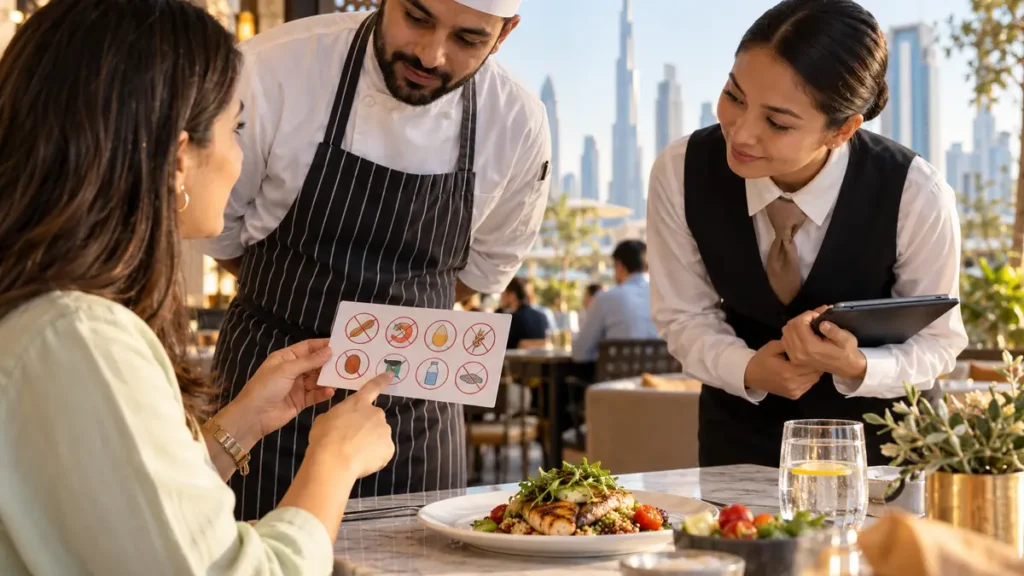
Dining out with a food allergy requires more than removing a visible ingredient from the plate. An allergen can be present in a sauce, garnish, marinade, cooking oil or shared utensil, and cross-contact can occur even when a dish does not normally contain it. The safest approach is to communicate early, ask precise questions and be prepared not to order when the restaurant cannot give a confident answer.
Dubai Municipality’s consumer dining-out food-safety advice tells customers to inform the server about allergies to avoid the risk of contaminated food. This is the starting point, not the final check. People with diagnosed allergies should follow their clinician’s individual advice and carry prescribed emergency medicine as directed.
A practical allergy conversation
| Stage | What to communicate | What to ask |
|---|---|---|
| Before booking | Name the specific allergen and severity | Can the kitchen discuss ingredients and cross-contact? |
| At the table | Repeat the allergy before ordering | Who will confirm the dish with the kitchen? |
| Before eating | Check that the dish is the allergy order | Were sauces, garnishes and sides checked? |
| If uncertain | Do not taste to test | Can a simpler verified option be prepared? |
| If symptoms begin | Follow the emergency plan immediately | Who is calling emergency services? |
Use the name of the allergen, not a vague preference
Say “I have a severe allergy to peanuts” rather than “no nuts” or “I do not like nuts.” If several foods are involved, provide a short written card in a language the restaurant can understand, but also speak to the server. A card is a communication aid; it is not a guarantee that the kitchen can safely prepare the meal.
Ask whether the ingredient appears in sauces, spice blends, desserts, bread, drinks and garnishes. The UAE packaged-food rules guide explains why a label can be useful for sealed products, but a restaurant recipe and shared preparation area require a different conversation. For seafood concerns, the Dubai seafood guide helps distinguish freshness and temperature issues from an immune-system allergy.
Cross-contact is different from an ingredient substitution
Removing cheese, nuts or a garnish after plating does not make a contaminated dish safe. Cross-contact can happen through a fryer, grill, knife, chopping board, blender, scoop, glove or storage container. Ask whether the kitchen uses dedicated equipment or a documented cleaning process. If staff cannot verify the answer, select another dish or restaurant rather than relying on reassurance without evidence.
Buffets deserve particular caution because guests may move serving tools between dishes and labels can be separated from the correct tray. The raw-chicken safety guide discusses cross-contamination from harmful microorganisms; allergen cross-contact is a different hazard, but the same principle of separating tools and surfaces is useful.
Choose simpler meals when information is limited
A dish with fewer components may be easier for the kitchen to verify, but simple appearance is not proof. Plain rice can be cooked in stock; grilled food can share a surface; salad dressing can contain sesame, dairy or nuts. Ask about the full preparation and request that unverified sauces and garnishes be omitted before cooking, not scraped off later.
- Call ahead during a quiet period when possible.
- Name every diagnosed allergen clearly.
- Ask about ingredients, shared fryers and preparation tools.
- Repeat the allergy when ordering and when the dish arrives.
- Keep prescribed medicine with the person, not in a parked car.
- Do not taste a dish to test whether it is safe.
- Leave and follow the emergency plan if symptoms develop.
Delivery orders need the same conversation
An app note can be missed, shortened or separated from the kitchen ticket. Contact the restaurant directly before ordering and ask whether it can accept the allergy request. When the food arrives, check the label, packaging and entire order. Do not assume a sealed bag confirms allergen control.
Temperature safety still matters. The cooked-food cooling guide explains how to handle leftovers, while the refrigerator food-safety guide covers cold storage. These controls do not remove an allergen, so store an allergy-safe meal separately and label it clearly.
Know when to treat the situation as an emergency
Allergic reactions can progress quickly and may involve breathing difficulty, throat or tongue swelling, widespread hives, vomiting, dizziness or collapse. Follow the person’s medical emergency plan and use prescribed medicine exactly as trained. Call the UAE emergency service without waiting to see whether a serious reaction resolves on its own.
The UAE emergency-numbers guide helps residents and visitors save the correct contacts. The Dubai consumer complaint guide explains how to preserve receipts and evidence for later reporting, but emergency care comes first.
Questions people often ask
Should I tell Dubai restaurant staff about a food allergy?
Yes. State the specific allergy before ordering and repeat it when the dish arrives. Dubai Municipality advises diners to alert the server.
Is removing the allergen from a finished plate enough?
No. The remaining food may already be contaminated. A safe alternative must be prepared using suitable ingredients and controls.
Can I rely only on a delivery-app allergy note?
No. Contact the restaurant directly and confirm that it can handle the request, then check the order when it arrives.
Does a separate fryer matter?
It can. Shared oil and equipment may transfer an allergen, so ask the restaurant how the relevant dish is prepared.
What should I do if a serious reaction starts?
Follow the person’s emergency plan, use prescribed emergency medicine as trained and call emergency services immediately.


