
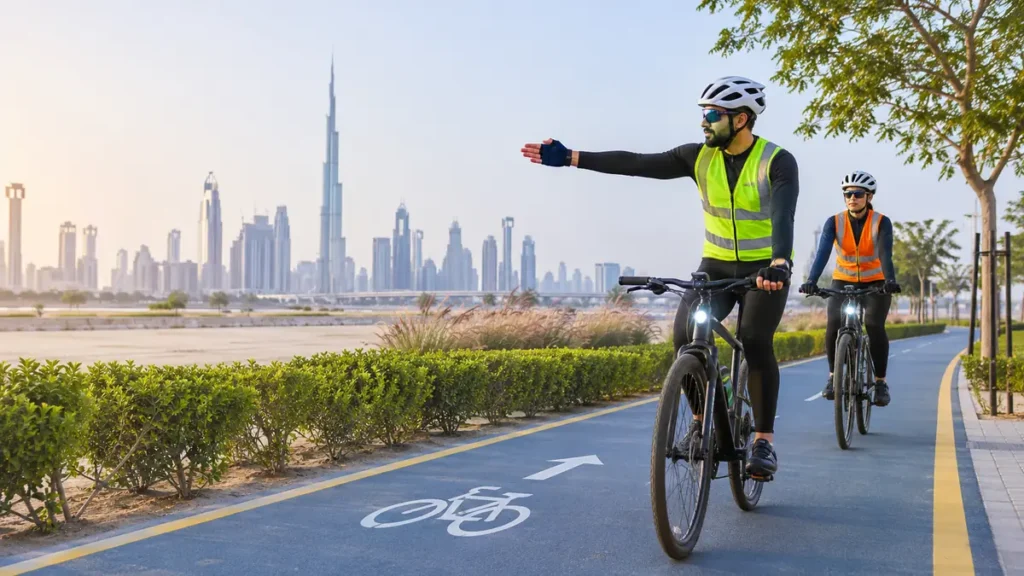
New federal traffic regulations taking effect on 1 January 2027 include clearer obligations for bicycle riders across the UAE. The rules matter whether a bicycle is used for exercise, commuting or a short neighbourhood trip. They are designed around predictable movement: a rider should be visible, stay in control and avoid carrying out actions that create sudden risk for pedestrians or vehicles.
The official Emirates News Agency summary of the new traffic regulations confirms the January start date and the broader safety framework. Emirate-level authorities can impose route, permit or equipment requirements, so riders should also follow local signs and current instructions.
Core bicycle duties
The regulations require cyclists to wear protective helmets and ride one behind another unless circumstances require otherwise. Riders must keep their hands on the handlebars, with one-handed riding allowed when giving a hand signal. Dangerous weaving, unsafe speed and riding in a way that endangers the public are prohibited.
| Action | General rule | Practical meaning |
|---|---|---|
| Helmet | Required | Wear a correctly fitted helmet for every ride |
| Group position | Ride single file unless circumstances require otherwise | Do not spread across a narrow track or traffic lane |
| Hands | Keep hands on handlebars | Remove one hand only when signalling |
| Passengers | Only where the bicycle is equipped for a passenger | Do not improvise a seat on the frame or rack |
| Towing | Do not use another vehicle to tow or propel the bicycle | Never hold onto a moving car or motorcycle |
Passengers and carrying loads
A cyclist may not carry a passenger unless the bicycle is designed and equipped for that purpose. A rear rack is not automatically a passenger seat. The equipment needs to support the rider safely without interfering with steering, braking or balance.
Loads should be secured so they do not swing into the wheel, block lights or widen the bicycle unexpectedly. Parents carrying children should use age-appropriate equipment, follow its weight limits and check that straps and foot protection are correctly positioned. For car journeys before a cycling outing, review the separate UAE child car-seat guide.
Hand signals and predictable movement
A hand signal should communicate an intended turn or lane movement early enough for others to react. Look behind, make the signal clearly, return the hand to the handlebar and move only when the path is safe. A signal does not create automatic priority.
- Check behind before changing direction
- Signal clearly without swerving
- Make eye contact where possible at crossings
- Slow before sharp turns and crowded areas
- Use lights and reflective clothing in low visibility
- Do not use a phone while the bicycle is moving
The same principle—communicate early and remain predictable—is explained in our Al Qudra Cycle Track guide and Dubai Ride route guide.
Where cyclists may ride
Use designated cycling tracks and obey signs for direction, speed and crossing behaviour. Local rules can restrict bicycles on specific roads, footpaths or pedestrian areas. A smooth, empty-looking road is not automatically an authorised cycling route.
Before a new route, review the map and identify safe access points rather than riding along a high-speed road to reach the track. The broader UAE driving-licence update is useful for motorists sharing the road with cyclists, while the driver-fatigue guide explains another part of the same 2027 road-safety framework.
Pre-ride equipment check
Before setting off, squeeze both brakes, inspect tyre pressure and condition, confirm wheels are secure and test the lights. The saddle and handlebars should not move under normal force. Carry water, identification and a charged phone, but mount or store the phone rather than holding it while riding.
If a collision or dangerous incident occurs, move out of immediate danger where possible and request help. Save the contacts in the UAE emergency numbers guide. If an official traffic record or fine later needs checking, the Dubai traffic-fine review guide explains how to preserve evidence and use official channels.
Questions people often ask
When do the new UAE bicycle rules take effect?
The federal implementing regulations are scheduled to take effect on 1 January 2027. Local route and safety rules already apply and must also be followed.
Is a helmet required for cycling in the UAE?
Yes. The new federal regulations require bicycle riders to wear protective helmets. Use one that fits correctly and fastens securely.
Can two cyclists ride side by side?
The general rule is to ride one behind another unless circumstances require otherwise. Always follow local signs and avoid blocking a track or creating danger.
Can I carry a passenger on a bicycle?
Only if the bicycle is equipped for carrying that passenger. Do not use a rack, frame or improvised seat as a substitute for approved passenger equipment.
Can a cyclist hold onto a moving vehicle?
No. Riders must not use another vehicle to tow or propel the bicycle. The practice removes control and creates a serious collision risk.


