
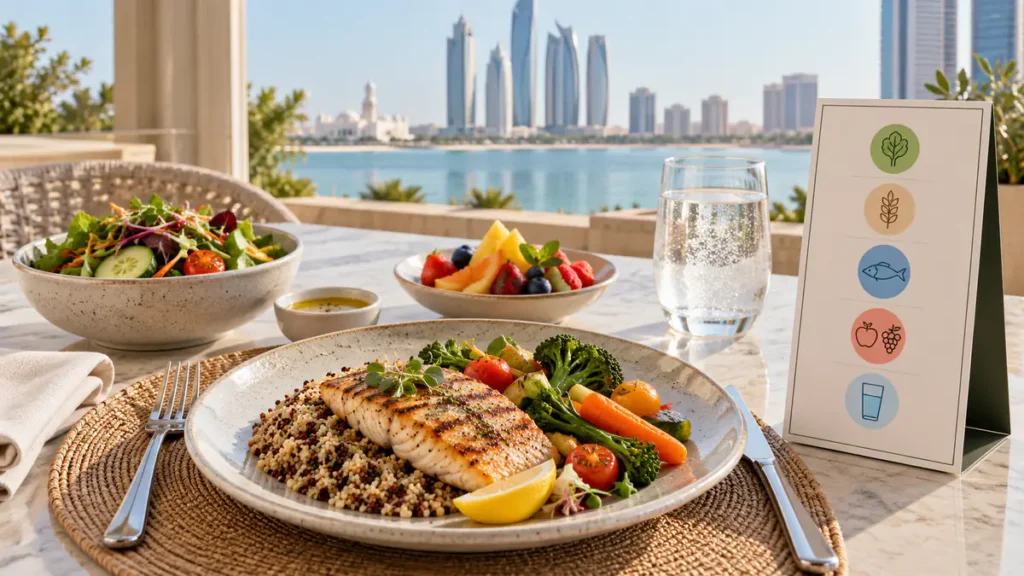
Healthy-menu requirements taking effect across Abu Dhabi’s tourism and hospitality dining sector from October 2026 are intended to make balanced choices easier to identify. For diners, the useful change is not a promise that every dish is automatically healthy. It is a clearer set of cues: calorie information, designated healthier options and the official SEHHI identity on meals that meet the programme’s nutritional criteria.
The authoritative reference is the Abu Dhabi Public Health Centre SEHHI programme. ADPHC explains that the SEHHI logo identifies meals that are lower in fat, sugar and salt and higher in fibre, while its Calories on the Menu programme helps consumers compare energy values. Diners should use those signals together with allergies, portion size and individual medical advice.
What changes on a menu
Reported implementation from 1 October requires licensed hospitality venues to provide qualifying healthy choices across main adult menu sections and a substantial share of children’s choices. The practical result should be that a diner can find a balanced option without searching a separate token page or asking the kitchen to invent one.
The UAE food-label reading guide explains how calories, serving size and ingredients answer different questions. A low-calorie number does not reveal allergens, sodium or whether a dish meets a person’s clinical needs.
| Menu signal | What it helps show | What to check next |
|---|---|---|
| SEHHI logo | Dish meets programme criteria | Ingredients and personal allergens |
| Calories | Energy for the stated serving | Portion size and shared dishes |
| Healthy children’s choice | More balanced child-focused option | Drink, side and dessert combination |
| Customisation note | Possible sauce or side change | Whether nutrition information changes |
How to read calorie information
Compare like with like. A starter-sized dish and a sharing platter should not be judged by the same total. Ask whether the number covers the complete plate, including dressing, rice, bread or sauce. If the restaurant changes a side or portion, the displayed figure may no longer describe the meal delivered.
People managing food allergies should use the UAE dining allergy guide and speak clearly to staff; a health logo is not an allergen-free mark. The food date-label guide is helpful for packaged items but does not replace restaurant allergen questions.
A practical ordering method
- Identify the SEHHI-marked or designated healthier options first.
- Compare the stated serving and calorie information.
- Ask what is included in sauces, dressings and side dishes.
- State allergies directly and request confirmation from the kitchen.
- Choose water or an unsweetened drink when it suits your needs.
- Stop at a comfortable portion rather than treating the plate as a target.
Healthy does not mean identical for everyone
Athletes, children, pregnant diners and people managing diabetes, kidney disease or food allergies can have different requirements. Menu labelling supports an informed choice; it is not a personalised prescription. When dietary treatment is involved, follow a qualified clinician or dietitian rather than a restaurant symbol alone.
Parents can adapt the planning ideas in the school canteen choices guide and the school lunch and allergy guide. The same principle applies: consider the full meal, not a single item in isolation.
When the information seems unclear
Ask staff which serving the calorie number describes, whether the SEHHI mark applies to the standard recipe and how a requested substitution affects it. If an allergy or food-safety concern is involved, explain the issue before ordering and do not accept a vague assurance.
The food-safety reporting guide shows the type of evidence that is useful in Dubai; in Abu Dhabi, use the responsible local authority channel. Keep the receipt and note the venue, time, dish and specific concern.
The strongest benefit of the October change is comparability. Diners can use recognised criteria and clearer information, while still making a choice that fits appetite, health and the occasion.
Questions people often ask
What is the SEHHI logo?
It is the Abu Dhabi Public Health Centre mark used to identify food choices that meet the programme’s nutrition criteria, including limits on fat, sugar and salt and attention to fibre.
Does a SEHHI meal contain no calories?
No. Every meal provides energy. The mark identifies a choice meeting defined criteria; calorie information helps compare the stated servings.
Are the new menu rules only for adults?
No. The implementation also covers children’s menus, with healthier options expected to form a meaningful share of child-focused choices.
Does a healthy-menu symbol mean allergen-free?
No. Allergies must be discussed separately with staff, including cross-contact and every sauce, garnish and side.
What if I customise the dish?
Ask whether the displayed nutrition information still applies. Adding, removing or replacing ingredients can change calories and other nutrition values.


