
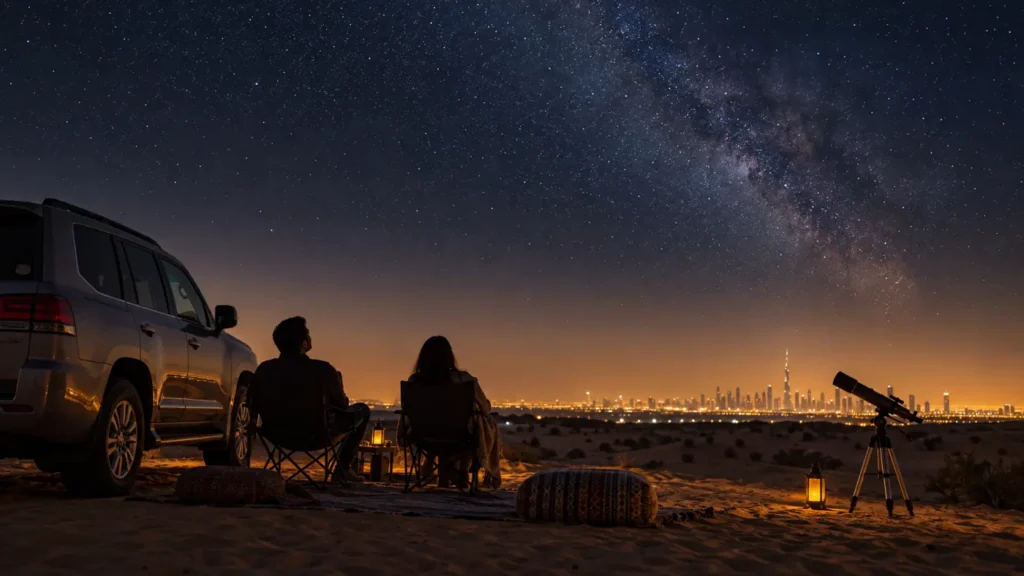
Dubai’s bright skyline can make the night sky feel out of reach, but a little planning makes an evening of stargazing more enjoyable and safer. This guide is for residents and visitors who want to look up after sunset without treating a random social-media post as a forecast, an event ticket or permission to enter a remote area. September can still be warm, so the best plan is a short, comfortable outing built around the current conditions rather than an all-night expedition.
Choose the kind of evening you actually want
There are two sensible ways to enjoy the sky. An organised observation session gives beginners equipment, guidance and a controlled meeting point. The other is a self-guided evening in a legal, familiar outdoor location with an open horizon. For the first option, check the current calendar and booking terms with the Dubai Astronomy Group. For the second, keep the aim modest: identify a few bright objects, enjoy the change of pace and leave while everyone is still comfortable.
A darker location is not automatically a better one. A car park beside a busy road, a construction edge, private land and an unmarked desert track can turn a simple outing into a poor decision. If you are considering a desert location, start with the practical safety advice in our Dubai desert trip safety guide and use an established route rather than improvising after dark. Families may prefer a venue-led programme, where toilets, parking and staff are easier to find.
Plan around the conditions, not a promise
Cloud, haze, humidity and city light all affect what you can see. Check the same-day forecast, sunset time and the organiser’s latest update before leaving. Astronomy listings may describe a planet, moon phase or meteor shower, but visibility is never guaranteed. Avoid wording your own plan as “we will see” a particular object; say “we will try to observe” it. That small change keeps expectations realistic, especially with children.
| Planning point | Why it matters | Best approach |
|---|---|---|
| Official programme | Times and entry arrangements can change | Confirm with the organiser on the day |
| Location | Darkness can create access risks | Use a lawful, familiar meeting place |
| Weather and haze | Clear skies affect visibility | Check shortly before departure |
| Return journey | Late driving needs planning | Agree the route and driver before leaving |
What to take for a comfortable short session
- A charged phone, power bank and a torch with a dim or red-light setting.
- Water, a light layer and closed footwear suitable for the ground.
- A simple sky-map app used only after your eyes adjust to the dark.
- Identification, a payment method and any confirmed event ticket.
- A plan for children to stay beside an adult rather than wandering in low light.
Give your eyes time to adapt. Keep phone brightness low, avoid repeated flash photography and look for open sections of sky rather than trying to photograph every object. A compact evening can sit nicely beside a daytime outing from our Dubai cultural day-out guide; it does not need to compete with a full itinerary. If you are driving from central Dubai, factor parking and the walk back to the car into the end of the evening instead of treating the observation time as the final task.
Make the journey home part of the plan
Decide who is driving, where the group will meet if separated and when you will leave before the session begins. If the forecast becomes poor or the venue changes its arrangements, choose a relaxed alternative rather than continuing into an unfamiliar area. Visitors using public transport should check the route home in advance through the Dubai Metro Nol guide. For emergencies, keep the details in our UAE emergency numbers guide saved on the phone.
Questions people often ask
Do I need a telescope for stargazing in Dubai?
No. Bright objects and constellations can be enjoyed with the naked eye; an organised session is the easiest way to try equipment before buying anything.
Is a desert location always necessary?
No. It can reduce city light, but safety, legal access and a reliable return journey matter more than chasing the darkest possible spot.
What time should I arrive at an organised event?
Use the arrival time supplied by the organiser, not a time copied from an older listing. Allow extra time for parking and registration.
Can children join a stargazing evening?
Many venue-led events welcome families, but check the organiser’s age guidance, duration and facilities before booking.
What if the sky is hazy or cloudy?
Follow the organiser’s update. A programme may continue with a talk or be rescheduled, while a self-guided outing is usually best postponed.


