
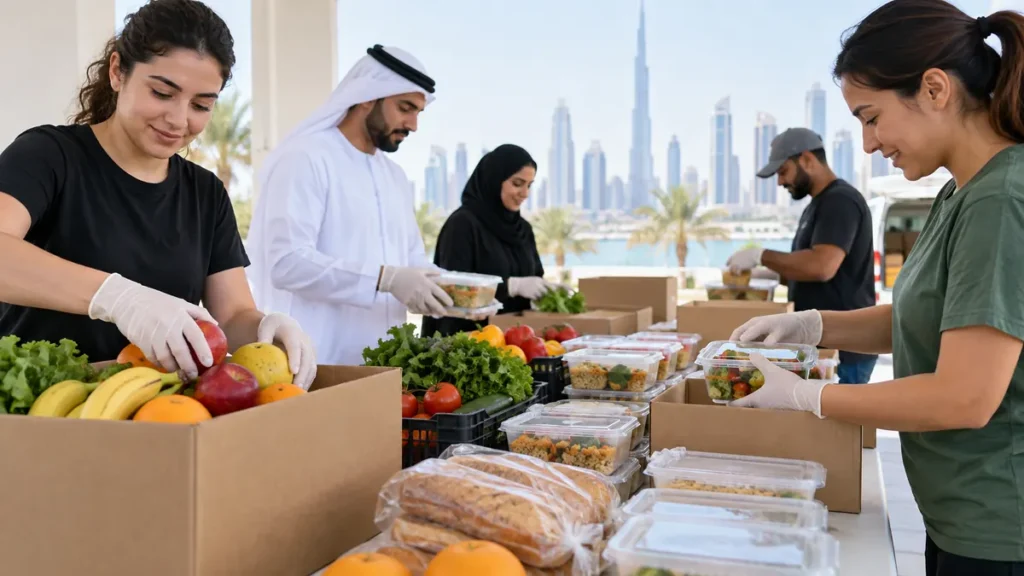
Surplus food can support people and reduce waste only when it remains safe, traceable and suitable to distribute. Good intentions do not make food safe after poor handling, uncertain storage or extended time at room temperature. Dubai households and event organisers should plan donations before food is prepared, use an authorised route and be ready to discard anything that cannot be verified.
Dubai Municipality’s information about the Emirates Food Bank explains its role in collecting and distributing suitable surplus food through approved partnerships, while the Municipality’s official safe-food-systems page stresses that food-waste reduction must remain connected to food safety. Before donating, ask the receiving organisation what it accepts, how it wants food packaged and when it can collect or receive it.
Decide suitability before offering food
Commercially sealed, in-date products are usually easier to assess than a tray of cooked food with an uncertain history. Check packaging integrity, date marks and storage directions. Do not donate food from a recalled batch, leaking container, swollen can or damaged seal. The Dubai food-recall guide explains how to identify a product and follow an official notice.
For cooked food, document preparation time and how hot or cold holding was maintained. Food that has already been served to individual plates, left on a dining table or handled by unknown people should not be repacked for donation. Use the cooked-food cooling guide to understand why large warm containers are difficult to cool safely.
Protect temperature and separation
Keep chilled food cold and hot food under controlled conditions required by the receiving programme. Never use a car boot as temporary storage in Dubai heat. Separate raw items from ready-to-eat food and protect allergen-sensitive meals from cross-contact. Clean, food-grade, leak-resistant containers are essential; reused packaging should be accepted only if the programme permits it and it can be hygienically prepared.
Label information should be truthful and useful: identify the food, preparation or opening time where relevant, storage condition and known ingredients or allergens. Do not guess. If a mixed dish cannot be described reliably, ask the receiving organisation whether it can be accepted.
| Food type | Check before donation | Do not donate when |
|---|---|---|
| Sealed packaged food | Date, seal and storage condition | Damaged, recalled or out of condition |
| Fresh produce | Clean, sound and free from spoilage | Mouldy, leaking or badly bruised |
| Cooked food | Known preparation and temperature history | Time or handling cannot be verified |
| Chilled or frozen food | Cold chain has remained intact | Thawed or held warm unexpectedly |
| Allergen-sensitive food | Ingredients and separation are reliable | Cross-contact information is unknown |
Food-donation checklist
- Contact an authorised recipient before packing the donation.
- Follow its accepted-food, quantity and timing rules.
- Use clean food-grade containers with secure lids.
- Protect the cold or hot chain during handover.
- Keep a simple record of what was given and when.
Plan portions so donation is not an afterthought
Better forecasting prevents surplus before it occurs. The family meal-prep guide helps households portion ingredients, and the Dubai buffet guide explains why food on a self-service line needs careful control. For school meals, use disciplined packing, allergen and temperature checks.
If food will be retained at home instead, use the home-freezer guide and the rice and leftovers guide. Storage guidance cannot repair food that was already mishandled.
When a suspected safety issue involves a business or distributed product, keep factual details and follow the official complaint-preparation guide. Do not hand questionable food to another person simply to avoid waste.
The safest donation is planned, accepted and transferred under controlled conditions. When there is genuine uncertainty, protect the recipient and do not donate the item.
Questions people often ask
Can I donate cooked food left on my dining table?
Do not donate it when the time and temperature history is uncertain or it has already been served.
Should I contact the recipient before arriving?
Yes. Confirm accepted foods, packaging, quantity, timing and the approved handover point.
Can frozen food be donated after partial thawing?
Do not assume it is suitable. Explain the temperature history and follow the receiving organisation’s safety decision.
What information belongs on a prepared-food label?
Include an accurate food name, relevant preparation or opening time, storage condition and known ingredients or allergens.
Is reducing food waste more important than discarding uncertain food?
No. Food-safety protection comes first; uncertain or mishandled food should not be passed to recipients.


