
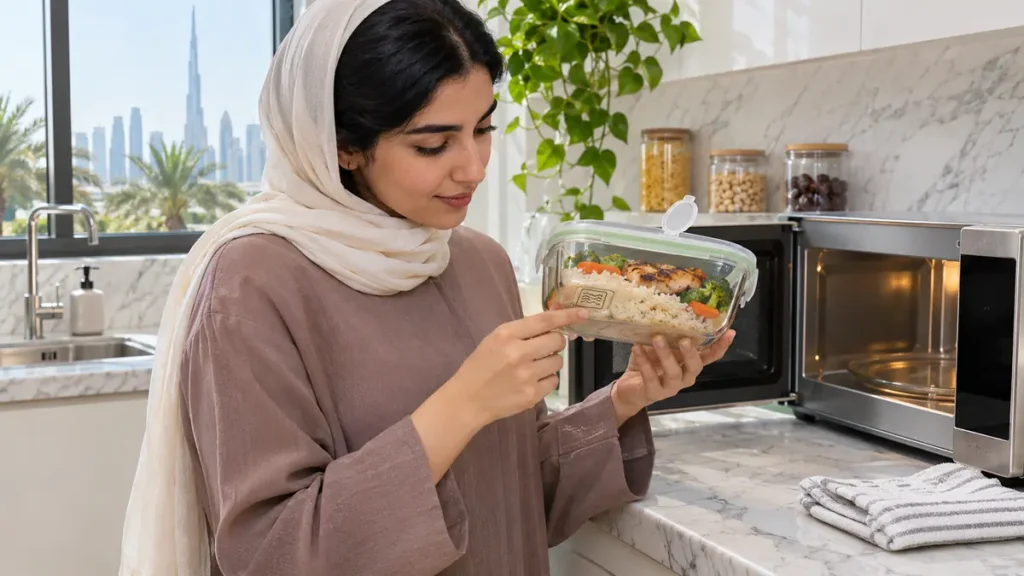
A container that holds food safely in the refrigerator is not automatically suitable for a microwave. Heat can warp some plastics, loosen seals, create pressure under a closed lid or cause a cold-looking dish to contain dangerously hot spots. Safer reheating starts with the label and the appliance instructions.
Dubai Municipality’s official consumer food-safety portal provides guidance on household storage, preparation and safe handling. Use it together with the food label, container manufacturer’s directions and microwave manual.
Check the container before heating
| Container or package | Action | Reason |
|---|---|---|
| Microwave-safe glass | Use as directed and inspect for cracks | Designed for controlled reheating |
| Labelled microwave-safe plastic | Follow time, temperature and lid directions | Suitability has conditions |
| Metal or foil | Do not use unless appliance instructions permit | Can spark or damage the oven |
| Takeaway packaging | Transfer unless clearly labelled suitable | Heat resistance may be unknown |
| Damaged container | Replace it | Cracks and warping trap residue |
Look for clear instructions
“Food safe,” “freezer safe” and “dishwasher safe” do not mean the same thing as microwave safe. Check the base, lid and removable seals separately. A glass bowl may be suitable while its decorative lid is not. If the label is missing or unclear, transfer food to a known microwave-safe container.
- Inspect the container for cracks, staining and warping
- Remove metal clips, foil and unsuitable cutlery
- Loosen or vent the lid as directed
- Use a cover that allows steam to escape
- Stir or rotate food during reheating
- Allow the stated standing time
- Use dry oven gloves and open lids away from the face
For packaged food, the Dubai grocery guide explains why storage instructions matter. Our canned-food guide covers metal packages that must never go straight into a microwave.
Prevent steam burns and pressure
A tightly sealed lid can trap steam. Follow the container instructions for venting, and never force open a swollen package while it is hot. Lift the far edge of the lid first so steam escapes away from hands and face. Liquids and foods with dense centres may continue heating after the microwave stops.
Reheat food evenly
Microwaves can leave cold spots, especially in thick meals, rice, sauces and mixed dishes. Divide large portions, spread food evenly, stir midway and follow the recommended standing time. The food thermometer guide explains measurement, while the safe thawing guide covers frozen meals.
Do not repeatedly warm and cool a family-size portion. Remove only what will be eaten and keep the rest properly chilled. Use the refrigerator guide and power-cut guide when temperature history is uncertain.
Clean and replace containers
Wash all parts according to their instructions, including valves, seals and corners. Let them dry fully before storage. Replace containers that remain greasy, smell strongly, crack, cloud or warp. Reusing a takeaway tray indefinitely is not a sensible substitute for a container designed for repeated heating.
When a packaged product or container is recalled, stop using the identified model or batch. The UAE recall guide explains how to verify a notice. For takeaway leftovers, use the Dubai takeaway guide.
Questions people often ask
Does food-safe mean microwave-safe?
No. The container must specifically permit microwave use under the stated conditions.
Should a microwave lid be completely closed?
Follow the product instructions. Most reheating needs a vent or loose cover so steam can escape.
Can metal takeaway containers go in a microwave?
No, unless the microwave and package instructions explicitly permit that specific use.
Why should food be stirred during reheating?
Stirring redistributes heat and reduces cold spots in mixed or dense food.
When should a reusable container be replaced?
Replace it when cracked, warped, badly stained, persistently smelly or no longer closing correctly.


