
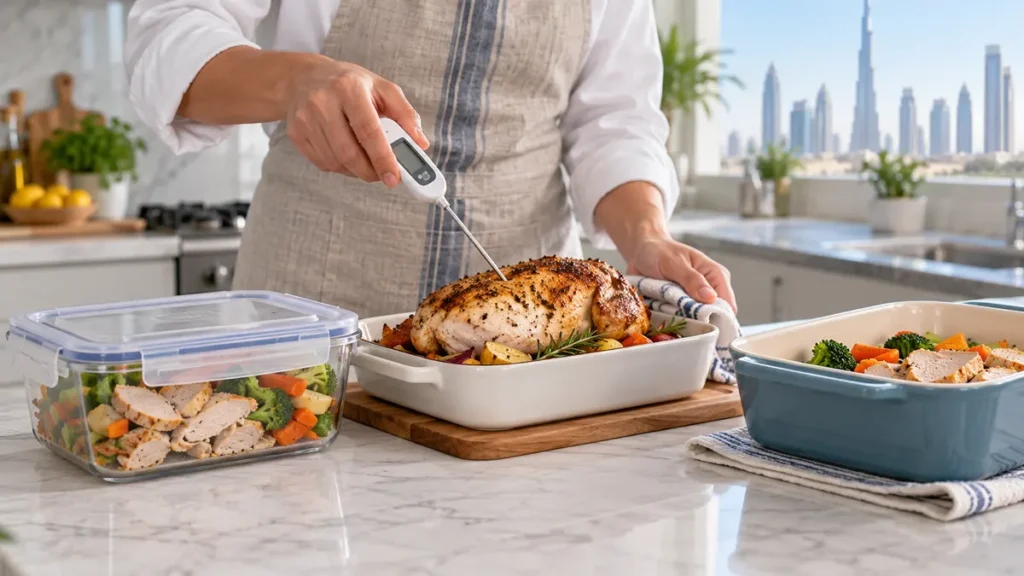
A food thermometer removes guesswork from home cooking. Colour, steam and cooking time can be misleading, especially with thick meat, reheated leftovers and batch-cooked food. The goal is not to chase a single number for every dish; it is to measure the coldest, thickest part correctly, follow the product or official guidance, and prevent the probe from carrying raw-food contamination into ready-to-eat food.
Dubai Municipality’s official kitchen and food-preparation safety guidance emphasises cleanable equipment, hygienic handling, suitable cold storage and safe working practices. Home cooks can apply the same principles: keep tools clean, separate raw and cooked food, control time and temperature, and discard food when its safety cannot be established.
Choose the right thermometer
| Type | Useful for | Main limitation |
|---|---|---|
| Digital instant-read probe | Quick checks in most foods | Not normally left in during cooking |
| Oven-safe probe | Roasts and long cooking | Must be positioned before cooking |
| Infrared thermometer | Surface checks | Does not prove the centre is safe |
| Fridge thermometer | Monitoring appliance temperature | Does not measure food core temperature |
For most households, a thin digital probe is the most versatile choice. Check that the display is readable and that the probe can reach the centre of the food. An infrared device only reads the surface, so it cannot replace an inserted probe for chicken, a thick burger or a casserole.
How to take a useful reading
- Wash hands before handling ready-to-eat food.
- Clean and sanitise the probe before and after each use.
- Insert it into the thickest part, away from bone and the pan.
- Check more than one point in an uneven or large item.
- Wait for the display to stabilise.
- Follow the food’s official or manufacturer cooking guidance.
- Record the result if preparing food for a vulnerable person.
A bone, stuffing pocket or hot pan can distort the reading. For thin food, insert the probe from the side so more of the sensing area sits inside the centre. Never use the same uncleaned probe on raw chicken and a salad. The home kitchen pest-prevention guide explains why clean storage and surfaces matter alongside temperature control.
Cooking is only one part of safety
After cooking, serve promptly or keep the food appropriately hot. If saving leftovers, divide a large quantity into shallow containers so heat can leave more quickly, then refrigerate without unnecessary delay. Do not place a very large, tightly covered hot pot in the fridge and assume the centre will cool safely.
The Dubai freezer guide covers freezing and defrosting, while the UAE food date-label guide distinguishes use-by and best-before information. A safe cooking reading does not extend a use-by date or make spoiled food acceptable.
Reheating leftovers
Reheat only the portion needed and make sure the centre is fully hot, not merely the edge. Stir foods such as soup, rice and curry so cold pockets are exposed, then check again. Microwave standing time matters because temperature continues to equalise after heating. If food has been left out too long, reheating is not a reliable way to reverse every hazard.
For packed meals, the UAE school lunchbox guide explains cold-pack preparation. The Dubai food-label guide helps follow storage and preparation instructions that are specific to the product.
Check the thermometer itself
A damaged, slow or inaccurate thermometer creates false confidence. Follow the manufacturer’s calibration check and battery instructions. Store the probe protected from bending and moisture. If a test reading is clearly implausible and cannot be corrected, replace the device.
When food from a restaurant or shop appears unsafe, keep the receipt and details and use the Dubai food-safety concern guide. For a power interruption that affects refrigerated food, the household emergency guide can support a simple outage checklist.
Questions people often ask
Where should I insert a food thermometer?
Measure the thickest or coldest part, avoiding bone, the pan and obvious pockets of fat. Check several points in large or uneven food.
Can an infrared thermometer check cooked chicken?
It only measures the surface. Use an inserted probe to check the internal temperature of thick foods such as chicken.
Should I wash the probe between readings?
Yes. Clean and sanitise it between raw and cooked foods and whenever moving between items to prevent cross-contamination.
Can reheating make food safe after it was left out too long?
Not reliably. Some hazards are not removed by reheating, so discard food when time and temperature control cannot be confirmed.
How do I know whether my thermometer is accurate?
Use the manufacturer’s calibration-check method and replace the battery or device if readings remain implausible or unstable.


