
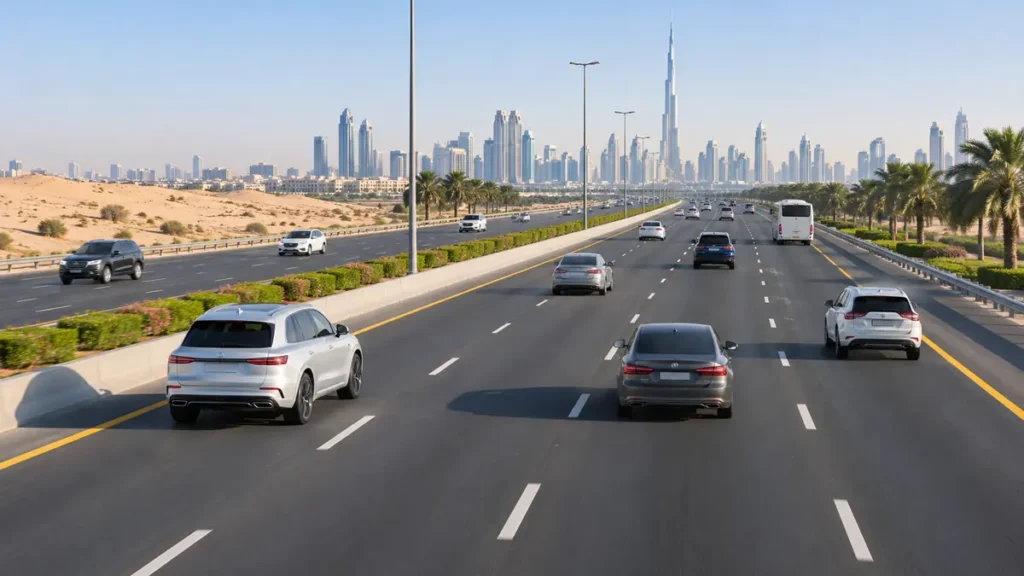
Overtaking is not simply moving into a faster lane. A driver must have a clear view, enough space, lawful road markings and time to complete the move without forcing another road user to brake or change direction. On multi-lane UAE roads, predictable lane discipline is essential because closing speeds can be high.
Abu Dhabi Police’s official lane-safety guidance warns against overtaking on the right and tells slower drivers to keep right so vehicles with priority can pass from behind or the left. Those principles must be followed together with current road signs and instructions from police and the competent road authority.
A safe overtaking sequence
| Stage | Driver check | Reason |
|---|---|---|
| Observe | Road signs, markings, mirrors and blind spot | Confirms whether the move is permitted and clear |
| Signal | Indicate early without assuming priority | Warns nearby road users |
| Move | Change lane smoothly with a safe gap | Avoids forcing another driver to react |
| Pass | Maintain control and the posted speed | Prevents an illegal or unstable manoeuvre |
| Return | Signal and leave a safe distance | Avoids cutting in front of the passed vehicle |
Pass from the correct side
The established UAE traffic framework requires overtaking a vehicle travelling in the same direction from the left, with limited circumstances described in the executive rules. A driver should not use the hard shoulder, bus lane or a closed lane to get around traffic. Road signs and lane arrows always matter.
Do not confuse a lane that happens to move faster with permission for an aggressive pass. If traffic is dense, maintain your lane and spacing instead of weaving. The Dubai speed-limit changes guide explains why current signs, not memory, control the maximum speed.
- Read signs and road markings before considering a pass.
- Check mirrors and the blind spot immediately before moving.
- Signal early but wait until a safe gap exists.
- Never exceed the posted limit to complete an overtake.
- Do not use the hard shoulder as a passing lane.
- Leave a safe gap before returning to the original lane.
- Cancel the manoeuvre when visibility or space becomes uncertain.
When not to overtake
Wait when the road ahead is not clearly visible, a solid line or sign prohibits the move, traffic is approaching, the available gap is small, or the road bends or narrows. Extra caution is needed near crossings, intersections, work zones, emergency scenes and places where pedestrians may appear.
Rain, spray, fog and sand reduce visibility and grip. Follow the UAE rain-driving guide and increase the buffer. A journey delay is safer than a pass made without a reliable view.
Do not pressure the vehicle ahead
Tailgating does not create a safe passing opportunity. Leave a distance that allows you to stop if the leading vehicle brakes. Flashing lights or using the horn aggressively can distract another driver and escalate risk. When a faster vehicle approaches and a safe lane change is possible, remain calm and follow signs rather than competing for position.
If a possible offence is recorded, check the official evidence using the Dubai traffic-fine review guide. The Dubai Police 901 guide explains how to raise a non-urgent concern.
Heavy vehicles, motorcycles and merging traffic
Larger vehicles have longer blind spots and stopping distances. Do not remain beside a truck, and do not return sharply in front of it. Motorcycles can be difficult to judge in mirrors, so check the blind spot carefully. A merging driver should match the flow safely and yield as required; an indicator does not create an automatic right of way.
Keep vehicle documents and maintenance current using the Dubai vehicle renewal guide. For inter-emirate trips, the UAE road-trip checklist helps drivers avoid fatigue and rushed decisions.
After a dangerous incident
Do not chase or confront another driver. Note the location, direction, time and vehicle details only when it is safe. For a collision or immediate danger, use the competent emergency channel and follow police instructions. The UAE emergency numbers guide distinguishes urgent from routine contacts.
Questions people often ask
Which side should a driver normally use to overtake in the UAE?
A vehicle travelling in the same direction should normally be overtaken from the left, subject to road signs and the limited situations described by the traffic rules.
Can I exceed the speed limit while overtaking?
No. Overtaking does not suspend the posted speed limit.
Can the hard shoulder be used to pass slow traffic?
No. The hard shoulder is not an ordinary overtaking lane and should remain available for emergencies and authorised use.
Does signalling give me priority to change lanes?
No. A signal communicates intention; the driver must still wait for a safe and lawful gap.
What should I do if another driver overtakes dangerously?
Avoid confrontation, keep control and create space. Report an immediate danger or collision through the appropriate police channel when it is safe.


