
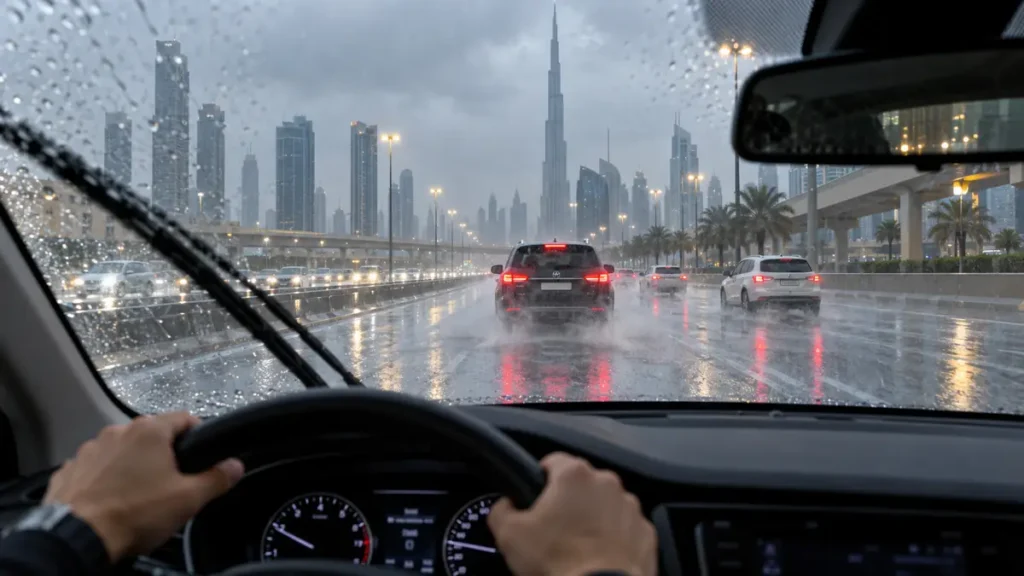
Rain can change a familiar UAE road within minutes. Spray reduces visibility, braking distances increase, lane markings become harder to read and water may collect at a low point that looked normal on the previous trip. The safest response is not a single driving trick; it is a chain of decisions that begins before the engine starts.
Check the National Centre of Meteorology and current police or road-authority messages for the route. Official warnings, closures and temporary controls outrank a navigation app’s suggested shortcut. If the trip is not essential, delaying it can be the most effective safety decision.
Rain-driving decision table
| Hazard | Safer response | Do not |
|---|---|---|
| Reduced visibility | Slow progressively, use normal headlights and increase distance | Use hazard lights while moving as a substitute for visibility |
| Standing water | Turn back or use an officially open route | Enter water of unknown depth |
| Strong wind | Hold the wheel steadily and allow space around large vehicles | Make abrupt lane changes |
| Road closure | Follow police and authority directions | Move cones or follow another car through |
| Vehicle problem | Stop only in a safe place and call the proper service | Stand in a live lane |
Decide whether the journey should begin
Review the whole route, not only conditions outside the window. Rain may be heavier near mountains, an underpass or the destination. Check tyres, wipers, lights and fuel before the season rather than during a storm. Clear mist from the inside of the glass using the vehicle’s ventilation system and know the controls before moving.
The public-warning alerts guide explains how to recognise official instructions. If fog is also expected, the foggy-morning driving guide covers changing electronic speed limits and reduced sight distance.
Make every control input smoother
Reduce speed early, increase following distance and avoid sudden braking, acceleration or steering. Use dipped headlights where required for visibility and keep both hands ready for wind or spray. Do not use cruise control when conditions make consistent traction or visibility uncertain. Watch several vehicles ahead so a queue or large pool of water does not arrive as a surprise.
A speed limit is a maximum under suitable conditions, not a promise that the posted number is safe in heavy rain. The Abu Dhabi E311 speed-limit guide explains the separate need to obey the signed limit; wet conditions may require a substantially lower safe speed.
Never test floodwater with a car
Water can hide a missing surface, strong flow or a depth that reaches critical vehicle components. Turn around when a road is closed or the depth is unknown. Do not follow a larger vehicle through, because its clearance and wake do not prove your route is safe. Never move cones or barriers.
- Check official weather and road alerts before departure.
- Use working wipers and normal headlights for visibility.
- Increase following distance and reduce speed smoothly.
- Avoid cruise control and abrupt manoeuvres.
- Turn back from standing water of unknown depth.
- Keep a charged phone and exact location information available.
- Stop only in a genuinely safe place if visibility becomes unmanageable.
Handle a minor incident without creating another
If the vehicle can move and authorities instruct drivers to use a safer location, follow that direction. Switch on hazard lights when stopped as appropriate, remain away from moving traffic and use the official reporting process. Do not stand between vehicles or take photographs from a live lane.
The Dubai minor-accident guide explains first reporting steps. If the car becomes stranded, the UAE emergency numbers guide helps distinguish an emergency from roadside assistance and prepares the location details responders need.
Plan an alternative to driving
When public transport is operating safely, it may reduce exposure, but the walk and final connection still need checking. The accessible Dubai public-transport guide shows how to inspect every connection. Keep family or colleagues informed of delays rather than trying to recover time on the road. Arriving late is preferable to forcing an unsafe route.
Questions people often ask
Should I use hazard lights while driving in rain?
Use vehicle lights in accordance with UAE rules and official police guidance. Hazard lights can make direction changes harder for others to read and should not replace safe speed, headlights and distance while moving.
Can I drive through water if another car passes?
No. Another vehicle’s clearance does not prove the depth, road surface or flow is safe for your car. Turn back when depth is unknown or the road is restricted.
Is the posted speed limit safe during heavy rain?
It is a legal maximum under suitable conditions. Rain may require a much lower speed, greater distance or postponing the trip while still obeying any temporary limit.
What should I do if visibility becomes extremely poor?
Reduce speed smoothly, avoid sudden lane changes and stop only at a genuinely safe place away from live traffic, following official instructions.
Where should I check UAE rain alerts?
Use the National Centre of Meteorology and official police or road-authority channels for the route. Do not rely on forwarded voice notes or old videos.


