
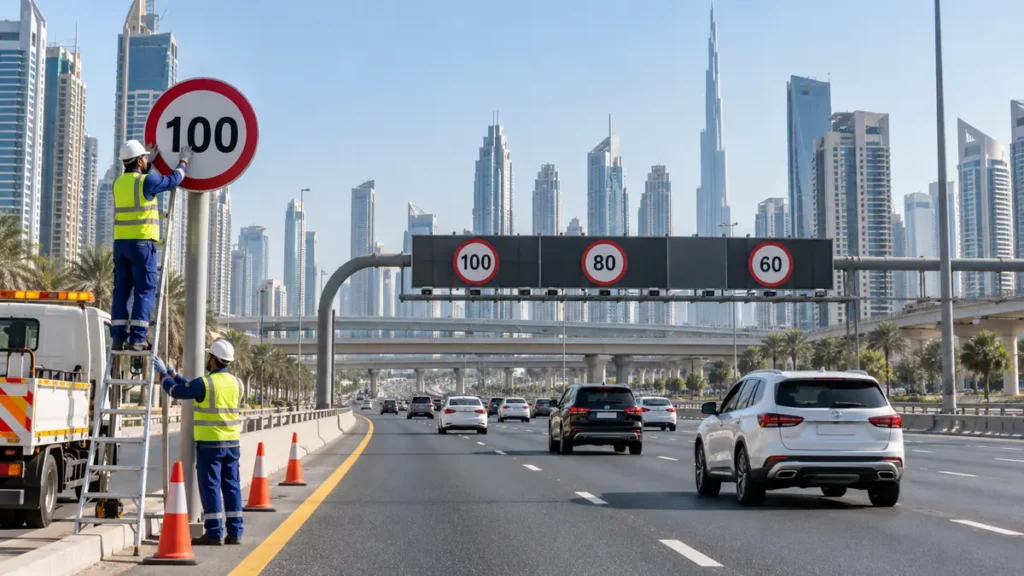
Dubai will revise maximum speeds on five road sections in both directions from 1 November 2026. Three limits will increase and two will decrease. The change is section-specific, so drivers should read the roadside sign in front of them rather than rely on memory, an old navigation display or the limit seen earlier on the same road.
The official RTA announcement says signs will be replaced and speed cameras reprogrammed in preparation for implementation. RTA and Dubai Police based the revisions on engineering studies, traffic conditions and the updated Dubai Speed Management Manual.
Dubai speed-limit changes from 1 November
| Road section | Current limit | New limit |
|---|---|---|
| Al Asayel Street, Oud Maitha Street to Al Meydan Street | 60 km/h | 80 km/h |
| Al Mustaqbal Street, Sheikh Rashid Street to Al Meydan Street | 60 km/h | 70 km/h |
| Latifa bint Hamdan Street, Sheikh Zayed Road to Al Khail Road | 60 km/h | 70 km/h |
| Al Rebat Street, Marrakech Street to Sheikh Mohammed bin Zayed Road | 100 km/h | 90 km/h |
| Sheikh Sabah Al Ahmad Al Jaber Al Sabah Street, 2nd December Street to Khalid bin Al Waleed Street | 80 km/h | 70 km/h |
Why the exact section matters
The announcement does not change every part of each named road. A driver may enter the affected stretch from a connector or leave it before the end point. Watch for the posted transition and adjust progressively. Do not accelerate early toward an increased zone, and do not wait until a camera or gantry to slow for a reduced zone.
The E311 speed-limit guide explains the basic rule: the signed limit applies to the road section. For Dubai journeys, the minor-accident reporting guide is worth saving before travel, not searching for after a collision.
Update routine routes and driver notes
People who use these corridors daily are most likely to drive from habit. Before 1 November, tell other household drivers and fleet staff which sections change. After implementation, remove old printed instructions or route notes. Navigation apps can lag behind a road update, so the physical sign remains the immediate reference.
Visitors collecting a hire car should also understand local road signs and insurance procedures. The Dubai Airport public-bus guide offers a non-driving alternative, while the Metro luggage guide helps travellers decide whether public transport is practical with bags.
- Note the effective date: 1 November 2026.
- Match the road name and the specified start and end points.
- Follow new roadside signs, not a remembered or app-displayed limit.
- Slow before entering a lower-limit section.
- Keep a safe following distance even where the limit increases.
- Brief family, employees or fleet drivers who use the routes.
- Check RTA and Dubai Police channels for later operational updates.
A higher limit is not a target
The maximum does not remove the duty to respond to congestion, visibility, roadworks or weather. Leave more space when traffic is unstable and avoid abrupt lane changes near sign transitions. The UAE rain-driving guide explains why a much lower speed may be necessary in poor conditions. The fog driving guide covers official alerts and changing visibility.
Plan without creating distraction
Review the route before moving. A passenger may check live information, but the driver should not handle a phone. If uncertain, continue safely until a legal place to stop rather than braking suddenly to study a sign or app. The official-alerts guide explains how to distinguish current authority messages from forwarded claims.
Questions people often ask
When do the five Dubai speed-limit changes begin?
RTA states that the revised limits take effect on 1 November 2026 in both directions on the specified sections.
Which Dubai roads get higher limits?
The affected sections of Al Asayel Street rise from 60 to 80 km/h, while Al Mustaqbal Street and Latifa bint Hamdan Street rise from 60 to 70 km/h.
Which roads get lower limits?
The specified Al Rebat Street section falls from 100 to 90 km/h, and the specified Sheikh Sabah Al Ahmad Al Jaber Al Sabah Street section falls from 80 to 70 km/h.
Will navigation apps update immediately?
Do not assume they will. Follow the current roadside sign and any police or RTA instruction even when an app shows an older limit.
Can I drive at the new higher limit before 1 November?
No. Follow the limit currently posted. The revisions apply from the stated effective date and only on the specified sections.


