
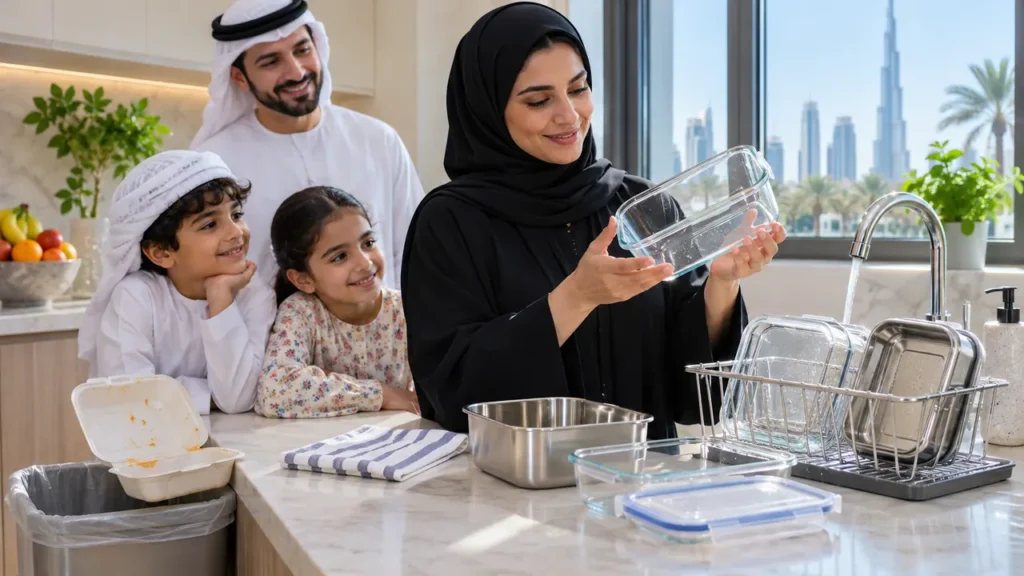
Reusable containers can reduce waste and make meal preparation easier, but only when the product was designed for repeated food contact and remains in good condition. A takeaway box, pizza container or disposable water bottle is not automatically a reusable storage container simply because it can be closed again.
Dubai Municipality’s official consumer-safety clarification says food-contact materials are monitored for compliance and notes that water bottles and pizza containers intended for single use should not be reused. Households should follow the manufacturer’s use, temperature and cleaning instructions rather than relying only on appearance.
Container decision table
| Container condition | Safer decision | Reason |
|---|---|---|
| Designed and labelled for reuse | Use within stated limits | Material and closure suit repeated use |
| Single-use takeaway packaging | Do not convert to long-term storage | It was not designed for repeated cycles |
| Cracked, warped or deeply scratched | Replace it | Damage can hinder cleaning or sealing |
| Unknown microwave suitability | Transfer food before heating | Heat limits are not confirmed |
| Clean glass or suitable metal | Use with the correct lid | Durable when undamaged and used properly |
Choose by task, not by colour
Match the container to the food, temperature and journey. A refrigerator box needs a secure lid and a shape that cools efficiently. A lunch container may need insulation around it. A freezer container needs room for expansion, while a microwave container must be explicitly suitable for that use. The Dubai grocery and storage guide explains how packaging fits into the wider cold chain.
Glass is easy to inspect and does not retain many odours, but it can chip or break. Stainless steel is durable but is not used in a microwave. Reusable plastics vary, so check the label rather than making a rule from the material name alone. Do not use a container for food if it previously held chemicals or non-food products.
Cleaning and inspection routine
- Remove food promptly instead of letting residue dry in corners
- Separate lids, seals and valves according to instructions
- Wash with suitable detergent and clean water
- Rinse grooves and gasket channels thoroughly
- Dry completely before closing or stacking
- Check for cracks, warping, odour and damaged seals
- Replace containers that can no longer be cleaned or closed reliably
Do not trap moisture by closing a container while it is still wet. Removable seals need particular attention because food and water can collect underneath. The refrigerator safety guide helps households avoid overcrowding, while the cooked-food cooling guide explains why shallow portions cool more predictably.
Heating, freezing and leftovers
Loosen or vent lids only as directed and avoid sudden temperature changes that could damage glass. Stir microwave-heated food so cold spots do not remain, and use a clean utensil each time. The food thermometer guide provides practical reheating checks.
For freezing, leave suitable headspace and label the contents and date. Thaw food by a safe method rather than leaving it on a warm counter; the safe-thawing guide covers the main options. A strong container does not make food safe after an uncertain time or temperature history.
When a product concern should be reported
Stop using a container if it cracks during normal use, releases fragments, develops an unusual chemical smell or appears inconsistent with its stated purpose. Keep the packaging, receipt and product details when safe. The Dubai reporting guide explains how to preserve facts and use official channels without making unsupported claims online.
Questions people often ask
Can a takeaway box be reused for meal storage?
Only if it is clearly designed and labelled for reuse. Do not assume single-use packaging is suitable for repeated washing, heating or storage.
Can every plastic container go in a microwave?
No. Use it for heating only when the manufacturer explicitly says it is microwave-suitable and follow the instructions.
When should a reusable container be replaced?
Replace it when cracked, warped, deeply scratched, persistently odorous or unable to close and clean reliably.
Should containers be closed while still damp?
No. Dry the container and removable parts completely before closing or stacking them.
Does a clean container make old leftovers safe?
No. Food safety still depends on the original preparation, cooling, storage time, temperature and reheating.


