
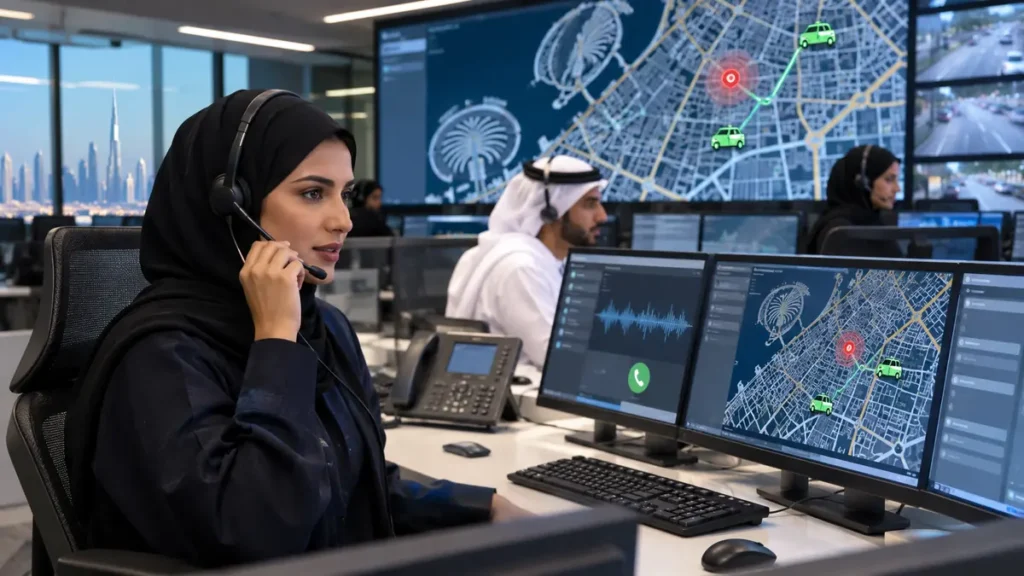
When someone calls 999 in Dubai, the useful information is not a long explanation—it is the exact location, immediate danger, what has happened and how responders can reach the caller. Control-room staff must assess the incident, classify it and coordinate the appropriate response. Clear facts can support that process; guesses, confrontation and repeated calls from an unsafe place can make the situation harder.
Dubai Police’s official Operations Strategy 2033 announcement describes how reports move from the initial call and assessment to classification, dispatch and coordination between control rooms, patrols, field teams and other authorities. It also identifies rapid response, operational readiness, technical support and sustainable communication as priorities, with AI intended to support faster and better-informed decisions.
From call to coordinated response
| Stage | What responders need | Caller contribution |
|---|---|---|
| Initial contact | Location and callback details | State the place first |
| Assessment | Immediate risks and injuries | Describe facts in short sentences |
| Classification | Type and urgency of incident | Answer questions without guessing |
| Dispatch | Best available resource and route | Give access or landmark details |
| Coordination | Updates from teams and caller | Report a material change safely |
The UAE emergency-numbers guide distinguishes police, ambulance and Civil Defence contacts. For a non-urgent Dubai Police matter, the Dubai Police 901 guide explains the alternative channel.
Start with the location
Give the building, street, direction of travel or nearest unmistakable landmark. In a tower, include the floor and unit when safe. On a highway, state the road, direction, exit or kilometre marker. If phone location sharing is requested, follow the operator’s instructions, but keep describing the place because a pin may not identify an entrance, carriageway or access gate.
- Move away from immediate danger when possible
- Call 999 for urgent police assistance
- State the exact location before the background story
- Describe injuries, weapons, fire or traffic danger
- Give a callback number and access instructions
- Do not confront, follow or film for a better view
- Update the operator if the risk or location changes
The Dubai Police Eye guide explains safe observation for non-immediate suspicious activity. After a road incident, the Dubai road-safety guide reinforces the need to move out of live traffic when possible.
Describe actions, not conclusions
Say what you saw or heard: a vehicle stopped across lanes, smoke from a window, a person collapsed or an assault in progress. Avoid assigning motives or identities you cannot know. If a person or vehicle moves, provide the direction and a factual description without pursuing them. Protect children and vulnerable people from public filming.
If messages or online activity are involved, preserve the original material rather than forwarding it widely. The UAE responsible-sharing guide explains why verification and privacy matter.
AI supports, but does not replace, the caller’s facts
Dubai Police says smart technology and operational data are being expanded to support decisions and efficiency. Technology can help analyse and coordinate, but it cannot guarantee that an incomplete or inaccurate report will be interpreted correctly. The operator’s questions are part of assessment, so answer them directly and do not end the call unless instructed or safety requires it.
For a missing item rather than an active danger, use the process in the Dubai lost-and-found guide. Businesses preparing staff procedures can adapt the evidence principles in the UAE incident-response guide.
Questions people often ask
What information should I give first on a Dubai 999 call?
Give the exact location, immediate danger, what happened and a callback number.
What happens after the operator assesses the call?
The incident is classified and the appropriate resources are dispatched and coordinated according to the situation.
Should I call 999 for a routine police question?
No. Use Dubai Police 901 for non-emergency enquiries; reserve 999 for urgent police assistance.
Does Dubai Police use AI in emergency operations?
Dubai Police says AI and smart technologies support operational data use, decisions and response efficiency while personnel remain responsible for the response.
Should I follow a suspect to keep the operator updated?
No. Stay safe, do not confront or pursue, and report only what you can observe without creating another danger.


