
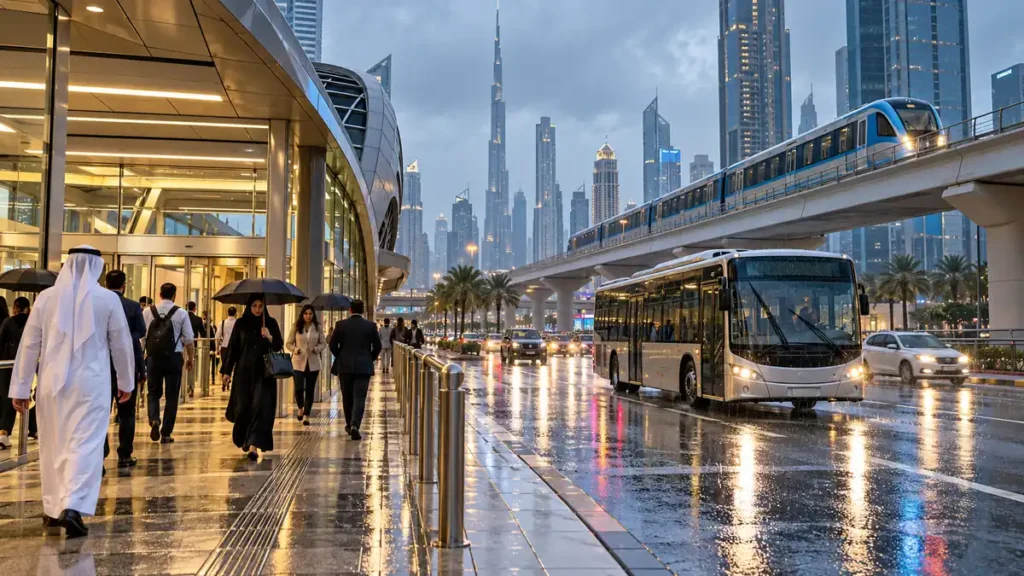
Rain changes a Dubai public-transport journey even when Metro, bus and taxi services continue to operate. The most common problem is not the time spent inside the vehicle; it is the exposed walk to a station, a delayed feeder connection, a crowded pickup point or a final street that has standing water. A resilient plan treats every transfer as a separate decision.
Use the RTA public-transport portal and its official app or alerts for current service information. A saved timetable is useful for normal planning but does not override a live diversion, station instruction or safety closure. Allow more time and avoid a non-essential trip when authorities advise the public to stay off the roads.
Wet-weather transport choices
| Mode | Rain advantage | Check before relying on it |
|---|---|---|
| Metro | Most of the journey is separated from road traffic | Walk to the entrance, lift access and final connection |
| Bus | Wide network and sheltered travel once aboard | Diversions, stop access and road delay |
| Tram | Useful for Marina and JBR corridors | Open-platform exposure and walking transfer |
| Taxi | Direct trip with limited walking | Demand, pickup location and safe road access |
| Marine transport | Useful only when officially operating | Weather suspension and pier access |
Start with the first and last 500 metres
Open the route map and inspect the real walk from the building to the station or stop. A six-minute walk on a dry day may include a low crossing, uncovered footpath or smooth ramp that becomes difficult in rain. Select an entrance with a covered connection where possible and avoid improvised shortcuts through pooled water. The same check is needed at the destination.
The accessible Dubai public-transport guide explains how to assess lifts, kerbs and the complete route. Travellers carrying bags should also review the Metro luggage guide, because wet floors and crowded transfers make bulky luggage harder to manage safely.
Use Metro as the stable spine, not the whole plan
Metro can reduce exposure to road congestion, but the journey still depends on getting to the correct entrance and reaching the final address. Check station announcements and use handrails on wet steps. Keep umbrellas closed and drained before boarding, and do not leave them across an aisle. Stand back from doors while adjusting wet bags or clothing.
If the destination requires a tram connection, the Dubai Tram guide explains validation and open-station transfers. For Expo City journeys, the Metro to Expo City guide shows why the final walking route and event entry plan matter as much as the rail leg.
Plan buses and taxis around access, not only arrival time
A bus may be running while a particular stop is difficult to reach. Follow any official diversion, wait behind the kerb and do not step into pooled road water to signal the driver. At a taxi pickup, choose a legal, visible and dry point where the vehicle can stop without blocking traffic. Do not ask a driver to enter a flooded street or ignore an official closure.
- Check live RTA service information shortly before departure.
- Add a generous transfer margin and charge your phone.
- Use covered entrances and authorised crossings.
- Keep a nol card or accepted payment method ready.
- Carry a compact umbrella without blocking aisles or doors.
- Save a dry fallback pickup point near the destination.
- Postpone the trip if official guidance advises against travel.
The Bus On Demand guide explains why an app pickup point must still be physically accessible. Airport passengers can use the airport public-bus guide to separate the airport connection from the flight check-in deadline.
Keep information and power available
Charge the phone, save the destination address and keep a small power bank dry. Send a revised arrival time rather than rushing a wet transfer. If the network is busy, station staff and official displays remain important. The UAE public-warning alerts guide explains why official safety messages take priority over a planned itinerary.
Questions people often ask
Does Dubai Metro stop whenever it rains?
No automatic rule means all rail service stops with rain. Check RTA’s live information because individual services, entrances or connections can change.
Should I take Metro or a taxi in wet weather?
Choose the option with the safest complete route. Metro may reduce road exposure, while a taxi can reduce walking; live conditions at both ends decide which is more practical.
What if my bus stop is surrounded by water?
Do not enter pooled road water. Move only to an authorised safe stop or connection shown by RTA, or postpone the trip.
Can marine transport operate during unstable weather?
Services may change or pause for safety. Confirm the specific route through current RTA information before travelling to the pier.
How much extra time should I allow?
There is no fixed number for every storm. Add time for the first and last walk, a missed connection and a slower pickup, then leave earlier or postpone if official advice requires it.


