
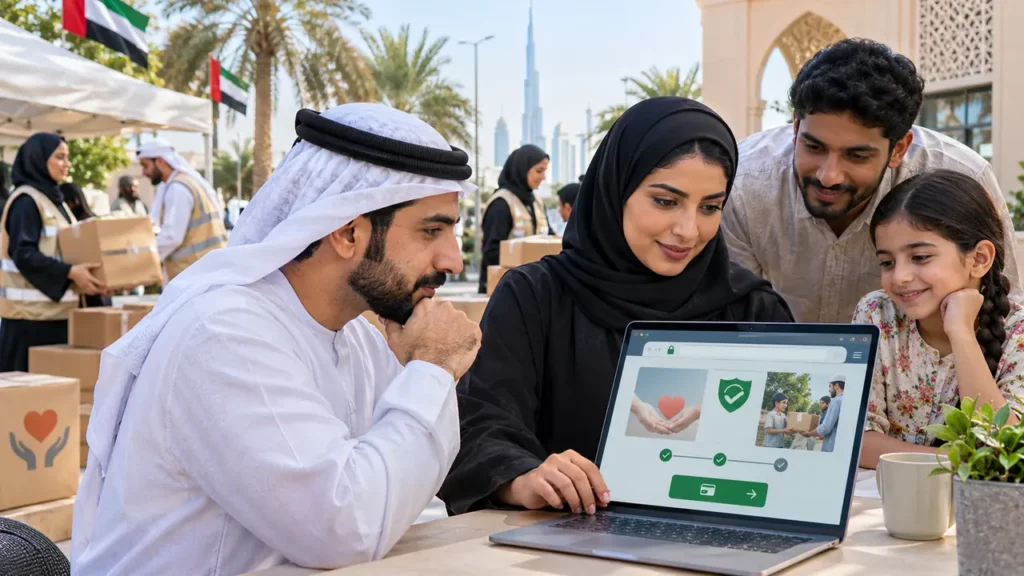
The UAE protects charitable giving through licensing and fundraising rules intended to ensure money reaches legitimate beneficiaries. Individuals cannot simply collect public donations through a personal bank account, social post or informal payment link because a sympathetic story appears genuine.
The Ministry of Community Empowerment’s November forum highlighted the shared responsibility of protecting authorised non-profit organisations from misuse. For donors, the practical response is to verify the organisation, campaign and payment channel before sending money or personal information.
Who may collect donations in the UAE
Licensed charities and authorised entities may collect, receive or provide donations within the legal framework. Other organisations generally require a permit and fundraising must be conducted through a recognised charitable or humanitarian organisation. Natural persons are not permitted to run public fundraising campaigns on their own.
A genuine need does not remove the legal requirement. Sharing a friend’s personal account number or creating a crowdfunding page can become an unauthorised public collection even when the organiser intends to help. Direct the case to an approved charity that can assess and manage support lawfully.
| Check | What to verify |
|---|---|
| Collector | Licensed charity or permitted entity |
| Campaign | Purpose appears on a verified official channel |
| Payment | Correct beneficiary and secure page |
| Receipt | Traceable reference and transaction record |
Digital appeals should be checked using Dubai official-service verification guide, and suspected payment theft can be documented with Dubai cybercrime reporting guide.
Checking a campaign before paying
Start from an official government or charity website instead of a link inside a forwarded message. Confirm the exact campaign, beneficiary purpose and payment account. Look for consistent contact information and ask the organisation directly if the appeal does not appear in its verified channels.
Urgency, disturbing images and celebrity-style endorsements can be copied or fabricated. Reverse-image searching may reveal reuse, but the decisive check is confirmation from the authorised organisation. Do not assume a blue tick on one social platform proves that a specific payment link is safe.
- Open the charity’s official site independently.
- Confirm that the exact campaign is authorised.
- Never send an OTP or UAE Pass approval to a caller.
- Keep payment receipts and screenshots.
- Report suspicious appeals instead of forwarding them.
Emotional claims still require verification; UAE misinformation guide and UAE public-warning guide help separate official warnings from unverified forwarding.
Protecting payment and identity details
Use the official payment page and review the beneficiary before authorising. Never disclose an OTP, card PIN, UAE Pass approval or full identity document to a caller. Save the receipt and campaign reference so the transaction can be traced.
A charity may need donor information for a legitimate receipt or compliance process, but the request should be proportionate and use a secure channel. Do not upload passport or Emirates ID copies to an unknown form merely because the appeal uses government colours.
Keep UAE emergency numbers guide available for urgent risks, while UAE digital participation guide explains how to engage with verified public initiatives.
Responding to suspicious appeals
If an appeal seems suspicious, stop forwarding it. Preserve the URL, phone number, account details, screenshots and payment time, then report through the relevant authority or police channel. Contact the bank immediately if money or credentials were exposed.
Safe giving is not less generous. Verification protects donors, legitimate charities and beneficiaries by keeping funds inside accountable channels. Families should teach children and older relatives to pause before responding to emotional messages.
Check current information directly with the ministry guidance on fundraising before making a time-sensitive plan.
Questions people often ask
Can an individual collect public donations for a friend in the UAE?
Individuals may not conduct public fundraising on their own. A legitimate case should be referred to an authorised charity or permitted entity.
How can I check whether a charity campaign is genuine?
Find the campaign through the organisation’s verified official channel and contact it directly if the payment details do not match.
Is a social-media payment link enough proof?
No. Profiles, images and endorsements can be copied. Verify the organisation, campaign and beneficiary independently.
What information should a donor never share with a caller?
Do not disclose an OTP, card PIN, recovery code or UAE Pass approval. Avoid sending identity documents through an unverified form.
What should I do after paying a suspicious appeal?
Contact the bank immediately, preserve evidence and report the incident through the appropriate official authority or police channel.


