
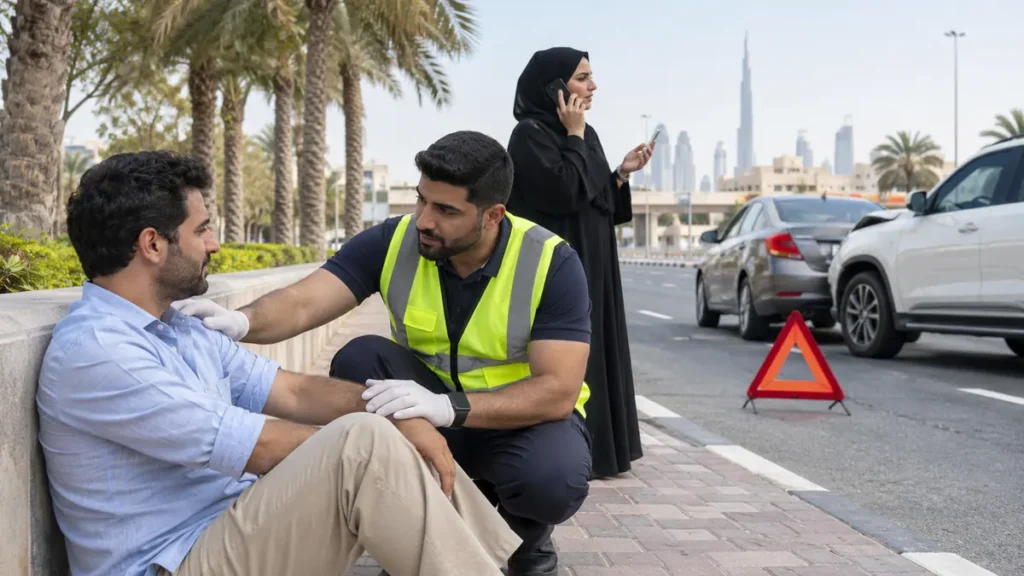
Stopping to help after a traffic accident is a serious responsibility. New UAE traffic regulations taking effect on 1 January 2027 state that a person must not provide first aid to traffic-accident victims unless holding a valid first-aid certificate issued by an approved authority. The rule does not mean a witness should ignore an emergency: calling for professional help, warning others and following emergency-operator instructions remain essential.
The official Emirates News Agency summary of the new traffic regulations confirms the certificate requirement. The public summary does not list every approved course or certificate, so residents should verify recognition with the competent authority before relying on a training card.
What the certificate rule changes
| Situation | Appropriate response | Avoid |
|---|---|---|
| You are not certified | Call emergency services, give location and follow instructions | Attempting procedures beyond operator guidance |
| You hold a valid approved certificate | Use trained skills within scope when the scene is safe | Improvising treatment you were not taught |
| Traffic remains dangerous | Protect yourself and warn approaching road users from safety | Standing in a live lane |
| Vehicle may catch fire | Tell emergency services and move to safety | Returning for belongings |
| Victim may have spinal injury | Follow professional guidance and avoid unnecessary movement | Pulling the person out without an immediate danger |
A certificate is not permission to take unnecessary risks. A trained person must still assess traffic, fire, fuel, electricity and unstable vehicles before approaching. An injured helper adds pressure to the emergency response.
First actions at the scene
- Stop only where it is lawful and safe
- Switch on hazard lights and remain alert to moving traffic
- Call 999 and give the exact road, direction and nearest landmark
- State the number of vehicles and injured people
- Mention fire, smoke, fuel, trapped occupants or hazardous loads
- Follow the emergency operator’s instructions
- Keep bystanders away from traffic and unstable vehicles
Save the contacts and distinctions in our UAE emergency numbers guide. Dubai residents dealing with a non-emergency police matter can separately consult the Dubai Police 901 guide.
Do not move a casualty without a safety reason
After a collision, a person may have a head, neck or spinal injury that is not immediately visible. Moving them can worsen harm. Unless there is an immediate threat such as fire or instructions from emergency professionals, keep the person still, reassure them and prevent crowds from pressing close.
Do not give food, drink or medication. Do not remove a helmet merely for comfort. A certified first aider should use only the techniques within current training and hand over clearly when paramedics arrive.
Prepare before an emergency
A driver who wants to assist should complete an approved first-aid course, keep the certificate current and carry basic protective supplies. Before enrolling, ask who approves the course, how long the certificate remains valid and whether refresher training is required.
Keep a reflective vest, warning triangle and stocked kit in the vehicle, but store them where they can be reached without standing in traffic. The Dubai car-safety checklist covers kit placement, while the UAE child car-seat guide explains a separate 2027 safety change.
Evidence and reporting
Do not photograph injured people for social media. If safe and lawful, record the location, time, vehicle positions and details requested by police without obstructing responders. Protect private information and share evidence only through authorised channels.
If a traffic fine or record later needs checking, use the steps in the Dubai traffic-fine review guide. The UAE photography privacy guide explains the broader consent principle, which is especially important when a person is injured or vulnerable.
Weather and secondary collisions
Rain, dust or darkness can make the accident scene more dangerous than the original impact. Stand behind a barrier where available, keep children inside a safe vehicle unless there is a reason to leave, and do not walk along a live carriageway to inspect damage. The UAE rain-driving guide gives additional visibility and stopping advice.
The most helpful witness is one who calls early, describes the scene accurately and avoids creating a second emergency.
Questions people often ask
When does the UAE traffic-accident first-aid rule take effect?
The new federal traffic implementing regulations are scheduled to take effect on 1 January 2027.
Can anyone give first aid after a traffic accident?
The new rule states that a person must hold a valid first-aid certificate issued by an approved authority before providing first aid to traffic-accident victims.
What can an uncertified witness do?
Call 999, give accurate location and hazard information, protect the scene from a safe place and follow the emergency operator’s instructions.
How do I know whether a certificate is approved?
Confirm the issuing body and recognition with the competent UAE authority before relying on the certificate for roadside assistance.
Should I move an injured person out of a vehicle?
Not unless there is an immediate danger or emergency professionals instruct you to do so. Unnecessary movement can worsen a hidden spinal injury.


