
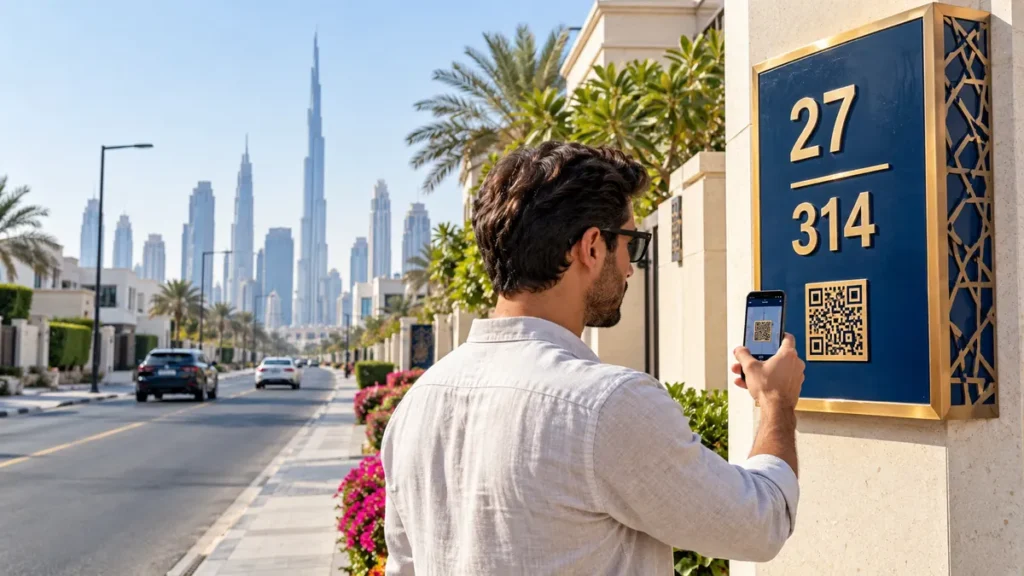
Dubai is introducing a new visual identity for street and area signs across 186 areas grouped into 19 sectors. The official RTA announcement says the phased rollout runs from the fourth quarter of 2026 to 2030 and is being coordinated with Dubai Municipality.
The change is more than a new colour scheme. It is designed to connect sector and area signs, internal street names and house plates so that a driver, pedestrian, delivery rider or emergency responder can identify a place more consistently. Because installation is phased, old and new signs may appear together during the transition.
What will change on the street
The system uses five colours, including blue to reflect Dubai’s sea environment and gold for its desert setting. Main signs will identify sectors and areas, while internal signs show local street names. House plates are planned to carry both the Makani number and a QR code, creating a bridge between the physical address and digital location information.
The first phase covers more than 2,000 signs in Za’abeel 1 and 2, Nad Al Sheba, Al Khawaneej 1 and Nazwa. That does not mean the rest of Dubai changes immediately. Travellers should continue using the address details supplied by the destination while watching for new official signs.
| Sign element | What it communicates | How a traveller should use it |
|---|---|---|
| Sector or area sign | Broad geographic identity and colour | Confirm the correct district before entering local streets |
| Internal street sign | Street name within the area | Match it with the destination’s written address |
| House plate | Property-level address information | Check the final building or villa |
| Makani number | Unique geographic reference | Share the digits exactly when precise location is needed |
| QR code | Digital information linked to the sign | Scan only when safely stopped and verify the destination |
Use Makani as a precision tool
A Makani number is more specific than a neighbourhood name. If two buildings have similar names or a new development is not easy to find, the number can help identify the exact entrance. Copy the digits carefully and keep the written address as a second reference.
Visitors arriving by public transport can combine the final address with the Dubai nol card guide. The digital nol QR ticket guide explains the separate transport ticket code; it should not be confused with an address QR code.
Scan without creating a road hazard
Never stop a moving vehicle or stand in traffic to scan a sign. A passenger can scan while the vehicle is safely parked, or the driver can use the printed Makani number instead. Confirm that the browser or map opens an expected official or location page before sharing personal information.
The UAE school-run safety guide helps when the sign is across a busy road. Drivers should use the Dubai parking guide to stop legally rather than blocking a gate or lane while checking directions.
A better address message
- Send the full place name and area.
- Add the street or building information shown by the destination.
- Include the Makani number when available.
- Share a map pin as a cross-check, not the only clue.
- Name the correct entrance, reception or loading point.
- Warn the recipient about temporary roadworks or gate restrictions.
- Keep a screenshot of the written address for weak-signal areas.
Plan for mixed signs during rollout
A phased programme means navigation apps, printed directions and street signs will not all update on the same day. If a driver sees an older sign, it does not automatically mean the route is wrong. Compare the area name, street, Makani number and destination entrance before changing course.
Taxi passengers can use the licensed Dubai taxi guide to prepare the destination details. Residents renewing car documents can also consult the Dubai vehicle registration guide, since the address on official records should be reviewed separately from street-sign changes.
Use address data in an emergency
When requesting urgent help, follow the operator’s questions and provide the Makani number or visible address details clearly. Do not delay an emergency call while trying repeatedly to scan a QR code. The UAE emergency numbers guide explains which number to call and what information to prepare.
The new system should become easier as the rollout expands. During the transition, the reliable approach is redundancy: area, street, building, Makani number and map pin, all checked against the destination.
Questions people often ask
When will Dubai’s new street signs be installed?
RTA says the phased rollout begins in the fourth quarter of 2026 and continues to 2030.
How many areas are included?
The official plan covers 186 areas grouped into 19 sectors.
Which areas are in the first phase?
RTA lists Za’abeel 1 and 2, Nad Al Sheba, Al Khawaneej 1 and Nazwa, with more than 2,000 signs planned initially.
Will house plates include Makani information?
Yes. The announced design includes a Makani number and QR code on house plates.
Should a driver stop in the road to scan a QR code?
No. Scan only when safely parked or let a passenger handle it. The printed Makani number can be used without scanning.


