
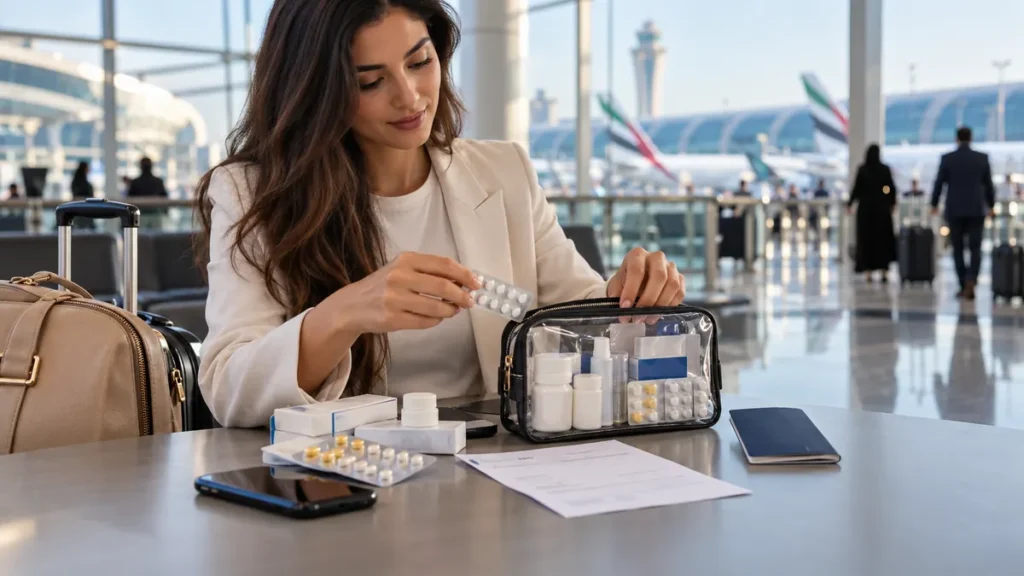
Travelling with medicine through Dubai becomes much easier when the paperwork, quantity and packing method are checked before the journey. The most important distinction is whether a product is an ordinary medicine or appears on the UAE list of narcotic, psychotropic or otherwise controlled medicines. A medicine that is routine in one country can be regulated differently in another, so brand familiarity is not enough.
The official MOHAP traveller service guide explains the personal-use permit route, supporting documents and quantity guidance. Dubai Airports also advises passengers to keep medication in original packaging with a prescription. Check both the UAE requirements and the airline’s cabin-baggage rules before leaving home.
Identify the medicine by its active ingredient
Use the generic or active ingredient, not only the brand name, when checking the official controlled-medicine list. Different countries may sell the same ingredient under different names. Ask the prescribing clinician or pharmacist for a clear list showing the medicine name, strength, dosage and purpose.
For the wider document check, use the UAE international travel document guide. If the trip includes a visa or entry-permit question, the UAE entry-permit guide helps locate the correct identifiers without confusing them with medical approval.
Prepare a prescription and medical report
Controlled medicines require stronger supporting evidence. The prescription and medical report should identify the patient, medicine, dose and medical need, and should come from the treating health provider. Check the current authentication requirement in the official service instructions. Carry accessible copies, but keep the originals secure.
Do not combine different tablets in an unlabelled organiser for the journey if that removes the information officers may need. Keep enough medicine in the cabin bag to manage a reasonable delay, subject to security and airline rules, and avoid placing the whole supply in checked baggage.
| Travel check | What to prepare | Why it matters |
|---|---|---|
| Medicine identity | Active ingredient, strength and brand | Confirms whether controls apply |
| Medical evidence | Prescription and medical report | Connects the medicine to the traveller |
| Quantity | Supply within the official personal-use limit | Avoids an unexplained excess |
| Packing | Original labelled containers | Makes inspection and dosage clearer |
| Permit or declaration | Approval where used, or documents for arrival declaration | Supports the lawful entry process |
Airport medicine checklist
- Check every active ingredient against the current official list.
- Carry a prescription and medical report bearing the traveller’s name.
- Keep medicine in original, clearly labelled packaging.
- Save the permit or application reference where applicable.
- Confirm refrigeration, needles, liquids and battery devices with the airline.
Plan for liquids, cold packs and devices
Dubai Airports notes that medication can be exempt from the usual cabin liquid limit, but screening staff may need supporting evidence. Tell the airline in advance about injectable medicine, sharps, oxygen, powered medical equipment or refrigeration needs. Do not assume a gel pack, battery or device will be accepted in the same way by every carrier.
The Dubai terminal-transfer guide helps when a connection involves security again. The mobile passport-check guide explains why the physical passport and required documents should remain accessible even when digital processing is available.
Allow time for declaration or questions
If prior approval was not obtained for a controlled medicine, MOHAP guidance says travellers should declare it on arrival with the prescription and medical report. Do not hide medicine, remove labels or give part of the supply to another traveller. Answer questions factually and show the relevant documents.
Keep medicine with you during a delay and monitor any temperature requirement. The flight-status guide helps reduce unnecessary time at the airport, while the missing-baggage guide explains why critical medicine should not rely solely on a checked suitcase. Families can adapt the preparation steps in the Dubai family-arrival guide.
Rules can change and personal cases differ. Recheck the official service shortly before travel, especially after a prescription changes.
Questions people often ask
Do all medicines need prior UAE approval?
No. Prior electronic approval is mainly relevant to narcotic and controlled medicines. Check the active ingredient against the current official list.
How much controlled medicine can a traveller bring?
MOHAP’s service guide states a maximum quantity needed for three months for narcotic and controlled medicines, subject to the official conditions and supporting documents.
Should medicine stay in its original packaging?
Yes. Original labelled packaging makes the medicine, strength and patient instructions easier to verify during travel.
Can medicine go in hand luggage at Dubai Airport?
Generally yes, but liquids, sharps, batteries and special equipment may need documents or airline approval. Confirm with the airline and airport guidance.
What if I did not obtain prior approval for a controlled medicine?
Official guidance says the traveller should declare it on arrival and present the prescription and medical report. Do not conceal or relabel it.


