
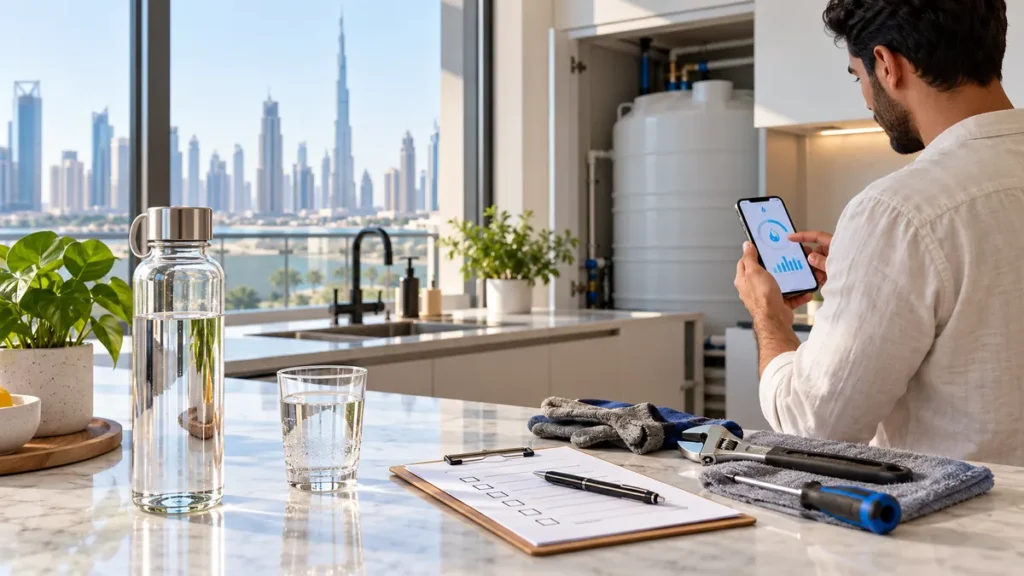
Water quality inside a Dubai home depends on more than the supply reaching the building. Tanks, pipes, pumps, taps, filters and reusable bottles all form part of the route between the meter and the glass. A well-managed building should keep that route clean, maintained and free from avoidable stagnation, while residents should know which warning signs to report.
Dubai Municipality’s guidance on household water safety recommends regular system maintenance and says tanks and water systems should be cleaned and disinfected at least every six months by approved companies. The official DEWA home water guidance also advises regular inspection of internal connections, tanks and appliances, and explains that abnormal usage can indicate a leak.
Understand who manages the system
In a villa, the owner or occupier may arrange tank and internal-pipe maintenance directly. In an apartment, building management normally coordinates shared tanks and common systems. Ask for the cleaning schedule and a service record rather than relying on a verbal assurance. A resident should not open, enter or dose a shared tank.
If unexpected water use appears, compare it with the household emergency-file guide and keep the building contact, unit number and DEWA account reference easy to reach. Visible leaks near appliances should be handled promptly to protect both water quality and the property.
Check for leaks without dismantling equipment
DEWA advises residents to turn off water-using appliances and observe the meter as a simple check. Water stains, damp cupboards, a continuously refilling toilet, pump cycling or an unexplained rise in use can justify professional inspection. Do not attempt electrical or pressurised-system repairs without a competent technician.
A slow leak can damage food-storage areas. Review the freezer safety guide if a leak or power issue affects appliances, and use the meal-prep guide to keep raw food away from maintenance work.
| Observation | Possible concern | Practical response |
|---|---|---|
| Water stain or damp wall | Hidden pipe or appliance leak | Stop nearby use and report for inspection |
| Unusual taste, odour or colour | Tank or internal-system issue | Pause drinking use and seek qualified assessment |
| Long-unused tap | Stagnant water in the outlet | Follow building guidance and flush safely |
| Dirty tank record or overdue service | Maintenance gap | Arrange an approved company |
| Abnormal meter increase | Leak after the meter | Use alerts and contact responsible maintenance |
Home water hygiene checklist
- Confirm the last tank cleaning and the next scheduled service.
- Use an approved specialist and retain the service record.
- Report odour, discolouration, particles or pressure changes.
- Wash reusable bottles daily and allow them to dry fully.
- Replace filters according to their instructions, not by guesswork.
Handle reusable bottles and filters properly
A clean supply can still be contaminated by a poorly washed bottle. Empty it daily, wash the cap, seal, straw and threads, rinse thoroughly and let every part dry. Do not continually top up yesterday’s water. Keep bottles away from direct sun and a hot parked car.
Filters are not maintenance-free. Record the installation and replacement date, use the correct cartridge and follow the manufacturer’s cleaning instructions. An overdue filter can restrict flow or become a hygiene problem. The date-label guide offers a useful method for recording opened and replacement dates, even though filter timing must follow its own instructions.
Respond to a suspected water-quality problem
If water suddenly changes colour, smell or taste, stop using it for drinking and food preparation until the responsible party assesses it. Photograph the appearance in a clean clear container, note which taps are affected and ask neighbours whether the issue is limited to one unit or wider. Do not post an unverified contamination claim as fact.
Use sealed water temporarily where appropriate and protect children or vulnerable residents. The UAE emergency-numbers guide helps distinguish urgent incidents from normal maintenance. If stored food may have been exposed, follow the Dubai food-safety reporting guide for evidence and safe disposal decisions. The food-label guide also helps interpret preparation instructions that require potable water.
The useful habit is documentation: know the maintenance date, recognise a change and report it through the responsible official or building channel before the problem grows.
Questions people often ask
How often should a Dubai home water tank be cleaned?
Dubai Municipality guidance recommends cleaning and disinfecting tanks and water systems at least every six months through approved companies.
Who is responsible for a leak after the DEWA meter?
DEWA states that internal connections after the meter are the customer or property side’s responsibility, so contact the owner, building management or a competent technician as appropriate.
What signs can indicate an internal water leak?
Water stains, damp areas, pump activity, a running toilet or abnormal consumption can be warning signs and deserve prompt inspection.
Should I keep using water that suddenly smells or looks different?
Pause drinking and food-preparation use, document the change and contact the responsible maintenance or authority channel for assessment.
Does a home filter remove the need for tank maintenance?
No. A filter needs its own timely replacement and does not replace cleaning, inspection and maintenance of the tank and internal water system.


