
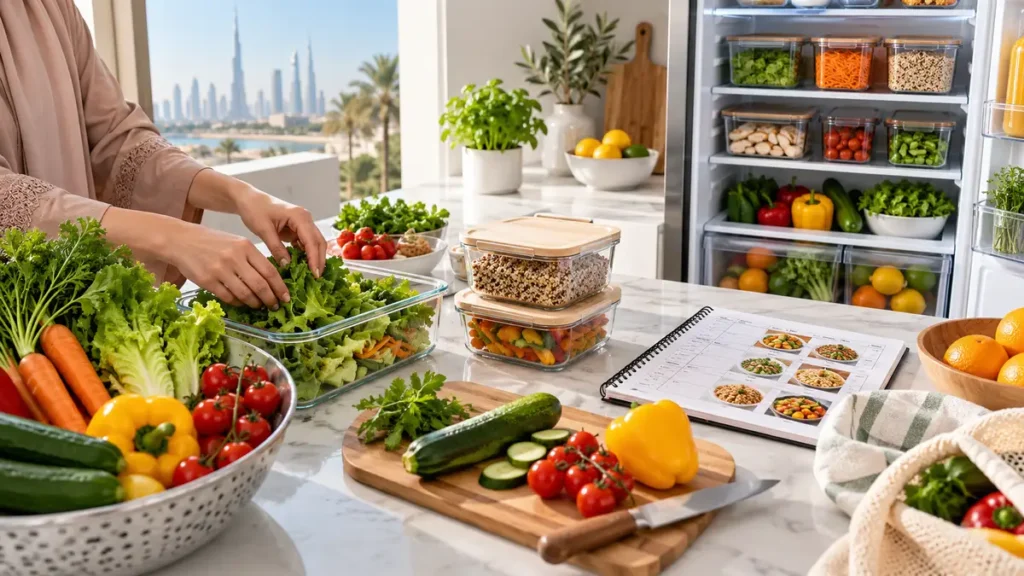
Household food waste often begins with small decisions: buying without checking the fridge, cooking for an imagined appetite, forgetting a container at the back of a shelf or confusing a production date with an expiry instruction. A useful reduction plan therefore starts with measurement and routine, not guilt.
ne’ma, the UAE National Food Loss and Waste Initiative, identifies households as a key part of the food-waste challenge and supports the national goal of cutting food loss and waste by half by 2030. The most practical household response is to learn what is wasted, why it happens and which one change prevents a repeat.
Use a seven-day audit
For one week, record edible food discarded, the approximate amount and the reason: forgotten, overcooked, too much served, spoiled after opening or rejected by the family. Do not count unavoidable peelings in the same way as untouched cooked food. The goal is to reveal patterns.
The UAE food date-label guide helps separate different label meanings, while the food-label reading guide connects dates with storage and serving information.
| Day | Action | Result to record |
|---|---|---|
| 1 | Inventory fridge, freezer and pantry | Items needing priority |
| 2 | Plan meals from priority food | Ingredients already available |
| 3 | Shop with quantities | Unplanned purchases avoided |
| 4 | Cook and portion realistically | Served versus uneaten |
| 5 | Label and use leftovers | Meals recovered safely |
| 6 | Review repeated waste | Main household cause |
| 7 | Set one new routine | Action for the next week |
Shop the home before the store
Photograph the fridge or write a short inventory before shopping. Plan two or three flexible meals around food that needs using first. A shopping list should include quantities, not just names. Promotions only save money when the household can store and use the amount safely.
Use the family meal-prep guide to avoid creating more portions than the household can cool and store. Plan one leftover meal before the week begins instead of hoping surplus will disappear.
Storage habits that prevent waste
- Keep food needing early use visible at eye level.
- Label opened containers and prepared meals with the date.
- Cool cooked food promptly in shallow portions.
- Freeze portions while still suitable, not as a final rescue.
- Rotate pantry items so older stock is used first.
- Keep raw food separated from ready-to-eat food.
- Discard food when safe storage cannot be confirmed.
The Dubai freezer guide covers packaging and defrosting. For cooked food, the cooling and storage guide explains why the printed date on an ingredient does not become the shelf life of the finished meal.
Serve less, offer more
Start with modest portions and allow seconds. This is especially useful for children, buffets and dishes the family has not tried before. Keep unserved food separate from what has been on individual plates; that makes safe storage or responsible redistribution more realistic.
Do not taste food to test safety. Smell and appearance cannot identify every hazard. When temperature history, contamination or storage time is uncertain, disposal is safer than reuse.
Donate only suitable surplus
Food donation should use an authorised channel and comply with safety instructions. Do not offer opened, partly eaten, temperature-abused or expired items. The Dubai surplus-food donation guide explains the difference between safe planned surplus and household leftovers that cannot be accepted.
For picnic or takeaway food, use the warm-weather food-safety guide. Preventing waste never justifies keeping a risky meal.
Turn the audit into one habit
At the end of seven days, choose the biggest avoidable category. If salad spoiled, buy a smaller amount and schedule it early. If rice was repeatedly left, reduce the batch. If takeaway portions were too large, plan the next day’s meal before ordering. One measurable change is more durable than a complicated system.
The national target becomes practical when the household can answer three questions: what is available, what must be used first and what quantity will actually be eaten.
Questions people often ask
What is the difference between food loss and food waste?
ne’ma describes food loss as occurring earlier in production and distribution, while food waste occurs at retail, food-service and household stages.
Should I throw food away on its best-before date?
Read the exact label and storage directions. Best-before and expiry wording can have different meanings; when unclear, ask the manufacturer or authority rather than guessing.
Is freezing always a safe way to rescue leftovers?
No. Freeze food while it is still safely stored. Freezing does not reverse time spent at an unsafe temperature.
Can I donate home leftovers?
Use an authorised programme and follow its acceptance rules. Opened, served or temperature-abused food is generally unsuitable.
What is the simplest first step?
Record discarded edible food for seven days and identify the largest repeated cause. Change one shopping, cooking or storage habit that addresses it.


