
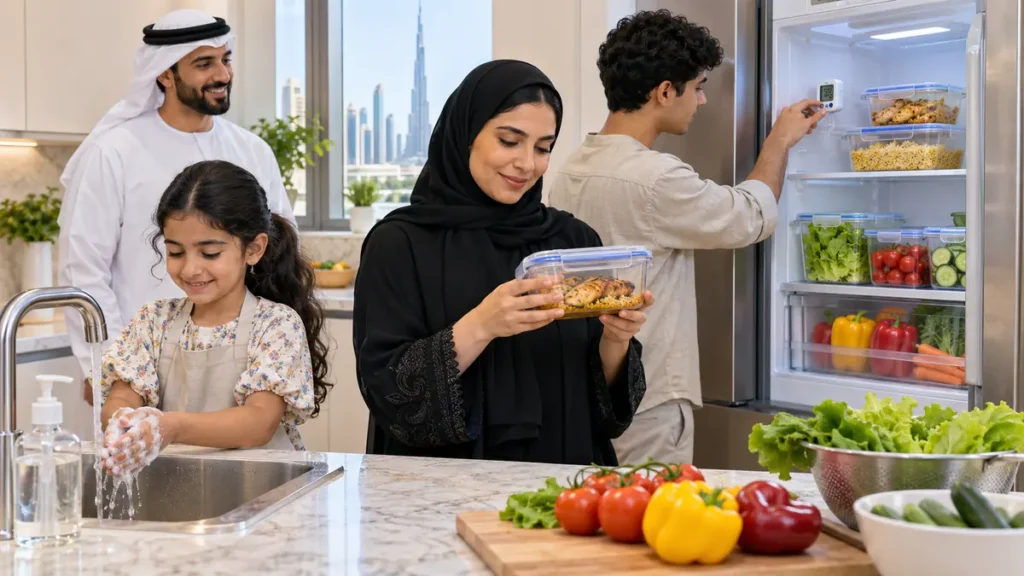
Dubai Municipality has launched a global roadmap for the future of food safety, focusing on stronger preparedness, early warning, scientific evidence, data and emerging technology. The roadmap is aimed at food-safety systems and professionals, but households still control the final steps between purchase and eating: transport, refrigeration, preparation, cooking and leftovers.
The official Emirates News Agency announcement says the roadmap was launched during the Dubai International Food Safety Conference. It describes priorities for anticipating and preventing emerging risks. It does not replace ordinary hygiene, change a food label’s meaning or make a home device an official inspection tool.
From system readiness to kitchen practice
| Roadmap idea | Household equivalent | Practical habit |
|---|---|---|
| Early warning | Notice a recall or unusual food condition | Check official notices and stop use |
| Traceability | Know what and where you bought | Keep label and receipt when needed |
| Prevention | Control time, temperature and contamination | Chill, separate and cook safely |
| Accurate information | Use authority guidance | Ignore viral kitchen myths |
| Resilience | Plan for outages or delays | Keep a thermometer and backup plan |
The Dubai grocery and storage guide covers the journey from trolley to refrigerator. The refrigerator safety guide explains airflow, temperature checks and avoiding overfilling.
Control the cold chain at home
Buy chilled and frozen food near the end of the shopping trip, use insulation when the journey is long and put products away promptly. A cold-feeling package is not proof that it stayed at a safe temperature throughout transport. Keep raw meat contained and below ready-to-eat food so leakage cannot contaminate produce or cooked dishes.
For frozen food, follow the safer options in the Dubai thawing guide. Do not thaw meat for hours on a warm counter, and do not refreeze food simply to disguise an uncertain storage history.
Use a repeatable preparation routine
- Wash hands before food preparation and after handling raw items
- Keep raw meat separate from salads and cooked food
- Use clean boards, knives, cloths and containers
- Cook according to reliable time and temperature guidance
- Cool leftovers promptly in suitable shallow portions
- Label stored food with a useful preparation date
- Discard food when safety is uncertain
A thermometer is more reliable than judging colour alone. The food thermometer guide covers placement, cleaning and reheating. The cooked-food cooling guide helps families portion and refrigerate leftovers without warming the whole fridge.
Treat allergen information as a safety issue
A smart food system cannot guess an individual allergy at the table. Read the current package label every time because recipes can change. When ordering, name the allergen, ask about ingredients and cross-contact, and do not accept a vague reassurance as a medical guarantee. A severe allergy requires the person’s professional care plan and prescribed emergency medicine.
The Dubai allergen guide provides direct questions for restaurants and shared serving areas. At home, keep labelled ingredients and dedicated utensils where cross-contact is a serious concern.
Respond carefully to recalls and concerns
If an official recall identifies a product, compare the brand, size, batch and date exactly. Do not discard the label before recording the details. Follow the authority or retailer’s instructions for return or disposal. If food appears unsafe, stop using it, isolate it from other food and record the place and time of purchase.
Seek medical help when symptoms are severe, persistent or involve a high-risk person. For an official report, describe observable facts rather than accusing a business online. Keep packaging, receipt and photographs when it is safe to do so.
Questions people often ask
What is Dubai’s new food-safety roadmap?
It is a framework for stronger, more proactive food-safety systems using science, data and emerging technologies.
Does the roadmap change household storage rules?
No. Families should continue established hygiene, separation, cooking, cooling and refrigeration practices.
Can food safety be judged by smell alone?
No. Some hazards do not produce an obvious smell, while an unusual odour is still a reason not to eat the food.
What information matters in a recall?
Match the exact product, brand, size, batch or lot and date information in the official notice.
How should a household report a concern?
Stop using the food, retain useful purchase details and use the relevant official authority or retailer channel with a factual description.


