
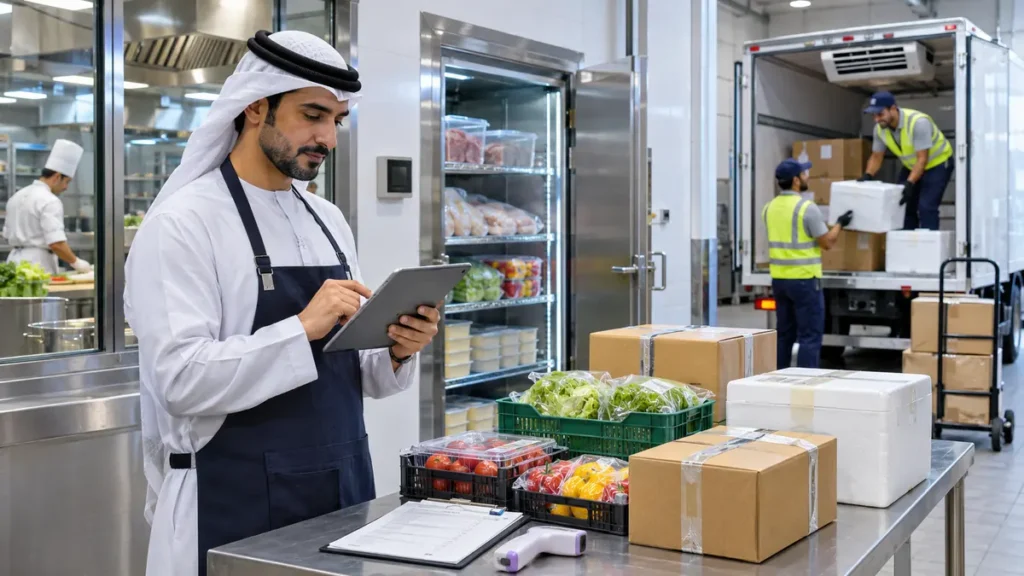
FoodWatch is Dubai Municipality’s digital platform for exchanging food-safety information across food establishments, suppliers, training providers and other authorised parties. For a food business, the platform is not a substitute for safe daily work; it is a way to verify, record and manage important controls.
The official Dubai Municipality FoodWatch FAQ explains that the Person in Charge, or PIC, can use the platform to check suppliers, trace products, verify delivery-vehicle permits, manage training and maintain digital food-safety records. The official food establishments page provides the Food Code and activity-specific guidance.
What a PIC can manage through FoodWatch
| Control area | Platform use | Daily evidence |
|---|---|---|
| Suppliers | Check location, inspection grade and business activity | Approved supplier list and current verification |
| Food products | Trace source, ingredients and nutrition information | Batch, invoice and receiving record |
| Delivery vehicles | Verify food vehicle permits | Vehicle and delivery check |
| Training | Manage qualifications and certification | Current staff training status |
| Food-safety system | Maintain relevant digital records | Completed monitoring and corrective actions |
Verify suppliers before the first delivery
A licence or familiar company name does not prove that a supplier is authorised for every food activity. Check the business activity, location and current information in the official system. Match invoices, product labels and delivery details to the approved supplier record. Escalate a mismatch before accepting the food.
Receiving staff should also examine temperature, packaging, contamination and traceability. The Dubai food shopping and storage guide explains consumer checks that mirror several useful receiving principles, while the refrigerator safety guide covers cold storage after acceptance.
- Keep the establishment and PIC details current.
- Verify supplier activity before approving purchases.
- Check food-vehicle permits at delivery where required.
- Link products to invoices, batches and receiving dates.
- Record monitoring at the time the task is performed.
- Document corrective action when a limit is missed.
- Review staff training before certificates expire.
Digital records must reflect real controls
A copied temperature, backdated checklist or generic “all okay” entry is not useful evidence. Records should identify what was checked, when, by whom, the result and what happened if the result was outside the establishment’s limit. Supervisors should review patterns rather than merely count completed forms.
The food thermometer guide shows how poor probe technique can undermine a record. The cooked-food cooling guide explains why a series of timed readings is more useful than one final number.
Manage staff and task responsibility
The PIC should understand the establishment’s activities and verify that trained staff are assigned to receiving, preparation, cooking, cooling, cleaning, allergen handling and pest reporting. A certificate alone does not prove the person follows the process during a busy shift.
Handwashing and task changes remain essential; review the Dubai kitchen handwashing guide. Raw poultry businesses should also use the separation steps in the raw chicken safety guide.
Traceability and corrective action
When a complaint, recall or failed check occurs, the establishment should be able to identify the supplier, batch, dates, quantities and affected menu items. Quarantine suspect stock and preserve the original record. Do not edit a failed result into a passing one; add the corrective action and verification.
Delivery and takeaway risks are covered in the Dubai takeaway safety guide. For longer storage, document any decision made after refrigeration is interrupted, including the time, affected batch and disposal action.
Questions people often ask
What is Dubai FoodWatch?
It is Dubai Municipality’s digital platform for food-safety information exchange, verification and record management among authorised food-sector parties.
Who uses FoodWatch in a food establishment?
The establishment’s authorised Person in Charge uses it for relevant controls, records and interactions within the scope assigned by Dubai Municipality.
Can FoodWatch verify a food supplier?
Yes. The official FAQ says a PIC can check supplier location, inspection grades and business activities.
Does FoodWatch replace paper or operational checks?
No. The business must still perform real food-safety controls. Digital records should accurately reflect those checks and corrective actions.
Can a PIC check delivery-vehicle permits?
Yes. FoodWatch can be used to approve and verify food vehicle permits upon delivery, according to the official FAQ.


