
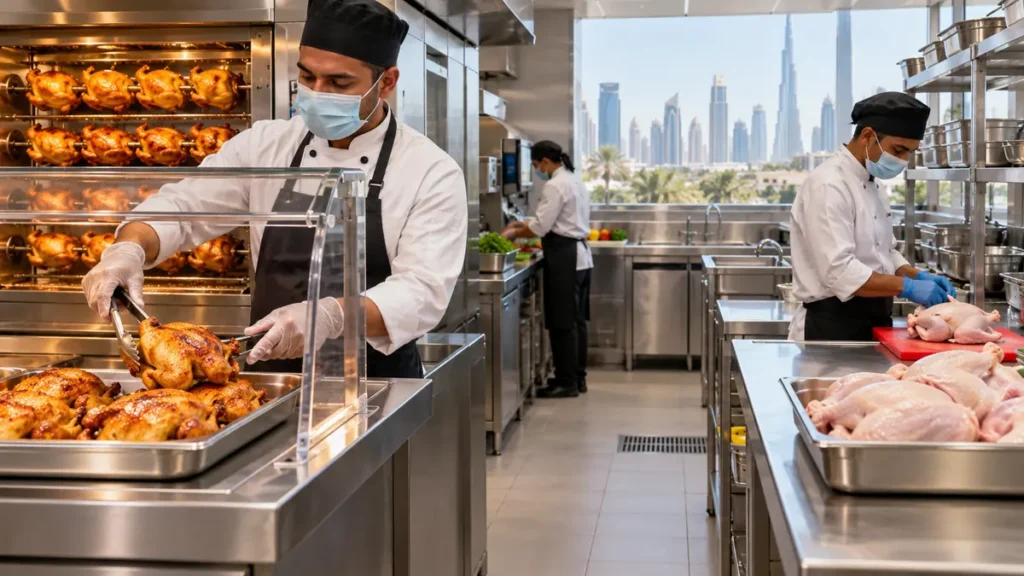
Rotisserie chicken is convenient, but its safety depends on much more than whether the skin looks browned. Raw poultry juices must not reach cooked food, the centre of the bird must be cooked properly, and finished chicken must be protected and held under controlled conditions until it is sold.
Dubai food businesses operate under municipal food-safety requirements. Consumers and operators can use the Dubai Municipality food traders and establishments page to find the Food Code and related guidance, while the consumer food-safety page provides official awareness information.
Where contamination can happen
| Checkpoint | Safer practice | Warning sign |
|---|---|---|
| Raw preparation | Separate equipment, hands and work area | Raw poultry or drips near cooked birds |
| Cooking | Validate the process and check the thickest part | Colour used as the only test |
| Hot holding | Keep finished chicken protected under control | Birds left uncovered or only lukewarm |
| Packing | Use clean packaging and separate raw purchases | Leaking raw packs placed with ready-to-eat food |
| At home | Eat promptly or cool and refrigerate correctly | Long delay in a warm car or on a counter |
The most serious visible concern is cross-contamination. Raw birds, trays, tongs, marinades and hands can carry microorganisms to chicken that has already been cooked. A display that allows raw drips to fall onto cooked food is not made safe by reheating the outside for a few moments.
What consumers can check before ordering
Look for a clean service area, covered or protected cooked food, separate utensils and staff who do not switch from raw poultry to ready-to-eat food without proper handwashing and equipment control. Ask for a freshly packed bird when possible. If the chicken seems lukewarm, has damaged packaging or is exposed to raw food, choose another item and raise the concern with the supervisor.
Our raw chicken shopping and storage guide explains separation in a trolley and refrigerator. The Dubai kitchen handwashing guide shows why gloves do not replace clean hands or proper task changes.
- Choose a counter that clearly separates raw and cooked poultry.
- Check that cooked birds are protected from customers and drips.
- Ask for clean packaging that closes securely.
- Carry hot food directly home instead of leaving it in a warm car.
- Serve promptly or refrigerate leftovers using a controlled cooling process.
- Reheat only the portion needed and make it thoroughly hot.
- Report a serious hygiene concern with clear details, not a public guess.
Cooking and hot holding are different controls
Cooking destroys hazards only when the entire product receives an effective process. A browned surface does not prove the thickest part is ready. Businesses should validate their cooking method and use a clean, sanitised probe where required. The practical steps in the food thermometer guide explain where and how to check a thick product.
After cooking, hot holding is intended to prevent harmful growth before sale. It cannot repair contamination from dirty tongs, raw drips or unsafe handling. Staff should limit exposure, rotate stock correctly and avoid mixing a new batch with an older one in a way that hides holding time.
Carry and store the chicken safely
Make the food stop the final stop before home. An air-conditioned passenger cabin is not a controlled hot or cold storage unit, and a parked car can heat quickly. If the chicken will not be eaten promptly, divide leftovers into shallow clean containers and refrigerate them without leaving the food at room temperature for an extended period.
Use the cooked-food cooling guide and refrigerator food-safety guide for home storage. The Dubai takeaway safety guide is useful when delivery or a longer journey adds time before eating.
Reheating and leftovers
Reheat leftovers thoroughly and avoid repeatedly warming the whole container. Add moisture if needed, cover appropriately and check the thickest pieces. When the time or temperature history is uncertain, discarding the food is safer than relying on smell. Food can be unsafe without an obvious odour or colour change.
Families serving someone with an allergy should also consider marinades, spice blends and cross-contact. The Dubai food-allergy ordering guide offers a clear way to ask questions before buying.
Questions people often ask
Is browned rotisserie chicken always fully cooked?
No. Surface colour is not a reliable test for the thickest part. A business should use a validated process and appropriate temperature checks.
Why are raw chicken drippings dangerous near cooked food?
They can transfer microorganisms from raw poultry to ready-to-eat chicken. Cooked food should be physically protected from raw preparation, equipment and juices.
Can hot holding make contaminated chicken safe again?
No. Hot holding helps control growth after cooking but does not correct cross-contamination or poor handling.
How should I take rotisserie chicken home?
Use secure packaging, keep it separate from raw groceries, travel directly home and eat promptly or cool and refrigerate leftovers safely.
Can I judge leftovers by smell?
No. Unsafe food may look and smell normal. Use the known handling and storage history; discard it when that history is uncertain.


