
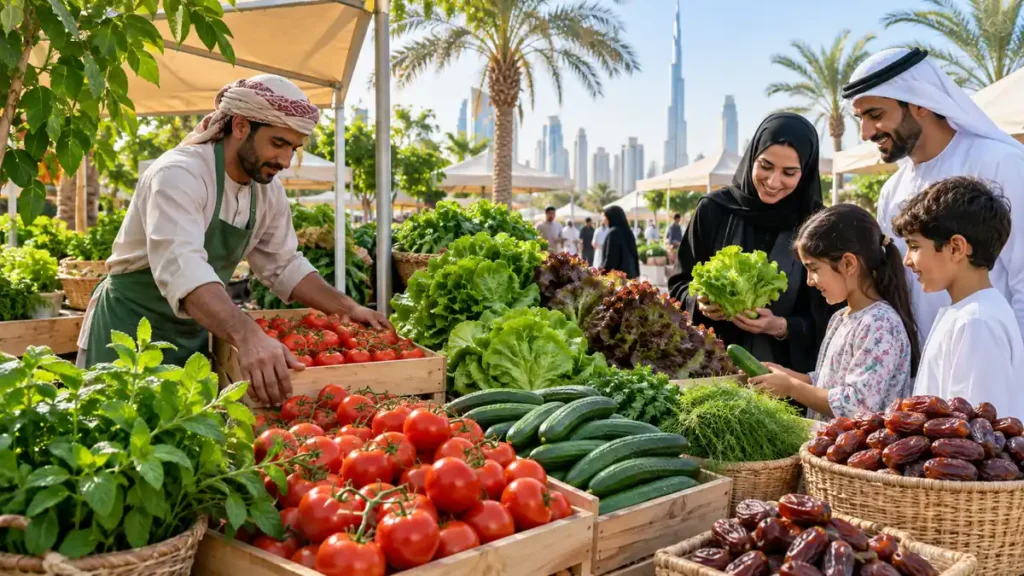
Dubai’s cooler season brings weekend farmers’ markets where shoppers can meet growers and buy locally harvested fruit, vegetables, herbs and other foods. The shortest distance between farm and stall can support freshness, but it does not remove the need to inspect produce, ask precise questions and protect food on the journey home.
Dubai Municipality’s official food traders and establishments page provides the Food Code and food-safety guidance used across the emirate. A market shopper still controls the final stages: selection, transport, washing, refrigeration and use before quality declines.
Check produce at the stall
| Produce type | What to look for | Storage plan |
|---|---|---|
| Leafy greens | Crisp leaves without slime | Refrigerate dry in a suitable container |
| Tomatoes | Firm with no splits or mould | Store according to ripeness |
| Herbs | Fresh aroma and upright stems | Keep cool and use promptly |
| Root vegetables | Firm, dry and undamaged | Store cool with airflow |
| Cut produce | Protected and properly chilled | Take home quickly and refrigerate |
The fresh-produce selection guide gives more detail on bruising and ripeness. The Dubai grocery guide explains how to organise the final part of a shopping trip.
Ask what a claim actually means
“Local,” “natural,” “pesticide-free” and “organic” are not interchangeable. Ask where the product was grown, whether a claim is certified and how recently it was harvested. Do not expect a seller to provide a medical guarantee or assume that an attractive stall proves a particular production method. For packaged food, read the current label rather than relying only on the stall sign.
- Make a meal-based list before visiting
- Inspect produce for damage, mould and leaks
- Ask where and when it was harvested
- Clarify any certified organic claim
- Keep chilled and cut food properly cold
- Pack delicate items above heavy vegetables
- Plan when each purchase will be eaten
The UAE date-label guide helps with packaged market products. If an allergen is relevant, use the direct communication steps in the food-allergen guide.
Protect food during the journey home
Buy the most temperature-sensitive food last. Use an insulated bag with a cold source for chilled items, keep food out of direct sun and avoid leaving it in a parked vehicle. Separate soil-covered vegetables from bread or other ready-to-eat products. Pack tomatoes, berries and herbs where heavier bags cannot crush them.
At home, move chilled purchases to the refrigerator immediately. The refrigerator safety guide covers airflow and storage zones. Do not wash every item before storage if moisture will make it deteriorate faster; wash hands and prepare produce according to the item and intended use.
Buy an amount the household can finish
A market display can encourage bulk buying, but freshness is lost when the household has no plan. Choose three or four meal uses, estimate realistic portions and freeze only produce that handles freezing well. Put the most perishable items at eye level and schedule them first. If herbs repeatedly wilt, buy a smaller bunch or share a purchase with another household using clean handling.
The household food-waste guide helps track repeated leftovers. A bargain is not economical when half of it becomes unusable.
Respond to a genuine safety concern
Stop using food that appears contaminated or unsafe, keep the seller and purchase details, and use the relevant official local-authority channel. A preference about appearance is not the same as a public-health concern. Describe the product, market, stall, date, time and observation factually, and seek medical help if someone becomes seriously unwell.
Questions people often ask
Does local produce automatically mean organic?
No. Local describes origin, while organic is a specific production claim that should be supported by the relevant certification.
Should all farmers’ market produce be refrigerated?
No. Storage depends on the item and ripeness, but cut or chilled produce should remain properly cold.
When should chilled items be purchased?
Buy them near the end of the visit and take them home promptly in suitable insulation.
Should vegetables be washed before storage?
It depends on the item. Extra moisture can shorten quality, so keep produce dry where appropriate and wash it before preparation.
How can shoppers reduce produce waste?
Buy from a meal plan, choose realistic quantities and use the most perishable items first.


